
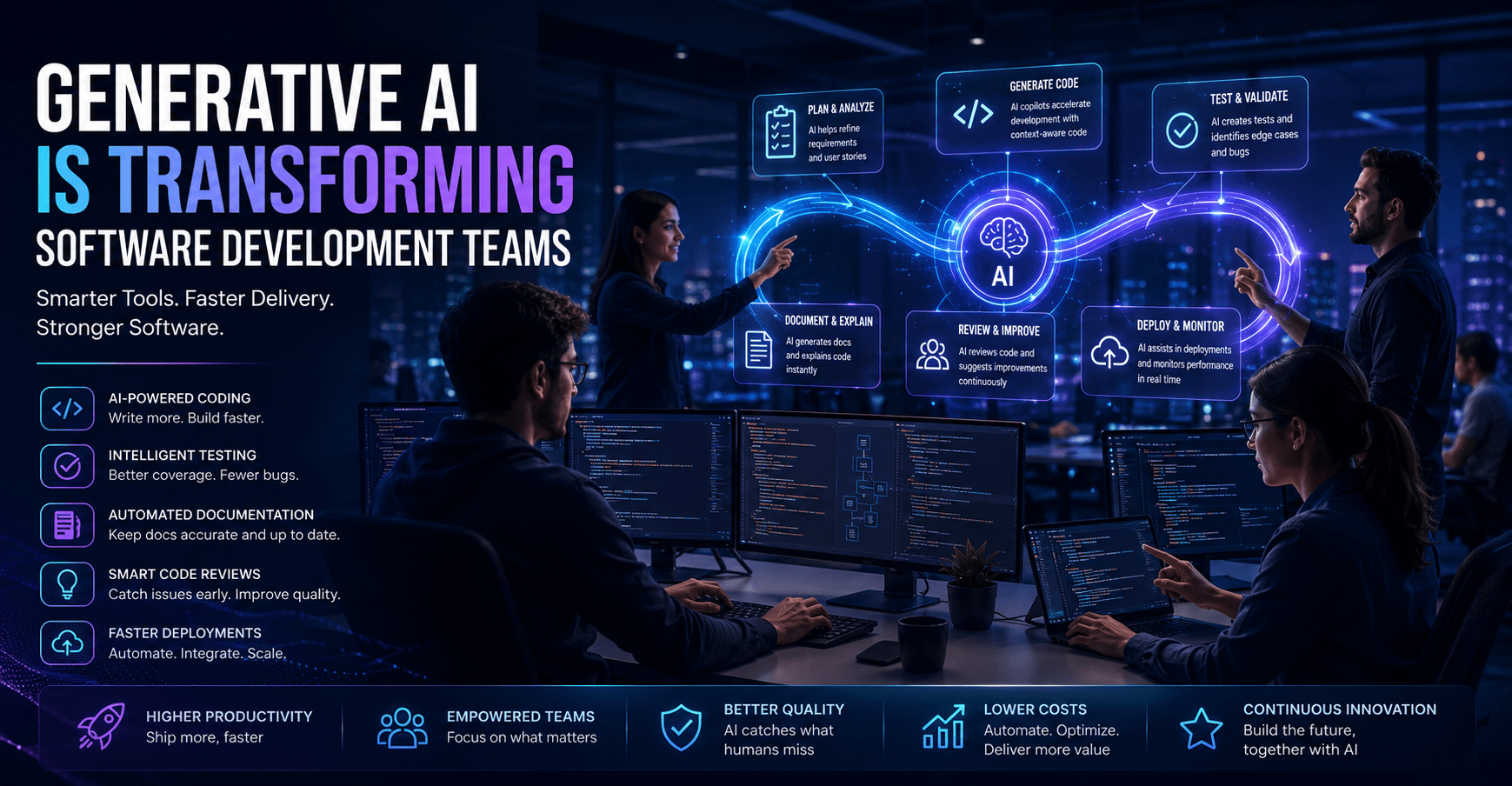
Just a few years ago, Generative AI was viewed as an experimental technology capable of writing snippets of code and answering technical questions.
Today, it is fundamentally changing how software development teams operate.
The conversation is no longer about whether developers will use AI.
The real question is:
How will engineering organizations evolve when AI becomes part of every stage of software delivery?
In 2026, Generative AI is no longer a developer tool.
It is becoming an operational layer within software engineering teams.
From requirements gathering to production support, AI is influencing how teams build, test, deploy, and maintain software.
The result is a major shift in productivity, collaboration, team structure, and engineering workflows.
The Evolution of Software Development
Traditional software delivery relied heavily on:
- Manual coding
- Documentation creation
- Code reviews
- Test development
- Debugging
- Knowledge transfer
- Incident investigation
These activities consumed significant engineering time.
Generative AI is changing that equation.
Instead of spending hours on repetitive tasks, developers can increasingly focus on:
- Architecture
- Product thinking
- Business logic
- System design
- User experience
- Innovation
This shift is redefining the role of modern software engineers.
Where Generative AI Is Making the Biggest Impact
1. Accelerating Code Development
The most visible impact of Generative AI is code generation.
Developers now use AI to:
- Generate APIs
- Build boilerplate code
- Create test cases
- Refactor legacy systems
- Generate infrastructure templates
- Write documentation
| Traditional Activity | AI-Augmented Activity |
|---|---|
| Manual coding | AI-assisted implementation |
| Manual test creation | AI-generated test suites |
| Documentation writing | Automated documentation |
| Boilerplate development | Instant scaffolding |
| Code lookup | Context-aware suggestions |
The result is faster development cycles and improved engineering efficiency.
2. Improving Developer Productivity
Generative AI acts like a continuously available engineering assistant.
Developers can:
- Ask architectural questions
- Troubleshoot issues
- Generate code samples
- Explore frameworks
- Review implementation approaches
This significantly reduces context switching and research time.
Productivity Areas Seeing Strong Gains
| Area | Impact |
|---|---|
| Coding speed | High |
| Documentation | High |
| Testing | High |
| Knowledge retrieval | High |
| Onboarding | Medium-High |
| Architecture support | Growing |
Many organizations report measurable improvements in engineering throughput.
3. Transforming Code Reviews
Code reviews traditionally require significant engineering bandwidth.
Generative AI can now:
- Identify common issues
- Flag security concerns
- Suggest improvements
- Highlight performance bottlenecks
- Detect code smells
Human reviewers still provide judgment and architectural oversight.
However, AI dramatically reduces review preparation time.
4. Enhancing Software Testing
Testing is one of the most time-consuming areas of software development.
Generative AI helps teams:
- Generate unit tests
- Create integration tests
- Suggest edge cases
- Improve test coverage
- Automate regression validation
This allows QA teams and developers to focus on higher-value testing activities.
Knowledge Sharing Is Being Reinvented
One of the biggest challenges in software teams has always been knowledge distribution.
Critical information often lives inside:
- Documentation
- Slack conversations
- Internal wikis
- Developer expertise
Generative AI is making organizational knowledge more accessible.
Developers can query internal systems and receive contextual answers instantly.
This reduces dependency on specific individuals and improves team scalability.
The Rise of AI-Augmented Development Teams
The traditional software team structure is evolving.
Historically, growth required:
- More developers
- More testers
- More analysts
- More support engineers
AI is changing this dynamic.
Smaller teams can now produce larger outputs.
Emerging Team Characteristics
| Traditional Team | AI-Augmented Team |
|---|---|
| Larger operational overhead | Higher efficiency |
| Manual knowledge transfer | AI-assisted learning |
| Slower onboarding | Accelerated ramp-up |
| Heavy documentation burden | Automated documentation |
| Manual repetitive work | AI automation |
This does not eliminate engineers.
It increases their leverage.
The Role of Developers Is Changing
Perhaps the most significant transformation is the evolution of the developer role itself.
Developers increasingly spend less time writing repetitive code and more time:
- Designing systems
- Validating outputs
- Defining business requirements
- Evaluating architecture
- Managing AI workflows
The value of engineering is shifting upward.
The Most Valuable Skills in the AI Era
| Declining Importance | Growing Importance |
|---|---|
| Boilerplate coding | Architecture design |
| Syntax memorization | Systems thinking |
| Manual testing | Workflow orchestration |
| Framework recall | Business understanding |
| Repetitive implementation | Engineering judgment |
AI is amplifying the importance of strategic engineering skills.
Why Leadership Must Adapt
Generative AI adoption is not just a tooling decision.
It is an organizational transformation initiative.
Leaders must address:
- Governance
- Security
- Adoption
- Training
- Productivity measurement
- Workflow redesign
Organizations that fail to guide adoption often experience fragmented AI usage and inconsistent outcomes.
New Leadership Responsibilities
| Leadership Focus | Purpose |
|---|---|
| AI Governance | Risk management |
| Training Programs | Workforce readiness |
| Tool Standardization | Consistent adoption |
| Productivity Metrics | Outcome measurement |
| Security Controls | Data protection |
| Change Management | Organizational alignment |
Leadership increasingly determines whether AI becomes a multiplier or a distraction.
The Risks of Generative AI
While benefits are substantial, challenges remain.
Common Risks
Security Concerns
Sensitive code and intellectual property may be exposed if AI tools are used improperly.
AI-Generated Technical Debt
Poorly reviewed AI-generated code can introduce maintainability problems.
Over-Reliance on AI
Developers may accept generated outputs without sufficient validation.
Governance Challenges
Organizations require clear policies around AI usage and accountability.
Generative AI and Engineering Culture
AI is also changing how engineering teams collaborate.
The future engineering culture emphasizes:
- Faster experimentation
- Continuous learning
- AI-assisted workflows
- Cross-functional collaboration
- Outcome-based delivery
Organizations that embrace these changes often adapt faster than competitors.
What High-Performing Teams Are Doing
Leading software organizations are:
- Embedding AI into daily workflows
- Training engineers on AI best practices
- Automating repetitive activities
- Creating governance frameworks
- Measuring productivity outcomes
- Encouraging experimentation responsibly
These teams view AI as an engineering accelerator rather than a replacement.
The Future of Software Development Teams
Over the next several years, software development teams will likely become:
- Smaller
- Faster
- More productive
- More architecture-focused
- More AI-enabled
The most successful teams will combine:
- Human creativity
- Engineering expertise
- Business understanding
- AI-assisted execution
This combination creates a powerful competitive advantage.
Final Thoughts
Generative AI is not replacing software development teams.
It is transforming how they work.
The most important shift is not faster code generation.
It is the creation of AI-augmented engineering organizations capable of delivering software faster, with greater efficiency and stronger business alignment.
The future belongs to teams that learn how to combine human judgment with AI-powered execution.
Organizations that embrace this transformation thoughtfully will gain a significant advantage in innovation, productivity, and software delivery performance.