
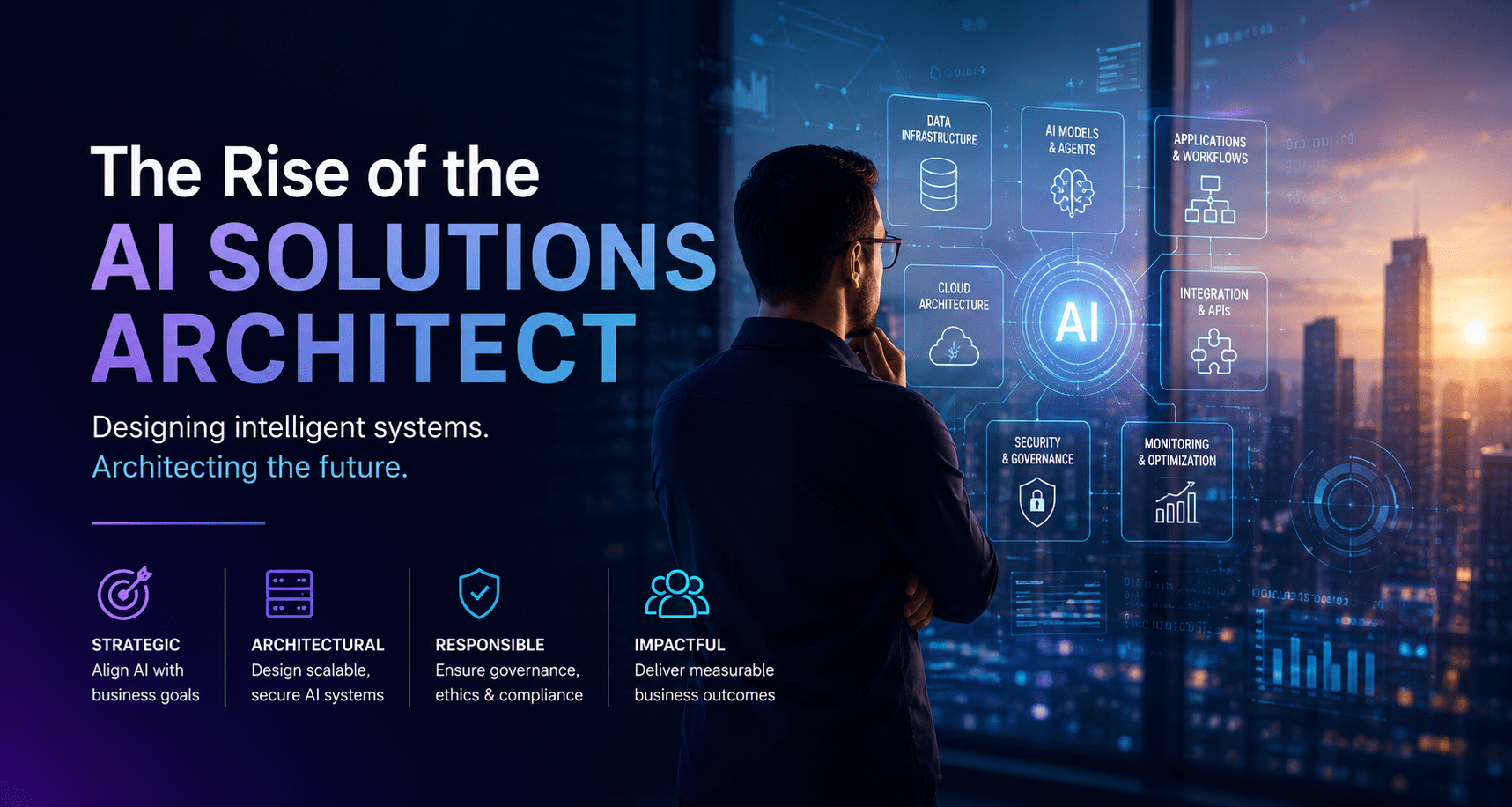
Artificial intelligence is rapidly evolving from isolated experimentation into the operational core of modern businesses.
Organizations are no longer asking:
“Should we use AI?”
They are asking:
“How do we operationalize AI safely, intelligently, and at scale?”
This shift is creating one of the most important new technology leadership roles of the decade:
The AI Solutions Architect.
As enterprises move from AI pilots to production-grade AI systems, companies increasingly need professionals who can bridge:
- Business strategy
- AI capabilities
- Data infrastructure
- Enterprise architecture
- Cloud systems
- Governance
- Security
- Operational scalability
The AI Solutions Architect is emerging as the critical connector between business ambition and real-world AI execution.
This is no longer a niche technical role.
It is becoming a strategic business role.
Why This Role Is Emerging So Quickly
Early AI adoption focused heavily on experimentation:
- Chatbots
- AI copilots
- Internal AI tools
- Prompt engineering
- Small AI workflows
But enterprise AI is becoming significantly more complex.
Modern organizations now require:
- AI governance
- Multi-model orchestration
- Secure enterprise AI integration
- AI-enabled workflows
- AI observability
- AI infrastructure scalability
- Compliance alignment
- Operational AI systems
Most companies quickly realize that deploying AI successfully is not simply about choosing a model.
It is about architecting an entire operational ecosystem around AI.
That is where the AI Solutions Architect becomes essential.
What Is an AI Solutions Architect?
An AI Solutions Architect is responsible for designing scalable AI systems that align with business objectives, operational requirements, infrastructure realities, and governance standards.
The role combines:
- AI strategy
- Systems architecture
- Cloud engineering
- Business operations
- Data infrastructure
- Workflow automation
- Enterprise integration
The AI Solutions Architect translates business problems into deployable AI systems.
The Core Responsibility of the Role
The role is fundamentally about orchestration.
Not just model building.
The AI Solutions Architect ensures that:
- AI systems integrate properly
- Data pipelines are scalable
- Governance controls exist
- Infrastructure supports AI workloads
- Security boundaries are enforced
- Operational workflows remain reliable
- AI produces measurable business outcomes
Key Responsibilities of an AI Solutions Architect
| Responsibility | Business Impact |
|---|---|
| AI Strategy Alignment | Ensures AI initiatives support business goals |
| AI Architecture Design | Creates scalable enterprise AI systems |
| Data Infrastructure Planning | Enables reliable AI operations |
| Model Integration | Connects AI models into applications and workflows |
| AI Governance | Reduces compliance and operational risk |
| Cloud & Infrastructure Design | Supports scalable AI deployment |
| Security & Privacy Oversight | Protects enterprise data and systems |
| Workflow Automation | Improves operational efficiency |
| Cross-Team Coordination | Aligns business and technical teams |
The Role Is Not Just Technical
One of the biggest misconceptions is that the AI Solutions Architect is simply a senior AI engineer.
The role is far broader.
Strong AI Solutions Architects understand:
- Business operations
- Enterprise workflows
- Organizational scalability
- Governance requirements
- Customer experience
- Operational risk
- Engineering systems
- AI capabilities and limitations
The role sits at the intersection of:
- Technology
- Operations
- Strategy
- Architecture
- Business transformation
Skills That Define a Strong AI Solutions Architect
1. AI & LLM Understanding
The architect must understand:
- Large Language Models
- AI agents
- Retrieval systems
- Vector databases
- AI orchestration
- AI limitations
- Prompt workflows
- Multi-model systems
However, the role focuses more on system-level integration than deep AI research.
2. Cloud & Infrastructure Knowledge
AI systems require strong infrastructure foundations.
Important skills include:
- AWS
- Azure
- Google Cloud
- Kubernetes
- Serverless architecture
- Distributed systems
- API architecture
- Scalable infrastructure
AI systems fail quickly without operational scalability.
3. Data Architecture Expertise
AI depends heavily on:
- Clean data
- Scalable pipelines
- Data governance
- Data security
- Real-time accessibility
The AI Solutions Architect must understand how enterprise data ecosystems operate.
4. Business Communication
One of the most valuable skills is communication.
The architect often becomes the bridge between:
- Executives
- Engineering teams
- Operations leaders
- Product teams
- Security stakeholders
- Data teams
The ability to explain AI operationally — not just technically — is becoming extremely valuable.
Why Enterprises Are Hiring This Role Aggressively
Many organizations are discovering that AI adoption stalls because:
- Systems are fragmented
- AI initiatives lack structure
- Data infrastructure is weak
- Governance is missing
- Teams are disconnected
- AI projects remain experimental
The AI Solutions Architect helps operationalize AI across the enterprise.
Industries Seeing Strong Demand
| Industry | AI Solutions Architect Demand |
|---|---|
| Financial Services | Very High |
| Healthcare | Very High |
| Retail & Ecommerce | High |
| SaaS Platforms | Very High |
| Manufacturing | Growing Rapidly |
| Logistics | High |
| Enterprise Technology | Very High |
| Insurance | High |
Virtually every industry modernizing operations with AI is beginning to require this role.
Why This Role Matters More Than Prompt Engineering
Prompt engineering created enormous attention during the early generative AI wave.
But enterprise AI maturity is changing hiring priorities.
Companies increasingly need professionals who can:
- Design systems
- Govern AI safely
- Integrate AI operationally
- Scale infrastructure
- Build reliable workflows
- Connect AI to business outcomes
The future is shifting from:
“AI experimentation”
…to:
“AI operationalization.”
That shift heavily favors AI Solutions Architects.
The Future Demand Outlook
The demand for AI Solutions Architects is expected to grow aggressively over the next several years because organizations are:
- Expanding AI budgets
- Moving AI into production
- Scaling AI workflows
- Modernizing infrastructure
- Building AI-native operations
- Creating enterprise AI governance programs
This role is increasingly becoming:
- High visibility
- High influence
- High impact
- High compensation
The AI Solutions Architect may become one of the defining enterprise technology leadership roles of the next decade.
The Evolution of Technology Leadership
Traditional enterprise technology roles were often separated into:
- Cloud architects
- Enterprise architects
- Data architects
- Solution architects
- Engineering leaders
AI is now blending these domains together.
The AI Solutions Architect increasingly sits above multiple technology layers and orchestrates them into intelligent business systems.
This makes the role strategically important for long-term enterprise transformation.
Common Career Backgrounds for AI Solutions Architects
| Existing Role | Natural Transition Path |
|---|---|
| Solutions Architect | Strong transition |
| Cloud Architect | Strong transition |
| Enterprise Architect | Strong transition |
| AI Engineer | Strong transition |
| Data Architect | Strong transition |
| Technical Product Leader | Growing transition path |
| Engineering Manager | Increasingly common |
The role is highly multidisciplinary.
What Winning AI Solutions Architects Do Differently
| High-Impact Behavior | Why It Matters |
|---|---|
| Focus on business outcomes | AI must create measurable value |
| Design scalable systems | AI pilots are not enough |
| Build governance early | Reduces operational risk |
| Understand enterprise operations | AI must fit real workflows |
| Bridge technical and business teams | Enables organizational adoption |
| Think operationally, not experimentally | Production AI requires operational maturity |
Final Thoughts
The AI Solutions Architect is quickly becoming one of the most strategically important roles in modern enterprise technology.
As AI shifts from experimentation into operational infrastructure, organizations increasingly need professionals who can:
- Design intelligent systems
- Scale AI responsibly
- Align AI with business strategy
- Build secure AI ecosystems
- Operationalize AI across the enterprise
The future of AI success will not be determined only by the quality of models.
It will increasingly be determined by the quality of architecture.
And that is exactly where the AI Solutions Architect becomes indispensable.