AI Governance Framework: How Enterprises Can Scale AI Responsibly in 2026
A practical AI governance framework: the five pillars, common mistakes, a step-by-step rollout and how enterprises can scale AI responsibly and securely.
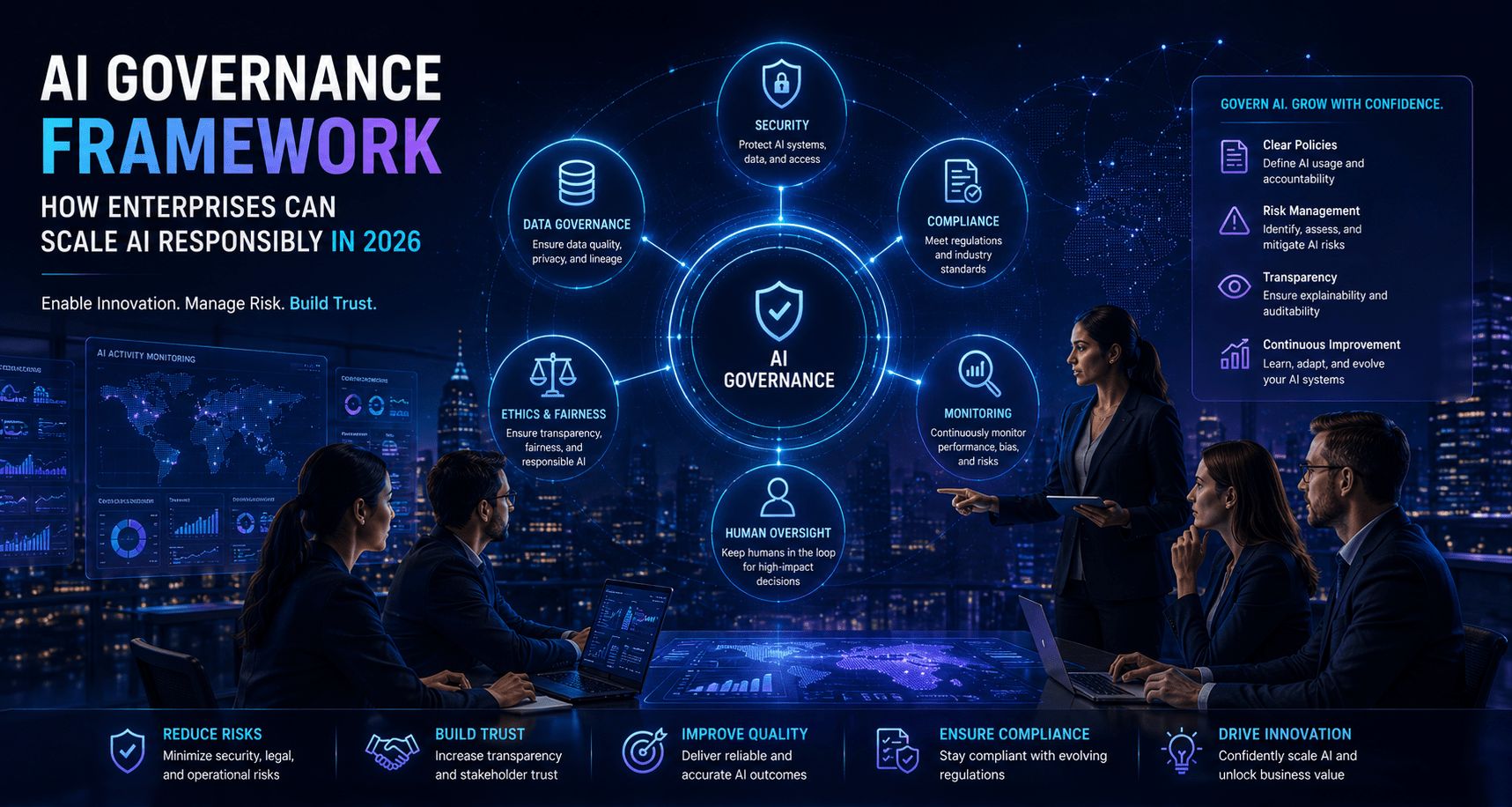
AI governance is the set of policies, technical controls, security standards, compliance processes and human oversight that lets an organization use AI responsibly at scale. Enterprises that build a governance framework early innovate faster, because teams know what is allowed, risks are managed deliberately, and customers, regulators and employees can trust the results.
While AI creates enormous opportunities, it also introduces new risks. Without governance, AI can become a business liability instead of a competitive advantage. That’s why AI governance has become one of the most important priorities for enterprise leadership in 2026 — companies with strong frameworks innovate faster, reduce operational risk, and build trust with customers, regulators, and employees.
What Is AI Governance?
AI governance is the framework that ensures AI systems are developed, deployed, and managed responsibly. It combines business policies, technical controls, security standards, regulatory compliance, human oversight, and ethical AI principles.
Why AI Governance Matters More Than Ever
Organizations now use AI to make decisions that directly affect customers, employees, financial operations, software development, healthcare, supply chains, and security. When governance is weak, the failure modes are concrete:
- Data exposure
- Compliance violations
- AI hallucinations
- Biased outcomes
- Security vulnerabilities
- Intellectual property risk
The Five Pillars of Enterprise AI Governance
Data Governance
- Data quality standards
- Access controls
- Classification & lineage
- Privacy protection
Model Governance
- Documented purpose
- Training source
- Performance metrics
- Drift monitoring
Security Governance
- Encryption
- Identity management
- Zero-trust access
- Threat monitoring
Compliance Governance
- Industry regulations
- Internal policies
- Regional privacy
- Audit standards
Human Oversight
- Human validation
- Escalation paths
- Audit trails
- Accountability
| Data governance practice | Business benefit |
|---|---|
| Data quality monitoring | Better AI accuracy |
| Role-based access | Improved security |
| Data lineage | Easier compliance |
| Privacy controls | Customer trust |
Common AI Governance Mistakes
| Mistake | Business impact |
|---|---|
| No AI policy | Inconsistent usage |
| Unapproved AI tools | Security exposure |
| Weak data quality | Poor performance |
| No human review | Operational risk |
| Missing audit logs | Compliance challenges |
| No employee training | Low adoption |
Building an Enterprise AI Governance Framework
Assessment
Identify AI use cases, evaluate risk, and review existing controls.
Policy Development
Define acceptable AI usage, establish approval processes, and assign ownership.
Implementation
Deploy governance tools, train employees, and integrate security controls.
Continuous Improvement
Monitor AI performance, review policies, audit usage, and improve governance.
AI Governance for Software Development Teams
Engineering organizations should set clear standards for AI-generated code, code review, security validation, intellectual property, documentation, and open-source usage.
With clear standards
- Faster delivery with guardrails
- Consistent code review
- IP and licensing clarity
Without them
- Unvetted security flaws
- License contamination
- Untraceable AI output
Emerging Trends for 2026
- Automated policy enforcement
- AI observability
- Continuous compliance monitoring
- AI risk scoring
- Explainable AI
- Responsible AI certifications
Best Practices
| Best practice | Why it matters |
|---|---|
| Create an AI governance committee | Cross-functional accountability |
| Develop an enterprise AI policy | Consistent decision-making |
| Monitor AI systems continuously | Reduce operational risk |
| Train employees regularly | Responsible adoption |
| Maintain audit trails | Compliance readiness |
| Review AI models periodically | Better performance |
The companies that lead the next decade won’t simply deploy more AI. They’ll deploy it responsibly, securely, and at scale.
Artificial Intelligence is becoming core business infrastructure — as essential to govern as cybersecurity, cloud, and data.
Just as those disciplines matured into strategic capabilities, AI governance is following the same path in 2026.
Responsible AI is no longer optional. It is becoming a competitive advantage.
Frequently asked questions
What is AI governance?
The framework that ensures AI systems are developed, deployed and managed responsibly. It combines business policies, technical controls, security standards, regulatory compliance, human oversight and ethical principles.
Why does AI governance matter?
AI now makes decisions that affect customers, employees and operations. Weak governance leads to data exposure, compliance violations and loss of trust.
How do you build an AI governance framework?
Start by identifying AI use cases and evaluating their risk, then define policies and ownership, put technical and security controls in place, train teams and monitor AI systems continuously.