PHP 8.3 and Beyond: The Evolution of a Modern Web Engine
What PHP 8.3 brings, from typed class constants to json_validate(), why modern PHP favors predictability, and why it deserves a look for new projects.
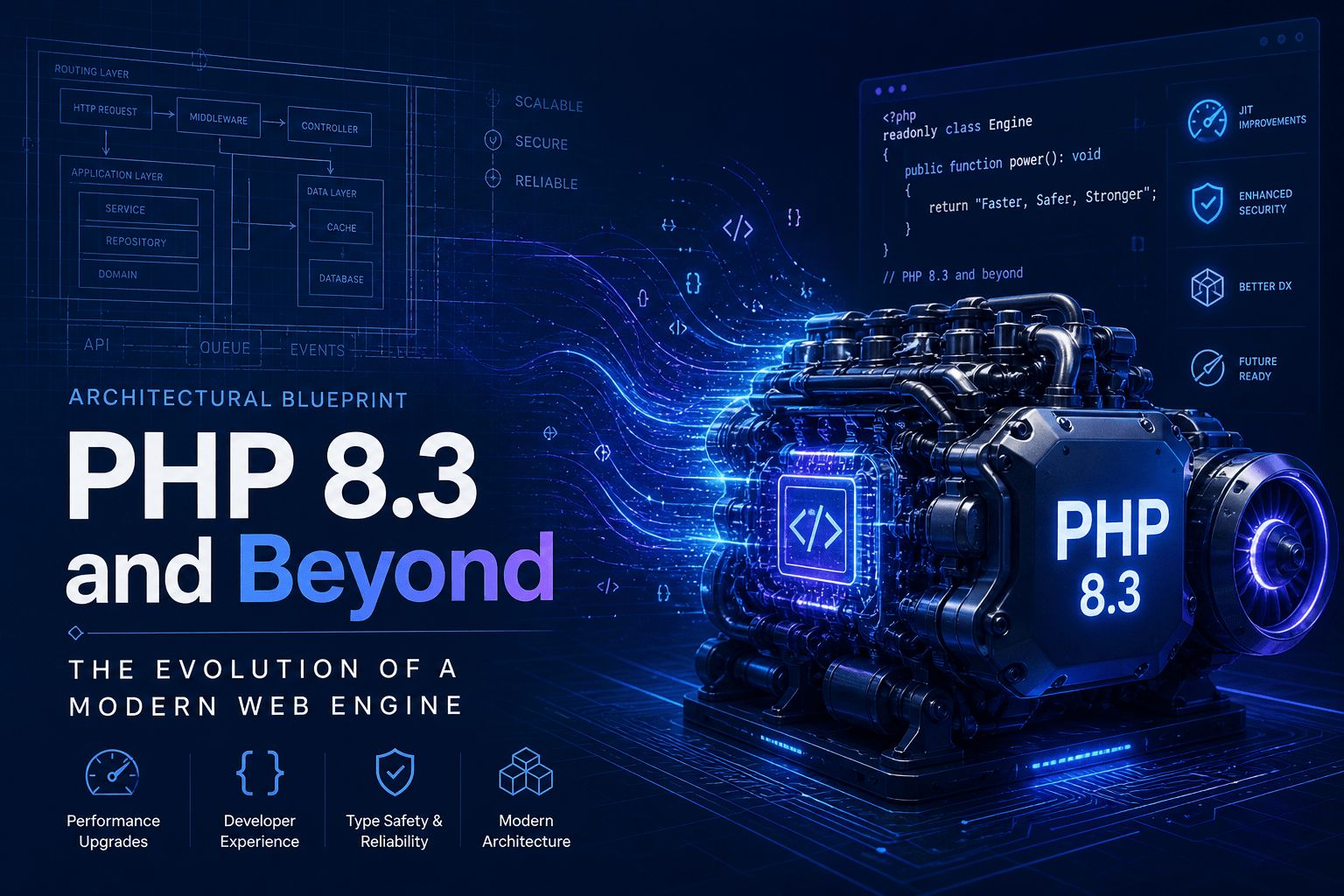
PHP 8.3 continues PHP's shift toward predictability: typed class constants, a native json_validate() function, a stronger Random extension and steady Zend Engine performance gains. Combined with strict typing, enums, attributes and JIT from earlier 8.x releases, modern PHP is a competitive, stable choice for APIs, SaaS products and content platforms.
Let’s zoom in on what’s new and why it matters.
PHP 8.3 – Polishing the Engine
PHP 8.3 continues the steady modernization that started with 8.0. The theme is consistency and developer safety.
Typed Class Constants
You can now define types for class constants. Before this, constants were untyped, which left room for subtle bugs. Now you can enforce structure at compile time. That’s a small feature with big consequences: fewer runtime surprises.
json_validate() Function
Validating JSON without decoding it used to require workarounds. Now there’s a native json_validate() function. It checks if a string is valid JSON without turning it into an array or object. Cleaner, faster, and more memory-efficient.
Randomizer Improvements
The Random extension keeps getting stronger. PHP now treats randomness more deliberately. In a world where security matters, predictable randomness is not your friend.
Performance Gains
Each minor release continues optimizing the Zend Engine (PHP’s core execution engine). These aren’t dramatic “2x faster” headlines, but incremental gains compound over time—especially for high-traffic applications.
What’s Coming in PHP 8.4 (In Development)
PHP’s direction is becoming clearer: stricter typing and more expressive syntax.
Proposed and accepted RFCs (Request for Comments, the formal way features are added) suggest improvements in property handling, potential refinements to type systems, and continued cleanup of legacy inconsistencies.
PHP is shedding its “loose and messy” stereotype. Slowly, deliberately, and scientifically.
Why This Matters for Developers
PHP today is not the PHP of 2010. It has:
- Strong typing support
- JIT (Just-In-Time compilation introduced in PHP 8.0)
- Enums
- Attributes (modern metadata system)
- Improved error handling
Frameworks like Laravel and Symfony have fully embraced these improvements, encouraging clean architecture and modern development patterns.
If you’re building APIs, SaaS products, or content platforms, modern PHP is competitive, stable, and battle-tested.
The Bigger Trend: Predictability Over Cleverness
Older PHP favored flexibility. Modern PHP favors correctness.
That shift aligns with how software engineering matured overall. Developers now prioritize:
- Static analysis
- Automated testing
- Strict contracts between components
And PHP is evolving in that same direction.
Final Thought
Programming languages don’t just evolve technically. They evolve philosophically.
PHP’s recent updates show a language growing up—less magic, more clarity. Less “it works somehow,” more “it works because.”
The web still runs on PHP. But the interesting part is how it runs: increasingly fast, increasingly strict, and increasingly future-ready.
If you’re building something new in 2026, PHP deserves a second look—not out of nostalgia, but out of pragmatism.
Frequently asked questions
What is new in PHP 8.3?
Typed class constants, the json_validate() function, improvements to the Random extension and further performance optimizations in the Zend Engine.
Is PHP still relevant in 2026?
Yes. With strong typing, JIT, enums and attributes, and frameworks such as Laravel and Symfony, modern PHP is competitive and battle-tested for APIs, SaaS and content platforms.
What does json_validate() do?
It checks whether a string is valid JSON without decoding it into an array or object, which is cleaner and more memory-efficient.