
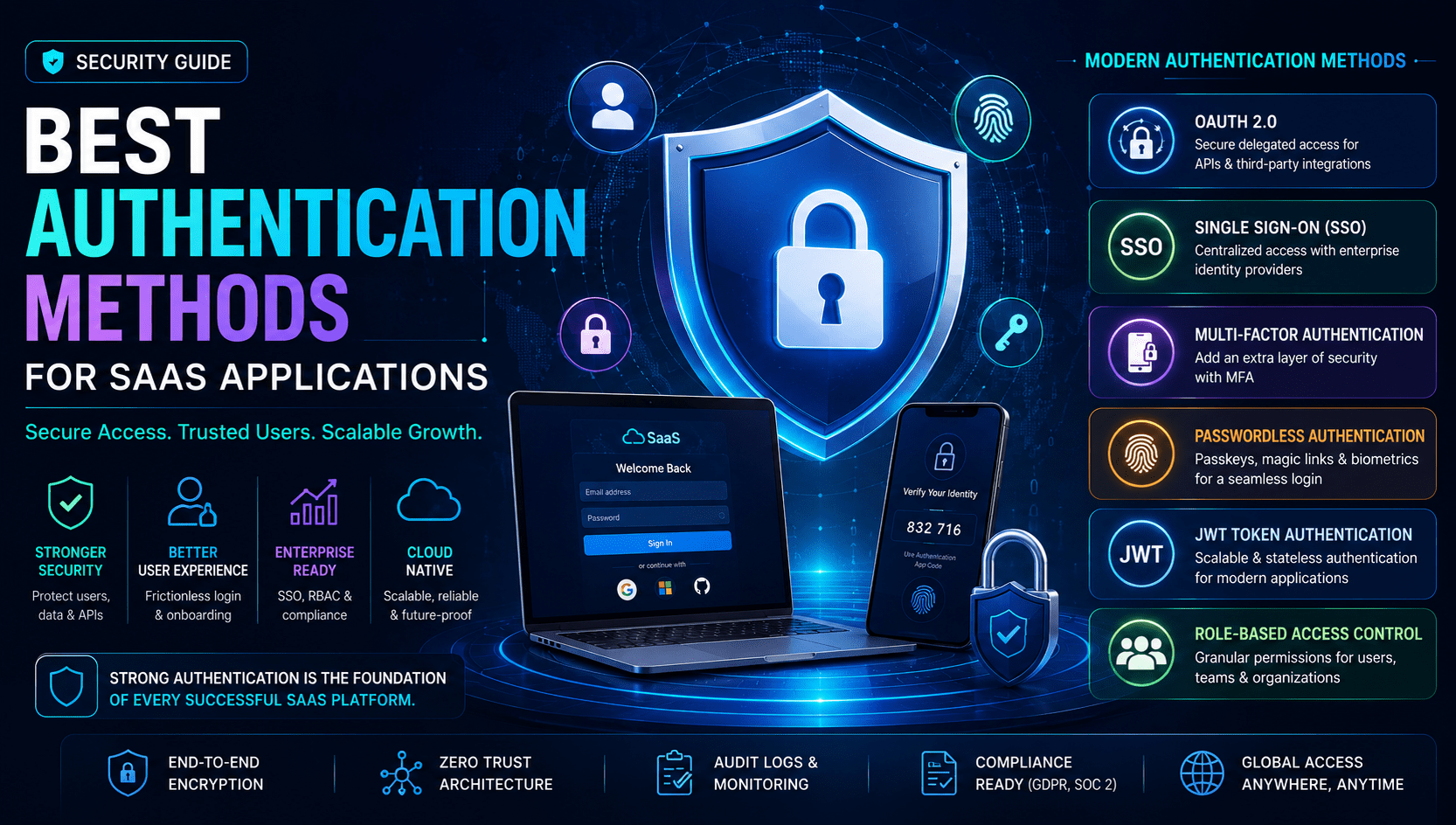
Authentication has become one of the most critical architectural layers in modern SaaS applications.
In 2026, authentication is no longer just about usernames and passwords.
Modern SaaS platforms must secure:
- Multi-tenant systems
- AI-powered workflows
- Distributed APIs
- Cloud-native infrastructure
- Mobile applications
- Remote workforces
- Third-party integrations
- Enterprise customers
At the same time, users expect:
- Frictionless login experiences
- Fast onboarding
- Passwordless authentication
- Cross-device access
- Secure identity management
This creates a difficult balancing act between:
- Security
- User experience
- Scalability
- Compliance
- Operational simplicity
The strongest SaaS platforms now treat authentication as a strategic infrastructure layer — not just a login page.
Why Authentication Is More Important Than Ever
Cybersecurity threats continue to increase rapidly across:
- SaaS platforms
- APIs
- Enterprise systems
- Cloud environments
- AI-enabled applications
Modern attacks increasingly target:
- Weak credentials
- Session hijacking
- Token theft
- API vulnerabilities
- Identity systems
- OAuth misconfigurations
At the same time, SaaS applications now manage:
- Sensitive customer data
- Financial information
- Enterprise workflows
- AI-generated content
- Business-critical operations
Authentication is now directly tied to:
- Platform trust
- Compliance
- Customer retention
- Operational security
- Enterprise adoption
The Evolution of Authentication in SaaS
Traditional authentication relied heavily on:
- Username/password systems
- Session cookies
- Basic MFA
- Static access control
Modern SaaS authentication is increasingly built around:
- Identity platforms
- Token-based authentication
- Passwordless systems
- Federated identity
- Risk-aware authentication
- Biometric access
- Zero-trust security
Authentication architecture is becoming significantly more sophisticated.
Best Authentication Methods for SaaS Applications
1. OAuth 2.0
OAuth 2.0 remains one of the most important authentication frameworks for modern SaaS applications.
It allows users to authenticate through:
- Microsoft
- GitHub
- Apple
- Enterprise identity providers
| OAuth Benefits | Why It Matters |
|---|---|
| Faster onboarding | Improves user acquisition |
| Reduced password management | Lowers security risk |
| Enterprise compatibility | Supports B2B SaaS adoption |
| Better user experience | Improves retention |
| API ecosystem support | Enables integrations |
OAuth is especially important for enterprise SaaS products.
2. OpenID Connect (OIDC)
OIDC extends OAuth with identity verification capabilities.
It is increasingly becoming the standard for:
- Enterprise authentication
- Cloud identity systems
- Modern SaaS identity management
OIDC is widely used because it supports:
- Secure identity tokens
- Federated identity
- Single sign-on (SSO)
- Enterprise IAM systems
3. Single Sign-On (SSO)
Enterprise SaaS applications increasingly require SSO support.
SSO enables users to authenticate once and access multiple systems securely.
Popular enterprise SSO providers include:
- Okta
- Azure AD
- Google Workspace
- Auth0
- Ping Identity
Why SSO Matters for SaaS
| SSO Benefit | Business Impact |
|---|---|
| Easier enterprise adoption | Improves B2B growth |
| Reduced password fatigue | Better user experience |
| Centralized identity management | Stronger security |
| Compliance support | Enterprise readiness |
| Reduced support tickets | Operational efficiency |
Many enterprise customers now expect SSO as a default SaaS feature.
4. Multi-Factor Authentication (MFA)
MFA is becoming mandatory for serious SaaS applications.
MFA combines:
- Passwords
- Authenticator apps
- Hardware keys
- Biometrics
- One-time codes
Even if credentials are compromised, MFA significantly reduces unauthorized access risk.
Best MFA Methods in 2026
| MFA Method | Security Strength |
|---|---|
| Authenticator Apps | Strong |
| Hardware Security Keys | Very Strong |
| Biometrics | Strong |
| SMS Codes | Moderate |
| Email Verification | Moderate |
SMS-based MFA is increasingly discouraged because of SIM-swapping risks.
5. Passwordless Authentication
Passwordless authentication is growing rapidly because passwords remain one of the weakest security points.
Popular passwordless methods include:
- Magic links
- Biometrics
- Passkeys
- Device authentication
- Hardware security keys
Why Passkeys Are Growing Fast
Passkeys are becoming one of the most important authentication trends in SaaS security.
Advantages include:
- Phishing resistance
- Better user experience
- Strong device security
- Reduced password reuse
- Faster authentication flows
Large platforms increasingly support passkey-based login systems.
6. JWT Authentication
JSON Web Tokens (JWT) remain widely used in:
- APIs
- Microservices
- SPA applications
- Mobile applications
- Distributed SaaS systems
JWTs support:
- Stateless authentication
- Scalable APIs
- Cross-service identity propagation
However, poor JWT implementation can create serious security risks.
Common JWT Mistakes
| JWT Mistake | Security Risk |
|---|---|
| Long-lived tokens | Session compromise |
| Weak signing secrets | Token forgery |
| Missing token rotation | Persistent access risk |
| Improper storage | Token theft |
| No revocation strategy | Unauthorized persistence |
JWT architecture requires careful implementation.
7. Role-Based Access Control (RBAC)
Authentication alone is not enough.
Modern SaaS systems also require:
- Authorization
- Access segmentation
- Permission management
RBAC helps control:
- User permissions
- Team access
- Admin privileges
- Tenant isolation
This becomes critical in multi-tenant SaaS environments.
8. Zero Trust Authentication
Zero-trust security is becoming increasingly important in SaaS architecture.
The principle:
“Never trust. Always verify.”
Modern systems increasingly evaluate:
- Device trust
- User behavior
- Location risk
- Session anomalies
- API access patterns
Authentication is becoming context-aware.
Authentication for AI-Powered SaaS Applications
AI introduces new authentication challenges:
- AI agent access
- API orchestration
- Autonomous workflows
- Sensitive data exposure
- AI-generated actions
AI-enabled SaaS systems increasingly require:
- Granular access control
- Secure AI permissions
- AI audit logging
- Workflow authorization
Authentication is becoming part of AI governance itself.
Recommended Authentication Stack for SaaS Applications
| Authentication Layer | Recommended Solution |
|---|---|
| OAuth & OIDC | Auth0 / Clerk / Okta |
| MFA | Authenticator apps + Passkeys |
| Enterprise SSO | Azure AD / Okta |
| API Authentication | JWT + OAuth |
| RBAC | Policy-based access systems |
| Session Management | Secure rotating tokens |
| Passwordless | Passkeys + biometrics |
Common Authentication Mistakes in SaaS Platforms
1. Weak Session Management
Poor token expiration and session controls create major security exposure.
2. Overcomplicated Authentication Flows
Security should not destroy usability.
The best SaaS systems balance:
- Security
- Simplicity
- Frictionless onboarding
3. Ignoring Enterprise Identity Requirements
Enterprise customers increasingly require:
- SSO
- SCIM provisioning
- Centralized IAM
- Audit controls
- Compliance support
Ignoring enterprise identity can slow B2B SaaS growth.
The Future of Authentication in SaaS
Authentication is moving toward:
- Passwordless systems
- Identity orchestration
- Biometric security
- AI-aware identity systems
- Context-based verification
- Continuous authentication
The future login experience will likely become:
- More invisible
- More intelligent
- More secure
- More adaptive
What Winning SaaS Platforms Are Doing
| Winning Strategy | Why It Matters |
|---|---|
| Supporting SSO early | Improves enterprise adoption |
| Implementing MFA by default | Reduces account compromise |
| Using passkeys | Improves both security and UX |
| Building RBAC systems early | Improves scalability |
| Designing zero-trust systems | Reduces operational risk |
| Prioritizing identity architecture | Enables long-term SaaS growth |
Final Thoughts
Authentication is no longer a standalone security feature.
It is a foundational SaaS infrastructure.
The strongest SaaS platforms in 2026 treat authentication as:
- A security layer
- A scalability layer
- A compliance layer
- A user experience layer
- An enterprise adoption layer
The future of SaaS security will increasingly depend on intelligent identity systems that combine:
- Strong authentication
- Frictionless user experience
- Enterprise-grade access control
- AI-aware governance
- Scalable cloud-native architecture
The companies that build strong identity infrastructure early will gain both security and a competitive advantage.