
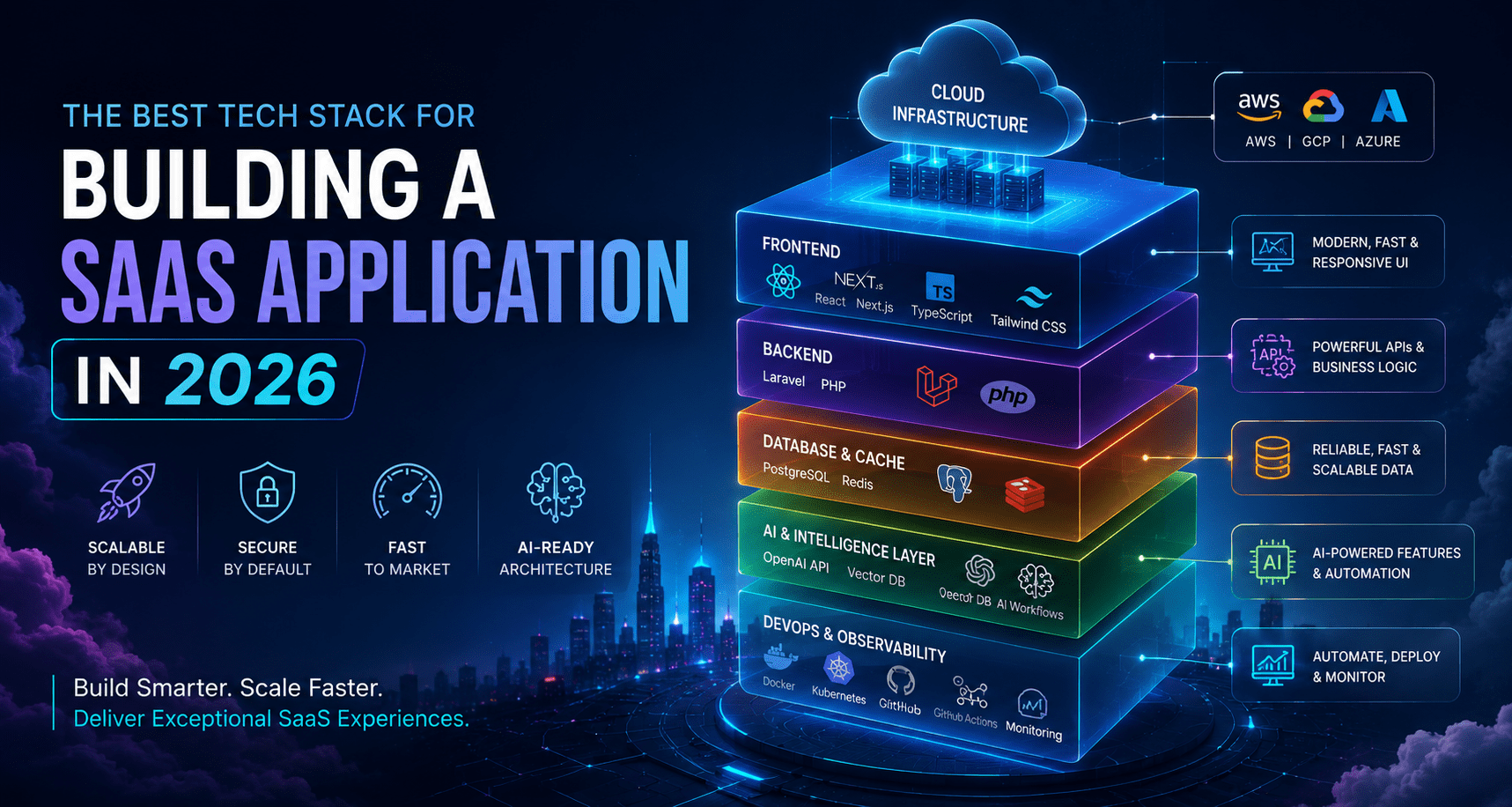
Building a SaaS application in 2026 is no longer just about choosing a frontend framework and backend language.
Modern SaaS platforms must support:
- Scalability
- AI integration
- Real-time operations
- Security
- Multi-tenancy
- Cloud-native infrastructure
- Fast product iteration
- Workflow automation
- Global performance
- API ecosystems
The modern SaaS stack is becoming increasingly architecture-driven rather than framework-driven.
The best technology stack today is not necessarily the “most popular” stack.
It is the stack that supports:
- Product velocity
- Operational scalability
- Developer productivity
- Long-term maintainability
- AI readiness
- Infrastructure efficiency
Choosing the wrong stack can slow growth for years.
Choosing the right stack creates compounding engineering leverage.
What Defines a Modern SaaS Stack in 2026
The modern SaaS architecture is increasingly built around:
- Cloud-native systems
- API-first development
- AI-enabled workflows
- Event-driven infrastructure
- Microservices or modular architecture
- Real-time scalability
- Intelligent observability
Today’s SaaS products are expected to scale operationally from day one.
The Core Layers of a Modern SaaS Stack
| Layer | Purpose |
|---|---|
| Frontend | User experience and client interaction |
| Backend | Business logic and APIs |
| Database | Data persistence and scalability |
| Infrastructure | Deployment and scalability |
| Authentication | Identity and access management |
| Observability | Monitoring and operational visibility |
| AI Layer | AI workflows and automation |
| DevOps | Delivery pipelines and operational automation |
Each layer now plays a strategic role in SaaS scalability.
Recommended Frontend Technologies
React Continues to Dominate
React remains one of the strongest frontend choices in 2026 because of:
- Ecosystem maturity
- Component scalability
- Strong developer availability
- Excellent SaaS ecosystem support
- AI tooling compatibility
Modern React stacks increasingly use:
- Next.js
- Server components
- Edge rendering
- Streaming UI
- AI-enhanced frontend workflows
| Frontend Stack | Why It Works |
|---|---|
| React + Next.js | Scalable ecosystem and performance |
| TypeScript | Strong maintainability |
| Tailwind CSS | Faster UI iteration |
| Zustand / Redux Toolkit | State management |
| shadcn/ui | Modern scalable UI systems |
Recommended Backend Technologies
PHP Is Still Highly Relevant for SaaS
Despite aggressive AI and JavaScript growth, PHP remains extremely effective for SaaS applications because of:
- Operational maturity
- Cost efficiency
- Large ecosystem
- Scalability improvements
- Laravel ecosystem strength
Laravel continues to be one of the strongest SaaS frameworks in 2026.
Node.js Remains Strong for Real-Time Systems
Node.js excels in:
- Realtime collaboration
- Event-driven systems
- Streaming operations
- WebSocket-heavy products
- AI integrations
Many modern SaaS companies now combine:
- PHP/Laravel for core business systems
- Node.js for real-time and AI workloads
Best Backend Stack Options
| Stack | Best Use Case |
|---|---|
| Laravel + PHP | SaaS platforms, APIs, enterprise workflows |
| Node.js + NestJS | Real-time systems and scalable APIs |
| Go | High-performance infrastructure services |
| Python + FastAPI | AI-heavy SaaS platforms |
| Java Spring Boot | Large enterprise SaaS ecosystems |
Why Laravel Is Extremely Strong for SaaS
Laravel now offers:
- Excellent developer productivity
- Strong authentication systems
- Queue management
- Event broadcasting
- SaaS billing integrations
- Multi-tenancy support
- Mature ecosystem
For many SaaS startups, Laravel dramatically accelerates MVP-to-scale timelines.
Database Choices in 2026
PostgreSQL Is Becoming the Default Choice
PostgreSQL continues dominating modern SaaS infrastructure because of:
- Reliability
- Scalability
- JSON support
- AI compatibility
- Analytics flexibility
- Transactional consistency
| Database | Best Use Case |
|---|---|
| PostgreSQL | Primary SaaS database |
| Redis | Caching and realtime operations |
| Elasticsearch / OpenSearch | Search and analytics |
| Vector Databases | AI and semantic search |
| ClickHouse | Analytics-heavy SaaS systems |
AI Is Becoming a Native SaaS Layer
One of the biggest 2026 changes:
AI is no longer an external integration.
It is becoming part of the core application architecture.
Modern SaaS products increasingly include:
- AI copilots
- AI search
- AI workflows
- AI automation
- Intelligent recommendations
- AI agents
- Semantic systems
This means SaaS stacks now require:
- AI APIs
- Vector databases
- Retrieval systems
- AI orchestration layers
Recommended Cloud Infrastructure
Kubernetes Is Growing — But Simplicity Still Wins
Large SaaS platforms increasingly adopt:
- Kubernetes
- Container orchestration
- Service mesh infrastructure
- Distributed systems
However, many successful SaaS startups still prioritize:
- Simpler deployment systems
- Faster iteration
- Lower operational complexity
Recommended Infrastructure Stack
| Infrastructure Layer | Recommended Technology |
|---|---|
| Cloud Platform | AWS / GCP / Azure |
| Containers | Docker |
| Orchestration | Kubernetes |
| CDN | Cloudflare |
| CI/CD | GitHub Actions |
| Monitoring | Datadog / Grafana |
| Logging | OpenSearch |
| Secrets Management | Vault |
Authentication Is Becoming More Important
Modern SaaS applications increasingly require:
- SSO
- OAuth
- Passkeys
- Multi-factor authentication
- Enterprise identity integration
Recommended solutions include:
- Auth0
- Clerk
- Keycloak
- AWS Cognito
- Laravel Sanctum
Multi-Tenancy Is a Strategic Architecture Decision
SaaS scalability increasingly depends on tenancy architecture.
| Model | Best For |
|---|---|
| Shared Database | Early-stage SaaS |
| Schema-Based Multi-Tenancy | Growing SaaS products |
| Database-per-Tenant | Enterprise SaaS |
Choosing the wrong tenancy strategy can create major scaling limitations later.
Observability Is No Longer Optional
Modern SaaS applications require:
- Real-time monitoring
- Error tracking
- Performance visibility
- User behavior analytics
- Infrastructure observability
Without strong observability, scaling becomes dangerous.
Security Is Now Part of Product Architecture
Security is increasingly integrated directly into:
- Development workflows
- CI/CD pipelines
- Infrastructure systems
- Identity systems
- AI governance
The most successful SaaS companies build security into the platform from the beginning.
The Rise of AI-Augmented SaaS Engineering
AI is transforming how SaaS products are built.
Modern engineering teams increasingly use AI for:
- Development acceleration
- Testing automation
- Documentation generation
- Infrastructure optimization
- Operational monitoring
- Customer support workflows
This dramatically improves engineering leverage.
Recommended SaaS Stack for 2026
| Layer | Recommended Stack |
|---|---|
| Frontend | React + Next.js + TypeScript |
| Backend | Laravel + PHP |
| Realtime Layer | Node.js |
| Database | PostgreSQL |
| Cache | Redis |
| AI Layer | OpenAI APIs + Vector DB |
| Infrastructure | Docker + Kubernetes |
| Cloud | AWS |
| Monitoring | Datadog + Grafana |
| CI/CD | GitHub Actions |
This combination balances:
- Developer productivity
- Scalability
- Operational efficiency
- AI readiness
- Long-term maintainability
What Matters More Than the Stack
One of the biggest misconceptions in SaaS engineering:
The stack alone does not determine success.
Architecture quality matters more than hype.
The best SaaS products succeed because of:
- Product-market fit
- Strong architecture
- Operational scalability
- Developer efficiency
- Fast iteration
- Customer understanding
Not simply because they use trendy technologies.
Final Thoughts
The best SaaS stack in 2026 is one that supports:
- Fast product development
- Long-term scalability
- AI integration
- Operational reliability
- Developer productivity
- Secure architecture
- Intelligent workflows
Modern SaaS engineering is increasingly about building adaptable systems rather than static applications.
The strongest SaaS companies are not simply choosing technologies.
They are building scalable engineering ecosystems.