
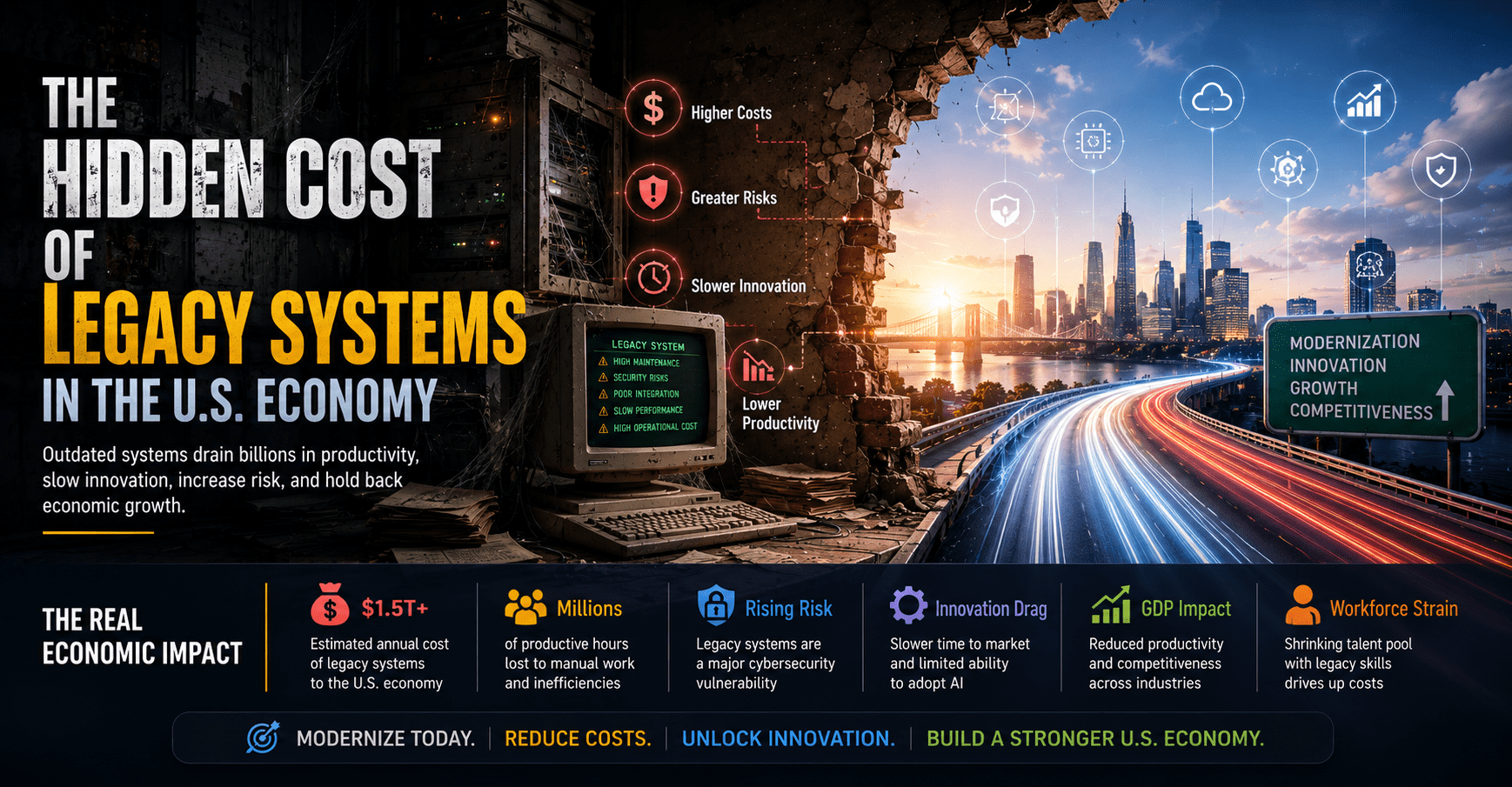
Legacy systems are quietly becoming one of the most expensive operational problems in the U.S. economy.
Across banking, healthcare, insurance, manufacturing, retail, logistics, government, and enterprise operations, thousands of organizations still depend on aging software infrastructure built decades ago. Many of these systems continue to power mission-critical operations despite increasing technical debt, security risk, maintenance cost, integration limitations, and declining operational efficiency.
The problem is no longer simply “outdated technology.”
Legacy infrastructure is now directly impacting:
- Economic productivity
- Business scalability
- Workforce efficiency
- AI adoption
- Cybersecurity resilience
- Innovation velocity
- Customer experience
- Operational agility
For many organizations, legacy systems have become invisible operational taxes that compound year after year.
What Is a Legacy System?
A legacy system is typically an older software or infrastructure environment that remains operational despite:
- Outdated architecture
- Unsupported technologies
- High maintenance dependency
- Limited scalability
- Weak integration capability
- Growing security exposure
Legacy systems are not always old because of age alone.
A platform becomes “legacy” when:
- It slows business agility
- Prevents modernization
- Increases operational risk
- Creates excessive maintenance burden
- Blocks innovation
Why Legacy Systems Still Exist
Many organizations continue running legacy systems because replacing them is difficult, expensive, and operationally risky.
In many industries:
- Core business logic lives inside legacy applications
- Critical workflows depend on old systems
- Institutional knowledge is undocumented
- Modern replacement projects are high-risk
This creates a dangerous cycle where companies delay modernization until operational pressure becomes unavoidable.
| Reason Legacy Systems Persist | Business Reality |
|---|---|
| High migration cost | Modernization budgets are difficult to justify |
| Fear of downtime | Core operations cannot stop |
| Complex integrations | Many systems depend on legacy workflows |
| Institutional dependency | Employees rely on legacy processes |
| Technical debt accumulation | Replacement becomes harder over time |
The Real Economic Cost of Legacy Systems
1. Massive Maintenance Spending
Organizations spend billions annually maintaining systems that deliver limited strategic value.
Instead of funding innovation, companies allocate large budgets toward:
- System maintenance
- Infrastructure patching
- Legacy vendor contracts
- Specialized support resources
- Outdated hardware environments
| Legacy Cost Area | Business Impact |
|---|---|
| Maintenance contracts | High recurring cost |
| Specialized staffing | Difficult hiring and retention |
| Infrastructure support | Expensive operational overhead |
| Security patching | Increased IT workload |
| Downtime management | Business disruption risk |
Many enterprises spend more maintaining outdated systems than investing in innovation.
2. Slower Innovation Cycles
Legacy systems slow:
- Product launches
- API development
- Cloud migration
- AI integration
- Customer experience modernization
- Workflow automation
Modern digital business depends heavily on:
- API-first architecture
- Real-time data access
- Cloud-native scalability
- Intelligent automation
Legacy environments often struggle to support these capabilities efficiently.
3. AI Adoption Barriers
One of the biggest hidden consequences of legacy systems is their impact on AI readiness.
AI systems require:
- Clean structured data
- Scalable APIs
- Modern infrastructure
- Workflow integration
- Real-time operational visibility
Legacy environments frequently lack these foundations.
| AI Requirement | Legacy System Challenge |
|---|---|
| Unified data | Data silos |
| API connectivity | Closed architecture |
| Workflow automation | Manual processes |
| Cloud scalability | Infrastructure rigidity |
| Real-time analytics | Slow data pipelines |
Many companies want AI transformation while still operating on infrastructure built for pre-cloud business environments.
Cybersecurity Risk Is Increasing
Legacy systems significantly increase cybersecurity exposure.
Older environments often contain:
- Unsupported software
- Weak authentication models
- Unpatched vulnerabilities
- Outdated encryption
- Poor visibility
- Limited monitoring
Cybercriminals increasingly target organizations running outdated infrastructure because legacy systems are harder to secure properly.
Common Security Risks in Legacy Environments
| Risk | Operational Impact |
|---|---|
| Unsupported software | No vendor security updates |
| Weak authentication | Increased breach risk |
| Limited logging | Reduced threat visibility |
| Old encryption standards | Compliance exposure |
| Poor segmentation | Larger attack surface |
Security modernization becomes increasingly difficult when organizations delay infrastructure modernization.
Operational Inefficiency Is Growing
Legacy systems often create hidden workforce inefficiencies.
Employees spend time:
- Re-entering data manually
- Switching between disconnected systems
- Managing outdated workflows
- Working around technical limitations
- Waiting for slow operational processes
This creates long-term productivity loss across the organization.
The Workforce Knowledge Problem
Many legacy systems depend on a shrinking group of specialists.
Organizations frequently rely on:
- COBOL developers
- Mainframe specialists
- Legacy ERP experts
- Outdated infrastructure administrators
As experienced professionals retire, knowledge gaps increase.
| Legacy Workforce Risk | Long-Term Impact |
|---|---|
| Retiring specialists | Knowledge loss |
| Smaller talent pool | Hiring challenges |
| Weak documentation | Operational dependency |
| Outdated skill demand | Rising labor cost |
This creates growing operational fragility.
Customer Experience Suffers
Modern customers expect:
- Real-time interactions
- Fast digital experiences
- Mobile-first workflows
- Personalized services
- Seamless integrations
Legacy systems frequently struggle to deliver these expectations efficiently.
Examples include:
- Slow customer portals
- Delayed transaction processing
- Fragmented user experiences
- Inconsistent support workflows
- Limited digital self-service capabilities
Customer experience degradation eventually becomes a competitive disadvantage.
Why Companies Delay Modernization
Despite the risks, modernization is often postponed because:
- Projects are expensive
- Transformation timelines are long
- Migration risk is high
- Operational disruption is feared
- ROI is difficult to quantify
Many executives continue prioritizing short-term operational continuity over long-term modernization strategy.
The Hidden Cost Multiplier Effect
Legacy systems create compounding operational cost.
The hidden multiplier includes:
- Maintenance spending
- Slower innovation
- Security exposure
- Workforce inefficiency
- Customer experience degradation
- AI adoption limitations
- Integration complexity
Over time, these combined costs often exceed the cost of modernization itself.
What Modernization Actually Looks Like
Modernization does not always mean replacing everything immediately.
Successful modernization often includes:
- API-enabling legacy systems
- Cloud migration
- Workflow automation
- Incremental platform replacement
- Data modernization
- Security modernization
- AI-ready architecture planning
Practical Modernization Priorities
| Modernization Priority | Business Benefit |
|---|---|
| API-first architecture | Easier integrations |
| Cloud infrastructure | Scalability and flexibility |
| Data modernization | AI readiness |
| Workflow automation | Operational efficiency |
| Security modernization | Reduced cyber risk |
| Application decomposition | Faster innovation |
Organizations modernizing strategically gain both operational and competitive advantage.
The Rise of Technical Debt Economics
Technical debt is no longer just an engineering issue.
It is increasingly becoming an economic issue.
At scale, technical debt affects:
- National productivity
- Digital competitiveness
- Innovation speed
- Workforce efficiency
- Cyber resilience
The organizations that modernize successfully will likely dominate the next generation of digital business operations.
Final Thoughts
Legacy systems are no longer simply “old technology.”
They are becoming hidden operational liabilities that impact:
- Innovation
- Productivity
- Security
- AI readiness
- Workforce efficiency
- Customer experience
The true cost of legacy infrastructure is often invisible because it appears gradually through slower operations, rising maintenance, reduced agility, and missed opportunities.
The companies that address modernization strategically today will be significantly better positioned for:
- AI adoption
- Intelligent automation
- Operational scalability
- Faster innovation
- Stronger customer experiences
- Long-term competitiveness
The cost of modernization is high.
But the long-term cost of doing nothing may be far higher.