
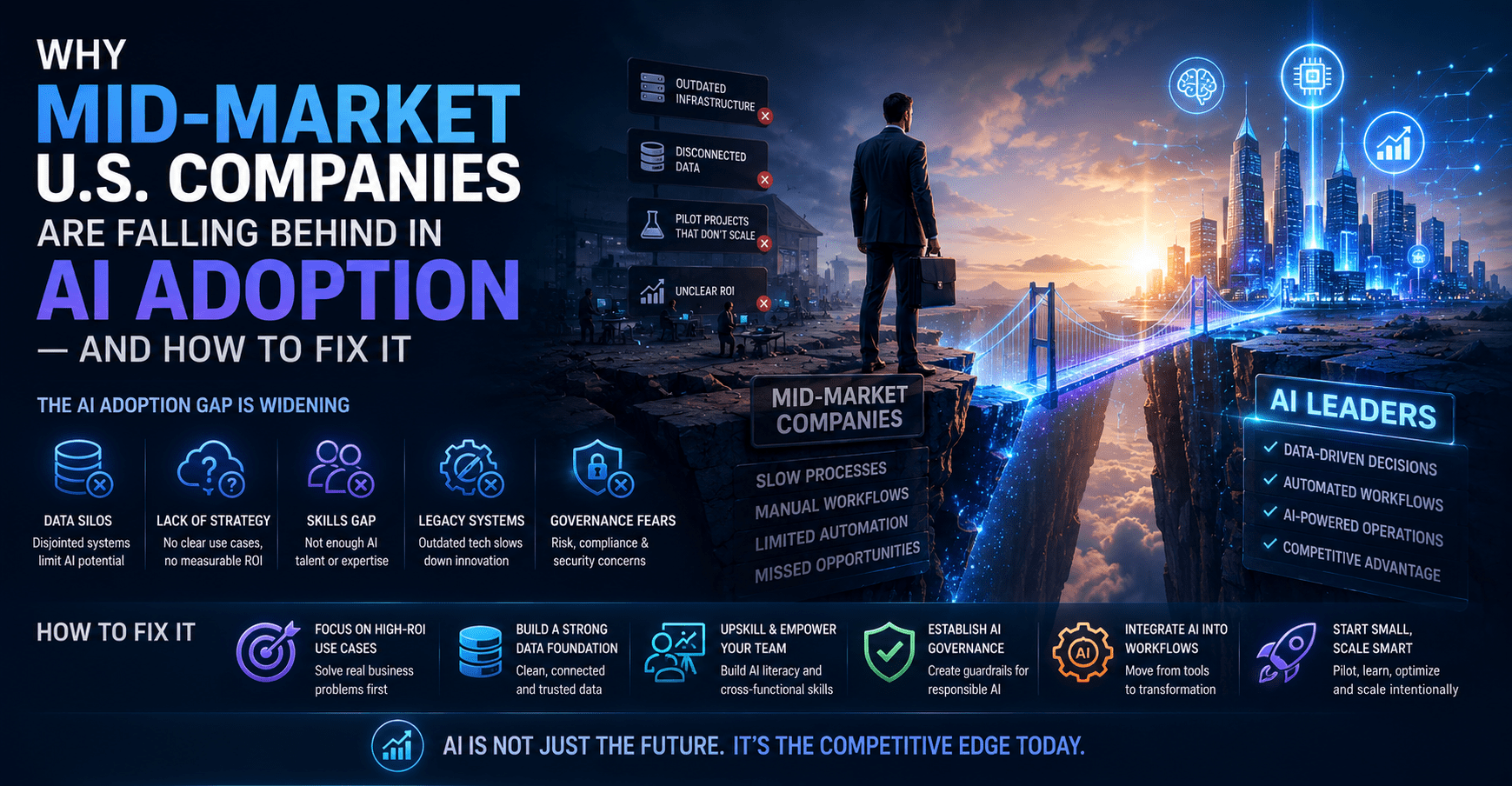
Artificial intelligence adoption is accelerating across the U.S. economy, but the benefits are not spreading evenly.
Large enterprises are investing billions into AI infrastructure, automation, copilots, internal knowledge systems, and autonomous workflows. Startups are aggressively rebuilding products around AI-native models. Meanwhile, many mid-market companies are stuck in a dangerous middle ground: aware that AI matters, but unable to operationalize it effectively.
This gap is becoming one of the most important competitive risks facing mid-sized businesses in 2026.
The problem is not lack of awareness. Most mid-market leaders already understand that AI will reshape operations, customer experience, workforce productivity, and competitive advantage. The real problem is execution. Surveys and industry research consistently show that AI adoption stalls because organizations lack clear strategy, data readiness, internal expertise, governance, and integration capabilities.
For many mid-market organizations, AI is still trapped inside disconnected pilots, experimental chatbot projects, or isolated productivity tools that never scale into core business operations.
The Mid-Market AI Problem
Mid-market companies face a unique challenge.
They are large enough to require operational efficiency, automation, analytics, and scalable decision-making — but not large enough to absorb expensive AI experimentation failures like Fortune 500 companies.
At the same time, they cannot move as quickly as startups because they often operate on older infrastructure, fragmented systems, lean IT teams, and traditional operational models.
This creates what many analysts now describe as the “AI execution gap.”
| Business Segment | AI Advantage | Main Limitation |
|---|---|---|
| Large Enterprises | Massive budgets and infrastructure | Organizational complexity |
| Startups | Speed and agility | Limited scale and stability |
| Mid-Market Companies | Existing operational scale | Limited AI readiness and integration |
Research from the World Economic Forum notes that mid-market businesses historically underinvest in technology compared to larger firms, leaving many organizations with weaker IT foundations for AI deployment.
Why Mid-Market Companies Are Falling Behind
1. Weak Data Infrastructure
AI systems are only as useful as the data behind them.
Many mid-market organizations still operate with:
- Disconnected ERP systems
- Siloed CRM platforms
- Spreadsheet-heavy workflows
- Inconsistent data governance
- Legacy databases
- Limited API integration
This creates a major architecture gap between AI ambition and operational reality.
Industry reports increasingly point to poor data quality and fragmented infrastructure as one of the biggest blockers to meaningful AI adoption.
| Infrastructure Problem | AI Impact |
|---|---|
| Data silos | AI cannot access unified business context |
| Legacy systems | Integration becomes expensive |
| Poor data quality | AI output becomes unreliable |
| Manual workflows | Automation opportunities are limited |
| Lack of APIs | AI orchestration becomes difficult |
Many organizations try to deploy AI before modernizing the operational foundation required to support it.
2. AI Without Business Strategy
One of the most common AI adoption failures is treating AI as a technology experiment instead of a business transformation initiative.
Companies often deploy:
- Chatbots
- AI assistants
- AI meeting tools
- AI content generation
- AI dashboards
…but without defining measurable business outcomes.
Harvard Business Review notes that many organizations incorrectly assume stalled AI initiatives are primarily execution failures, when the deeper issue is weak organizational adoption design.
Successful AI adoption starts with operational objectives:
| Good AI Goal | Weak AI Goal |
|---|---|
| Reduce support costs by 25% | “Implement AI chatbot” |
| Automate invoice processing | “Use generative AI” |
| Improve sales forecasting accuracy | “Adopt AI platform” |
| Reduce onboarding time | “Deploy AI assistant” |
Mid-market companies frequently buy AI tools before defining operational transformation priorities.
3. Skills Gaps and Internal Fear
Many mid-market companies lack:
- AI architects
- Data engineers
- AI product managers
- Prompt engineering expertise
- Governance specialists
- AI operations experience
Research from AWS SMB studies and multiple SMB surveys identifies skills shortages as one of the biggest barriers slowing AI adoption.
At the same time, employees often fear:
- Job displacement
- Workflow disruption
- Performance measurement changes
- Increased monitoring
- Loss of role importance
This creates organizational resistance even when leadership supports AI initiatives.
4. The “Pilot Project Trap.”
Many mid-market businesses are stuck in endless proof-of-concept cycles.
Typical pattern:
- Small AI experiment launches
- Initial excitement grows
- Limited integration occurs
- ROI becomes unclear
- Executive attention fades
- Project stalls
This is now one of the most common AI adoption patterns across mid-sized organizations.
| Pilot Trap Signal | Organizational Symptom |
|---|---|
| No production deployment | AI remains experimental |
| No measurable KPI | ROI cannot be proven |
| No executive sponsor | Momentum disappears |
| No workflow integration | Employees stop using it |
| No governance model | Scaling becomes risky |
AI value only emerges when AI becomes operationalized inside core workflows.
5. Fear of Governance and Compliance Risk
Mid-market companies increasingly worry about:
- Data leakage
- Compliance exposure
- AI hallucinations
- Regulatory uncertainty
- Intellectual property risks
- Shadow AI usage
The rise of unauthorized employee AI usage (“shadow AI”) is becoming a major operational concern for businesses that lack clear AI governance policies.
Without governance frameworks, companies often slow adoption entirely instead of managing risk properly.
How Mid-Market Companies Can Catch Up
1. Start With High-ROI Operational Use Cases
The fastest AI wins usually come from operational efficiency.
Strong mid-market AI use cases include:
| Department | High-Value AI Use Case |
|---|---|
| Customer Support | Ticket summarization and routing |
| Finance | Invoice automation |
| HR | Resume screening and onboarding |
| Sales | CRM enrichment and forecasting |
| Operations | Workflow automation |
| Marketing | Content generation and personalization |
IDC research suggests SMBs are increasingly focusing on pragmatic AI use cases that deliver measurable operational value quickly.
Avoid starting with highly complex enterprise-wide transformation projects.
2. Build an AI Readiness Foundation
Before scaling AI, organizations should modernize:
- Data pipelines
- Cloud infrastructure
- API architecture
- Security controls
- Identity systems
- Governance processes
AI success depends heavily on operational readiness.
| Readiness Area | Priority |
|---|---|
| Data quality | Critical |
| API integration | Critical |
| Cloud scalability | High |
| Security controls | High |
| Governance | High |
| Workforce enablement | High |
Research increasingly frames AI readiness as an organizational learning challenge, not just a technology purchase decision.
3. Create AI Governance Early
Governance should not begin after deployment.
Mid-market companies should define:
- Approved AI tools
- Data usage rules
- Security boundaries
- Human review requirements
- Vendor policies
- Compliance oversight
This reduces fear while enabling safe adoption.
4. Train Employees Instead of Replacing Them
The companies seeing the strongest AI outcomes are typically augmenting employees rather than replacing them.
Goldman Sachs SMB research found that most small businesses using AI view it as workforce augmentation rather than workforce replacement.
The goal should be:
- Faster workflows
- Better decision support
- Reduced repetitive work
- Improved customer responsiveness
Not an immediate workforce reduction.
5. Move From AI Tools to AI Workflows
The biggest transformation happens when AI becomes embedded into operations.
Weak adoption:
- Standalone chatbot
- Isolated AI writing tool
- Experimental dashboard
Strong adoption:
- AI integrated into CRM workflows
- AI embedded into customer support operations
- AI-assisted financial processing
- AI-driven operational analytics
- AI-enabled automation pipelines
The future belongs to workflow-level AI integration, not isolated AI utilities.
What Winning Mid-Market Companies Are Doing Differently
| Winning Behavior | Why It Works |
|---|---|
| Focus on operational ROI | Easier executive buy-in |
| Build governance early | Reduces risk and fear |
| Modernize infrastructure first | Enables scalable AI deployment |
| Train teams continuously | Improves adoption |
| Integrate AI into workflows | Creates lasting operational value |
| Start small but scale intentionally | Prevents pilot stagnation |
IBM research also suggests organizations with stronger AI leadership structures and operational integration models execute AI adoption more effectively.
Final Thoughts
The AI gap inside the U.S. mid-market is widening quickly.
Large enterprises are operationalizing AI at scale. Startups are building AI-native products from day one. Mid-market businesses risk falling behind if AI remains trapped inside disconnected experiments and short-term productivity tools.
The companies that succeed over the next three years will not necessarily be the ones spending the most money on AI.
They will be the companies that:
- Build operational readiness
- Modernize infrastructure
- Focus on measurable workflows
- Train employees effectively
- Create governance early
- Operationalize AI systematically
AI adoption is no longer primarily a technology decision.
It is now an operational competitiveness decision.