
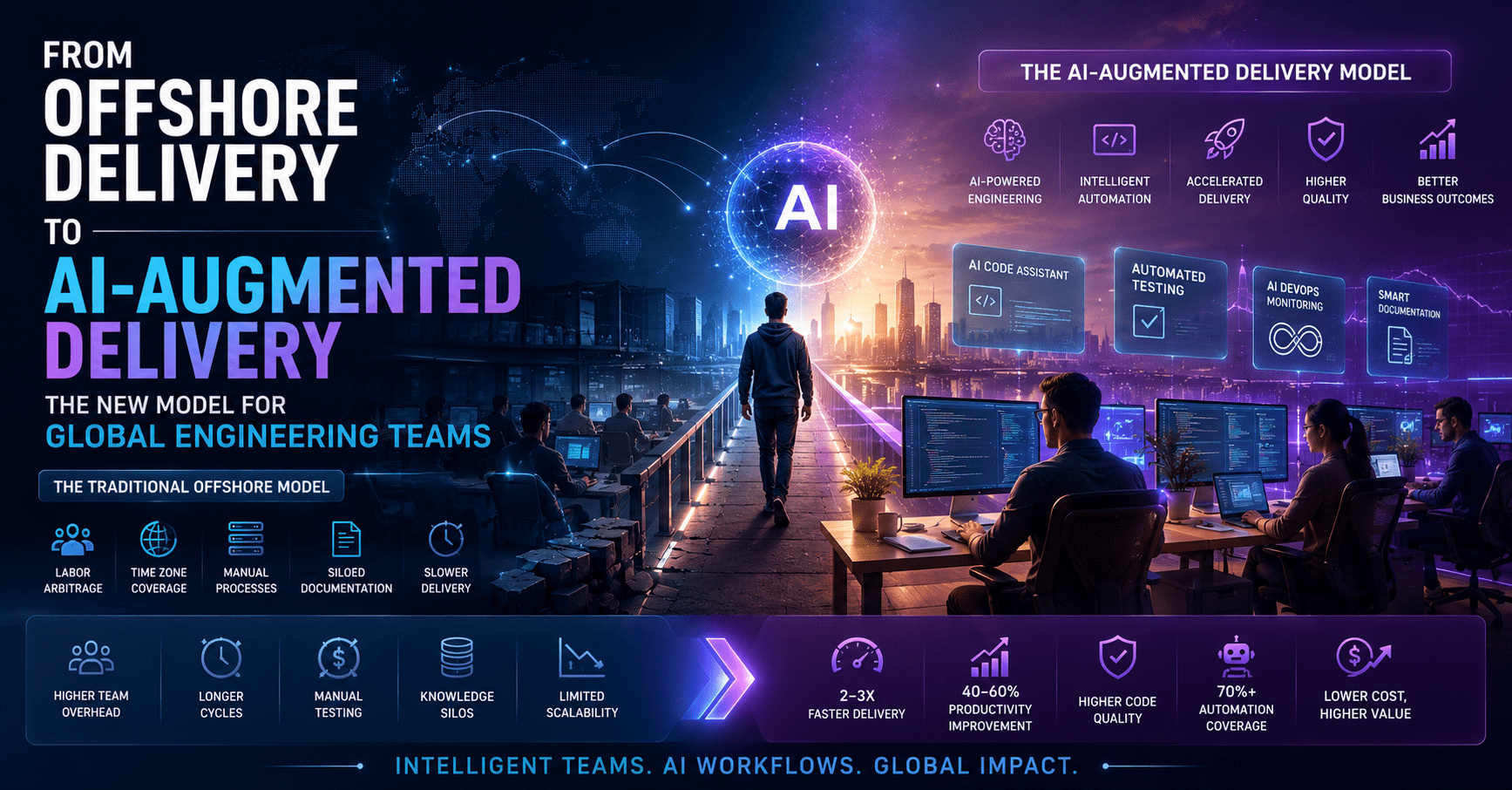
For more than two decades, offshore delivery models have helped global companies scale software engineering capacity while optimizing operational costs.
The traditional offshore model was built around labor arbitrage:
- Lower development cost
- Larger engineering teams
- Extended delivery capacity
- Time-zone coverage
- Centralized project execution
That model is now changing rapidly.
Artificial intelligence is fundamentally reshaping how global engineering teams operate, collaborate, estimate work, generate code, automate testing, manage documentation, accelerate QA, and deliver software products.
The next phase of global engineering is no longer defined only by geography.
It is increasingly defined by AI augmentation.
Organizations are now shifting from traditional offshore delivery to AI-augmented delivery models where engineering productivity is amplified through:
- AI coding assistants
- Automated testing
- AI-enabled DevOps
- AI-driven documentation
- Intelligent project management
- Workflow automation
- Autonomous engineering operations
This transition is creating one of the largest operational shifts the global technology services industry has experienced since the rise of cloud computing.
The Traditional Offshore Delivery Model
Traditional offshore delivery focused heavily on scaling human engineering capacity.
The core value proposition was straightforward:
| Traditional Offshore Model | Primary Goal |
|---|---|
| Lower-cost engineering talent | Reduce delivery cost |
| Distributed delivery centers | Increase scale |
| Dedicated development teams | Expand capacity |
| Follow-the-sun support | Improve coverage |
| Centralized project execution | Standardize delivery |
This model worked effectively for:
- Enterprise software development
- QA and testing
- Maintenance projects
- ERP implementations
- Application modernization
- Support operations
However, the model also introduced limitations.
The Biggest Problems With Traditional Offshore Delivery
1. Scaling Often Meant Adding More People
Traditional offshore delivery frequently relied on headcount expansion.
When projects grew:
- Teams expanded
- Coordination complexity increased
- Communication overhead grew
- Delivery velocity slowed
| Traditional Scaling Model | Operational Problem |
|---|---|
| More engineers | More management complexity |
| More QA resources | Longer coordination cycles |
| More documentation | Slower decision-making |
| Larger distributed teams | Communication bottlenecks |
This model eventually created diminishing productivity returns.
2. Knowledge Silos Slowed Engineering Efficiency
Many offshore delivery organizations have accumulated fragmented:
- Documentation
- Code standards
- Technical decisions
- Business logic
- Deployment processes
This made onboarding slower and institutional knowledge difficult to scale.
3. Repetitive Engineering Work Consumed Too Much Time
Engineering teams spent enormous time on:
- Boilerplate coding
- Documentation
- Test generation
- Bug triaging
- Ticket classification
- Environment setup
- Manual QA validation
- Release coordination
These repetitive workflows created operational inefficiency at scale.
The Rise of AI-Augmented Delivery
AI-augmented delivery changes the operational model completely.
Instead of scaling only through additional human resources, organizations now scale through:
- Human + AI collaboration
- Intelligent workflow automation
- AI-assisted engineering execution
- AI-driven delivery acceleration
The focus shifts from:
“How many engineers do we need?”
…to:
“How much engineering output can we amplify?”
What AI-Augmented Delivery Looks Like
AI Coding Assistants
Modern engineering teams increasingly use AI copilots to:
- Generate boilerplate code
- Suggest architecture patterns
- Create APIs
- Refactor legacy systems
- Generate unit tests
- Accelerate debugging
| AI-Augmented Coding Benefit | Operational Impact |
|---|---|
| Faster implementation | Reduced delivery timelines |
| Reduced repetitive coding | Higher engineering focus |
| Faster onboarding | Improved team productivity |
| Better documentation support | Reduced knowledge gaps |
AI does not replace engineers.
It amplifies engineering throughput.
AI-Driven QA and Testing
Testing is becoming increasingly automated through AI systems capable of:
- Generating test cases
- Detecting edge-case failures
- Predicting regression risks
- Automating UI testing
- Improving test coverage
Traditional QA-heavy delivery models are evolving into:
- Smaller QA teams
- AI-assisted validation
- Continuous testing workflows
AI-Powered DevOps
AI is increasingly integrated into:
- Infrastructure monitoring
- Deployment analysis
- Incident prediction
- Root-cause analysis
- Performance optimization
- Cloud cost monitoring
This significantly reduces operational overhead for distributed engineering teams.
The New Productivity Model
The old offshore model optimized:
- Labor cost
- Team size
- Delivery capacity
The new AI-augmented model optimizes:
- Engineering velocity
- Workflow efficiency
- Automation coverage
- Delivery intelligence
- Knowledge scalability
| Traditional Offshore KPI | AI-Augmented KPI |
|---|---|
| Team size | Engineering output |
| Billable hours | Delivery acceleration |
| Resource allocation | Workflow automation |
| Offshore utilization | AI-assisted productivity |
| Delivery capacity | Intelligent execution |
This is a major operational mindset shift.
Why Global Engineering Teams Are Adopting AI Faster
Global engineering organizations are uniquely positioned for AI adoption because they already operate with:
- Structured workflows
- Defined delivery processes
- Repeatable engineering operations
- Distributed collaboration systems
- Documentation-heavy environments
These characteristics make AI integration easier.
AI performs especially well in environments with:
- Repetitive workflows
- Large knowledge bases
- Predictable delivery pipelines
- High-volume operational tasks
The New Role of Offshore Teams
The role of offshore engineering teams is evolving rapidly.
The future model is not:
“Low-cost coding factory.”
The future model is:
“AI-enabled global engineering acceleration.”
Modern engineering partners are increasingly expected to provide:
- AI-assisted delivery
- Intelligent automation
- AI governance
- AI-integrated DevOps
- AI-enhanced QA
- AI-powered analytics
- Faster product iteration
Skills That Matter in the AI-Augmented Era
The most valuable engineering skills are shifting.
| Traditional Engineering Focus | Emerging AI-Augmented Focus |
|---|---|
| Manual implementation | AI orchestration |
| Repetitive coding | System architecture |
| Manual QA | Intelligent validation |
| Static documentation | AI-assisted knowledge systems |
| Task execution | Workflow optimization |
The strongest engineering teams now combine:
- Technical expertise
- AI fluency
- Systems thinking
- Workflow automation capability
- Product-oriented engineering
Risks in AI-Augmented Delivery
AI augmentation also introduces new challenges.
1. Governance and Security
Organizations must manage:
- Data privacy
- Source code exposure
- AI vendor policies
- Compliance requirements
- Intellectual property protection
2. AI-Generated Technical Debt
Poorly governed AI-generated code can create:
- Inconsistent architecture
- Security vulnerabilities
- Hidden maintenance problems
- Technical debt accumulation
Human engineering oversight remains essential.
3. Over-Reliance on Automation
AI should augment engineering teams, not eliminate engineering thinking.
Strong organizations maintain:
- Architecture review
- Human validation
- QA oversight
- Security review
- Engineering accountability
What Winning Engineering Organizations Are Doing
| Winning Strategy | Why It Works |
|---|---|
| Integrating AI into workflows | Improves operational efficiency |
| Training engineers on AI tooling | Accelerates adoption |
| Automating repetitive tasks | Frees engineering focus |
| Building AI governance early | Reduces operational risk |
| Combining human expertise with AI | Maintains quality and scalability |
| Measuring delivery acceleration | Improves ROI visibility |
The Future of Global Engineering Delivery
The future of software delivery will not be defined by:
- Cheapest labor
- Largest offshore team
- Lowest hourly rate
It will increasingly be defined by:
- Intelligent delivery systems
- AI-augmented engineering
- Workflow automation
- Faster product iteration
- Operational scalability
- Engineering efficiency
The organizations that adapt fastest will gain:
- Faster release cycles
- Lower operational overhead
- Better engineering scalability
- Improved customer responsiveness
- Stronger competitive advantage
Final Thoughts
The offshore delivery industry is entering a major transformation phase.
AI is not eliminating global engineering teams.
It is fundamentally reshaping how those teams operate.
The future belongs to organizations that combine:
- Global engineering talent
- AI-assisted delivery
- Intelligent automation
- Operational scalability
- Human engineering expertise
The next generation of successful delivery organizations will not simply provide offshore resources.
They will provide AI-augmented engineering acceleration.