
Artificial Intelligence is entering its next major phase.
Over the past two years, businesses have focused on Generative AI—using large language models to generate text, code, images, and insights. In 2026, the conversation has shifted toward something much more impactful: AI Agents.
Every major technology company is investing in agentic AI. From customer support and software development to finance and operations, organizations are exploring autonomous systems capable of planning, reasoning, and executing complex tasks.
However, one of the biggest misconceptions in enterprise AI is that AI Agents and AI Workflows are the same thing.
They are not.
Understanding the difference is essential for organizations looking to invest wisely in AI.
What Is an AI Workflow?
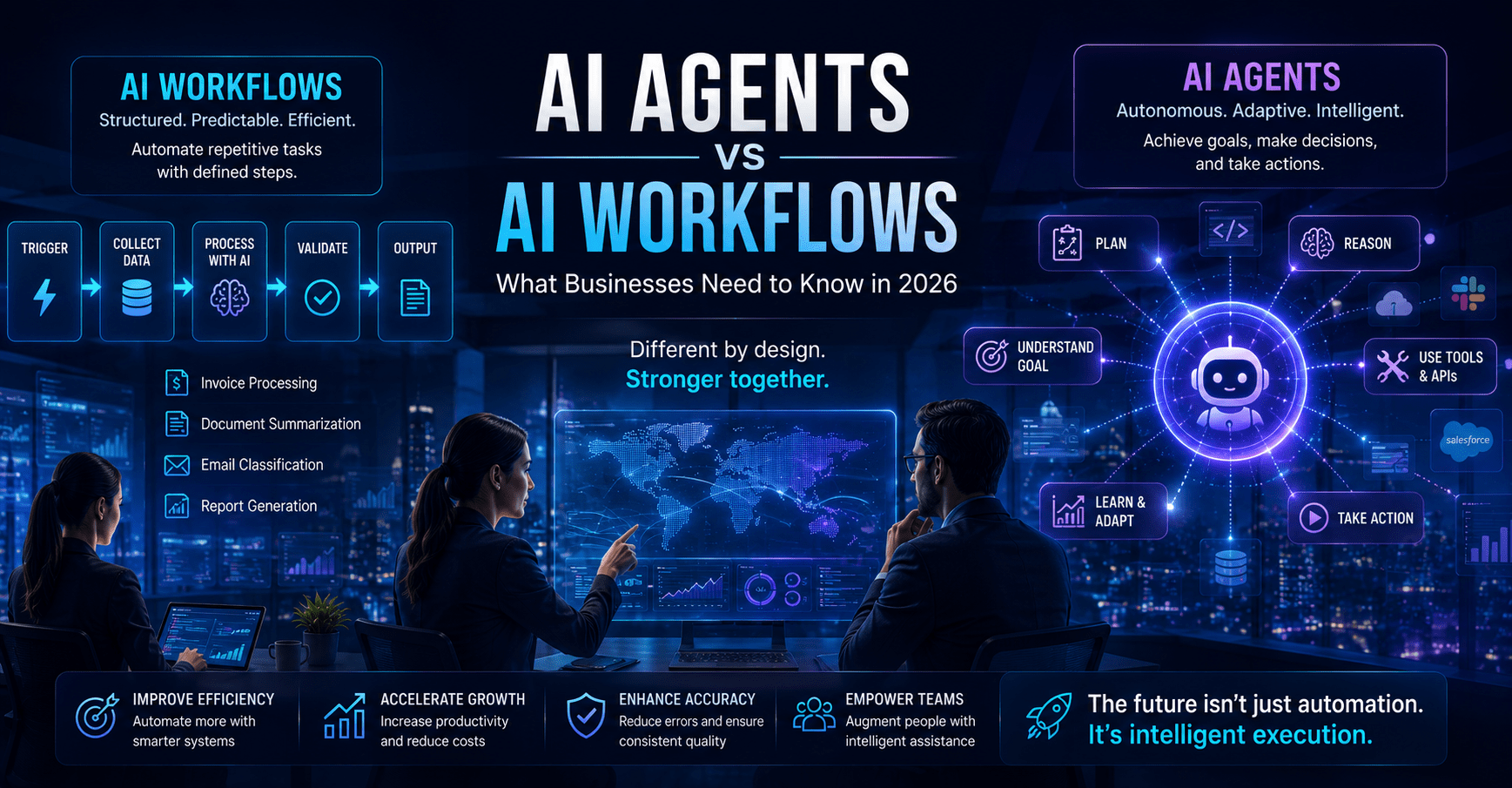
An AI workflow is a predefined sequence of automated steps where AI performs specific tasks under clearly defined rules.
Examples include:
- Automatic email classification
- Invoice processing
- Document summarization
- Customer sentiment analysis
- Content generation
The process is predictable and follows a structured path.
What Is an AI Agent?
An AI Agent goes beyond automation.
It can:
- Understand objectives
- Plan multiple steps
- Make contextual decisions
- Use external tools
- Interact with APIs
- Learn from feedback
- Complete complex tasks with limited human intervention
Rather than following a fixed flow, an AI Agent adapts to changing situations.
AI Workflow vs AI Agent
| AI Workflow | AI Agent |
|---|---|
| Rule-based execution | Goal-driven execution |
| Fixed sequence | Dynamic decision-making |
| Limited flexibility | Adaptive reasoning |
| Human-controlled | Semi-autonomous |
| Best for repetitive tasks | Best for complex business processes |
Why Enterprises Are Moving Toward AI Agents
Organizations are looking for more than automation.
They want systems that can:
- Reduce operational overhead
- Improve customer experiences
- Accelerate software delivery
- Increase employee productivity
- Support decision-making
AI Agents offer these capabilities by combining reasoning with action.
High-Value Enterprise Use Cases
| Department | AI Agent Use Case |
|---|---|
| Customer Support | Resolve tickets, escalate complex issues |
| Software Engineering | Generate code, review pull requests, create tests |
| Sales | Qualify leads and prepare proposals |
| Finance | Analyze expenses and detect anomalies |
| HR | Screen resumes and answer employee questions |
| Operations | Coordinate workflows across multiple systems |
The Biggest Mistakes Companies Make
Many organizations rush to build AI Agents without first establishing:
- Clean data
- Secure integrations
- Governance policies
- Human oversight
- Clear business objectives
AI succeeds when it solves measurable business problems—not when it is deployed simply because it is new.
Building an AI-Ready Organization
Successful enterprises typically follow this path:
- Optimize business processes.
- Introduce AI workflows for repetitive tasks.
- Establish governance and security.
- Deploy AI Agents for high-value decision support.
- Continuously monitor and improve performance.
What Skills Will Matter Most?
As AI Agents become mainstream, demand will grow for professionals who understand:
- AI architecture
- Prompt engineering
- Workflow orchestration
- API integrations
- Data governance
- AI security
- Business process optimization
Final Thoughts
AI Workflows improve efficiency.
AI Agents transform how work gets done.
Organizations that understand where each approach fits will achieve faster adoption, stronger ROI, and more sustainable AI transformation.
The future is not about replacing people with AI.
It is about enabling people with intelligent systems that can reason, collaborate, and execute alongside them.