
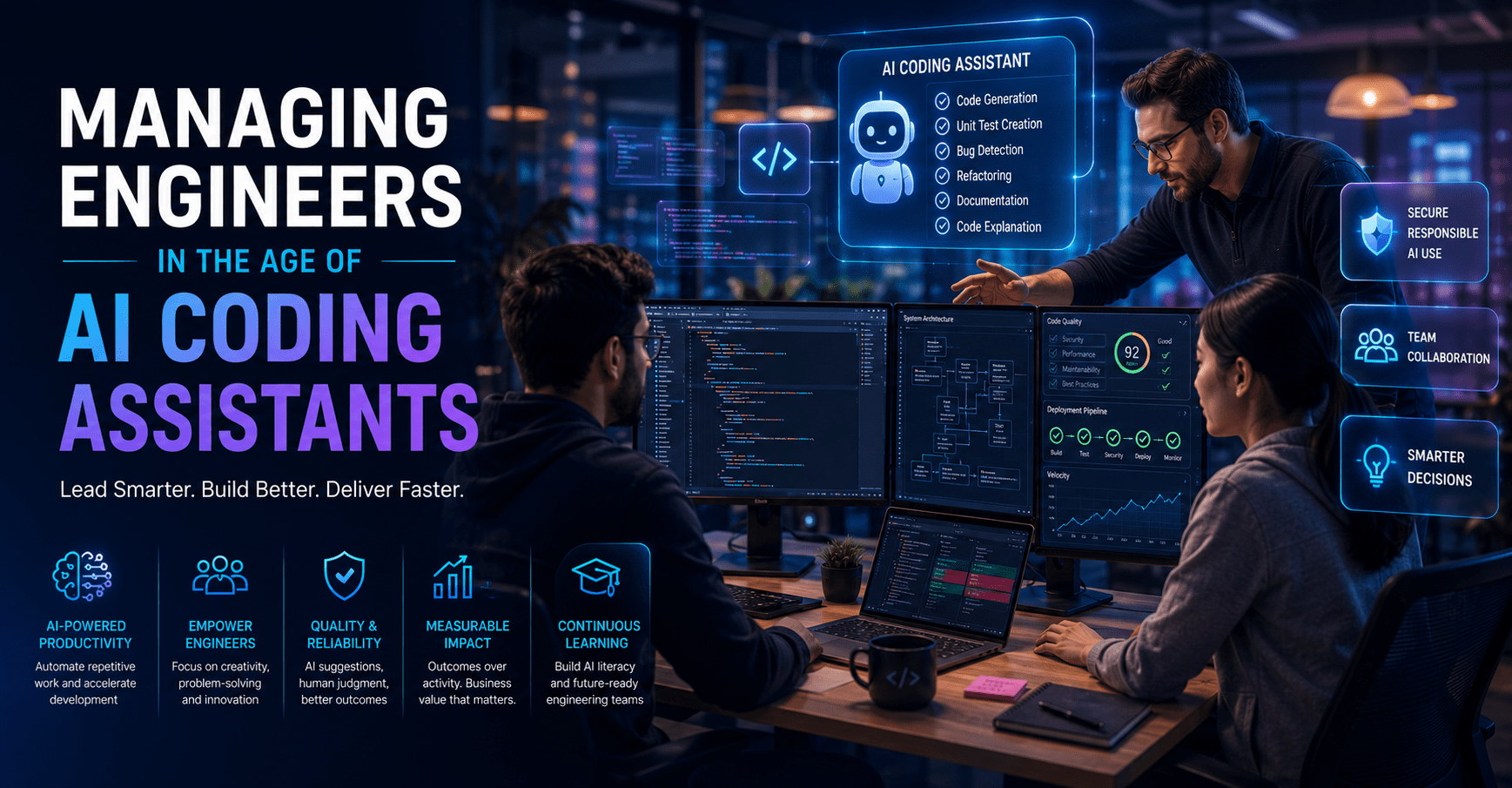
The software engineering profession is experiencing one of the most significant workplace transformations since the rise of cloud computing.
AI coding assistants such as GitHub Copilot, Cursor, Amazon Q, Claude Code, Gemini Code Assist, and ChatGPT are no longer experimental productivity tools. They are becoming everyday collaborators for engineering teams.
For engineering managers, this creates an entirely new leadership challenge.
Success is no longer measured by how many developers can write code quickly.
Instead, high-performing engineering organizations are learning how to combine human expertise with AI-powered development while maintaining software quality, security, collaboration, and innovation.
Managing engineers in the age of AI requires a new leadership mindset.
The Shift from Code Writers to Problem Solvers
Historically, engineering managers focused on:
- Coding velocity
- Sprint completion
- Feature delivery
- Team utilization
- Bug reduction
While these metrics remain important, AI is changing how engineering value is created.
Developers now spend less time writing repetitive code and more time solving complex business problems.
Engineering managers should encourage teams to focus on:
- Architecture decisions
- Product thinking
- Customer impact
- System design
- Software quality
- Cross-functional collaboration
The value of engineers is increasingly determined by judgment rather than typing speed.
How AI Coding Assistants Are Changing Engineering Teams
AI Becomes a Team Member
Modern AI coding assistants can now:
- Generate production-ready code
- Explain unfamiliar codebases
- Create unit tests
- Suggest architectural improvements
- Generate documentation
- Refactor legacy applications
- Detect common bugs
- Recommend security improvements
Rather than replacing engineers, AI removes repetitive work that slows innovation.
Traditional vs AI-Augmented Engineering
| Traditional Engineering | AI-Augmented Engineering |
|---|---|
| Manual coding | AI-assisted implementation |
| Individual research | AI-supported discovery |
| Manual documentation | AI-generated documentation |
| Repetitive debugging | AI-assisted troubleshooting |
| Slower onboarding | AI-enabled knowledge sharing |
| Time spent on boilerplate | Time spent solving business problems |
Leadership Challenge #1: Measuring Productivity
One of the biggest mistakes engineering managers can make is continuing to measure productivity using outdated metrics.
Lines of code are becoming increasingly irrelevant.
Instead, engineering leaders should measure:
- Business outcomes
- Feature quality
- Customer value
- Software reliability
- Deployment frequency
- Developer satisfaction
- Cycle time
- Production stability
Modern Engineering Metrics
| Traditional Metric | Better AI-Era Metric |
|---|---|
| Lines of code | Customer value delivered |
| Hours worked | Engineering impact |
| Individual output | Team productivity |
| Story count | Business outcomes |
| Coding speed | Solution quality |
AI changes how work gets done—not how success should be measured.
Leadership Challenge #2: Preventing AI Dependency
AI can dramatically accelerate software development.
However, over-reliance creates risks.
Developers should never accept AI-generated code without understanding:
- Architecture implications
- Performance trade-offs
- Security risks
- Maintainability
- Scalability
Engineering managers should reinforce the principle:
AI generates. Engineers validate.
Leadership Challenge #3: Redefining Code Reviews
Code reviews are no longer just about finding syntax errors.
AI can already identify:
- Formatting issues
- Common bugs
- Duplicate logic
- Basic security flaws
Human reviews should increasingly focus on:
- Architecture
- Business logic
- Scalability
- User experience
- Maintainability
- Design decisions
The purpose of code reviews is evolving from correction to engineering mentorship.
Leadership Challenge #4: Building AI Literacy
AI adoption should never be left to individual experimentation.
Organizations need structured enablement.
Managers should invest in:
- Prompt engineering fundamentals
- Responsible AI usage
- Secure coding practices
- AI governance
- Architecture validation
- AI-assisted debugging
Teams that learn together adopt AI more effectively than individuals working independently.
Leadership Challenge #5: Protecting Security and Intellectual Property
AI assistants introduce new security considerations.
Engineering leaders should establish clear policies regarding:
- Proprietary source code
- Customer information
- API credentials
- Internal documentation
- Compliance requirements
- Approved AI tools
Strong governance builds trust while enabling innovation.
What High-Performing Managers Do Differently
1. Focus on Outcomes, Not Activity
Instead of asking:
“How many hours did this take?”
Ask:
“What business value did we deliver?”
2. Encourage AI-Assisted Learning
AI can accelerate onboarding for junior developers by:
- Explaining unfamiliar code
- Recommending best practices
- Providing examples
- Summarizing documentation
This allows senior engineers to focus on coaching rather than repetitive explanations.
3. Invest in Architecture Skills
As AI handles more implementation work, engineering value shifts toward:
- Architecture
- System design
- Domain knowledge
- Product strategy
- Critical thinking
Organizations should invest heavily in these capabilities.
4. Create Responsible AI Guidelines
Every engineering team should establish guidance covering:
- Approved AI tools
- Code validation
- Security reviews
- Documentation standards
- Data privacy
- Ownership of generated code
Clear expectations reduce risk and encourage responsible adoption.
Building an AI-Augmented Engineering Culture
The most successful teams treat AI as a productivity multiplier rather than a replacement.
Characteristics include:
| High-Performing Team Practice | Business Benefit |
|---|---|
| AI-assisted coding | Faster delivery |
| Human architectural oversight | Better scalability |
| Continuous AI learning | Higher adaptability |
| Strong governance | Reduced security risk |
| Knowledge sharing | Faster onboarding |
| Outcome-based leadership | Better customer value |
Culture determines whether AI becomes a competitive advantage.
Skills Engineering Managers Should Prioritize
As AI becomes embedded in development workflows, managers should encourage engineers to strengthen:
- Systems thinking
- Software architecture
- Business communication
- AI literacy
- Product ownership
- Security awareness
- Critical thinking
- Collaboration
These skills will become increasingly valuable as repetitive coding becomes automated.
The Future of Engineering Leadership
The role of an engineering manager is evolving.
Tomorrow’s leaders will spend less time monitoring task completion and more time enabling high-performing, AI-augmented teams.
Successful managers will:
- Coach instead of supervise
- Enable instead of control
- Measure outcomes instead of activity
- Promote experimentation with accountability
- Build cultures of continuous learning
Leadership itself is becoming more strategic.
Final Thoughts
AI coding assistants are not replacing software engineers.
They are changing what great engineering looks like.
The organizations that thrive will not simply adopt AI tools.
They will build engineering cultures that combine:
- Human creativity
- Technical excellence
- Responsible AI usage
- Continuous learning
- Strong leadership
The future belongs to engineering leaders who understand that AI amplifies great teams—but only thoughtful leadership turns that amplification into lasting business value.