
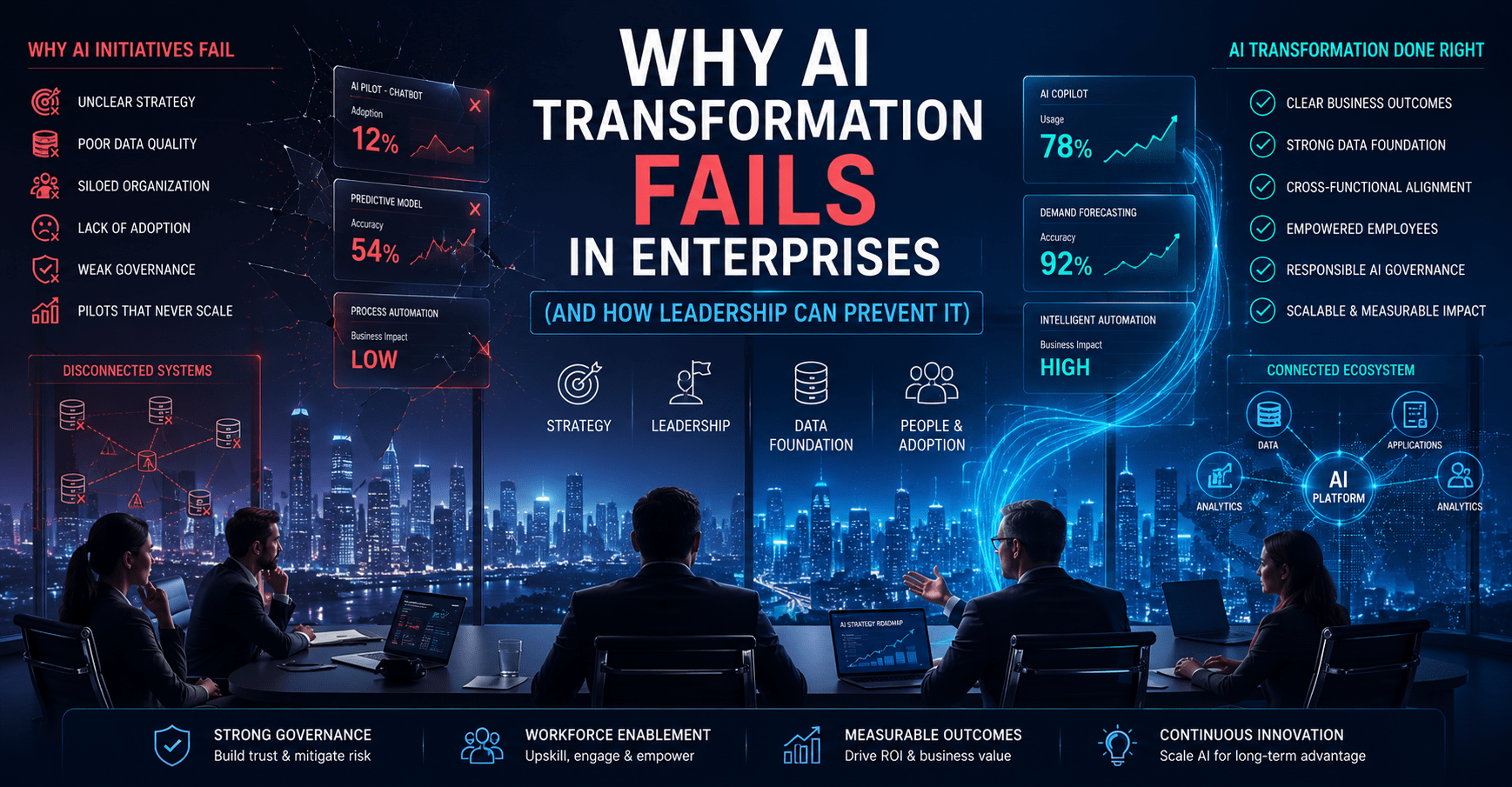
Artificial intelligence has become one of the highest-priority initiatives in boardrooms across the world.
Organizations are investing billions into:
- Generative AI
- AI copilots
- AI agents
- Workflow automation
- Intelligent analytics
- Enterprise AI platforms
Yet despite unprecedented investment levels, many AI transformation initiatives fail to deliver meaningful business outcomes.
The problem is rarely the technology itself.
Most AI transformation failures are leadership failures.
The organizations successfully scaling AI are not necessarily using better models.
They are creating better transformation strategies.
In 2026, the difference between AI success and AI failure is increasingly determined by leadership execution rather than technological capability.
The AI Transformation Gap
Many organizations begin AI initiatives with enormous enthusiasm.
Executives hear promises of:
- Productivity gains
- Operational efficiency
- Cost reduction
- Faster innovation
- Competitive advantage
However, reality often looks different.
Many enterprises experience:
- Isolated AI pilots
- Poor adoption
- Weak ROI
- Employee resistance
- Data quality challenges
- Governance concerns
- Unclear ownership
The result is a growing gap between AI ambition and AI execution.
Why AI Transformation Fails
1. AI Is Treated as a Technology Project
One of the most common mistakes is treating AI as purely an IT initiative.
Many organizations assume:
“Buy AI tools and transformation will happen.”
Unfortunately, AI transformation is not primarily a technology problem.
It is an operational transformation challenge.
Successful AI adoption requires:
- Process redesign
- Organizational alignment
- Leadership sponsorship
- Workforce enablement
- Governance frameworks
Technology alone cannot create transformation.
2. No Clear Business Objective
Many AI programs start with technology exploration rather than business outcomes.
Organizations often pursue:
- ChatGPT initiatives
- AI pilots
- Automation experiments
Without clearly defining:
- Revenue impact
- Cost reduction targets
- Productivity goals
- Customer experience improvements
Without measurable objectives, AI initiatives become innovation theater.
Signs of This Problem
| Warning Sign | Impact |
|---|---|
| AI projects without KPIs | Difficult ROI measurement |
| Multiple disconnected pilots | Fragmented adoption |
| Undefined success criteria | Leadership uncertainty |
| Tool-first thinking | Weak business outcomes |
3. Poor Data Foundations
AI systems are only as effective as the data supporting them.
Many enterprises still operate with:
- Data silos
- Legacy systems
- Inconsistent reporting
- Poor data quality
- Fragmented operational systems
Organizations frequently discover that their biggest AI challenge is actually a data challenge.
Why Data Problems Kill AI Initiatives
| Data Issue | Business Impact |
|---|---|
| Incomplete data | Weak AI outputs |
| Data silos | Limited visibility |
| Poor governance | Compliance risk |
| Inaccurate records | Reduced trust |
| Legacy infrastructure | Integration challenges |
Without strong data foundations, AI cannot scale effectively.
4. Lack of Executive Ownership
AI transformation often falls into an organizational gray area.
Questions emerge:
- Who owns AI?
- Who funds AI?
- Who governs AI?
- Who measures outcomes?
Without executive sponsorship, AI initiatives frequently stall.
Successful organizations typically have:
- Executive champions
- Dedicated transformation leadership
- Cross-functional accountability
- Clear governance structures
AI cannot become an organizational priority if leadership treats it as a side project.
5. Employee Resistance
One of the most underestimated challenges is human adoption.
Employees often worry about:
- Job displacement
- Increased monitoring
- Workflow disruption
- Learning complexity
- Changing responsibilities
Resistance is rarely about AI itself.
It is often about uncertainty.
Organizations that fail to address workforce concerns frequently experience low adoption rates.
Why Change Management Matters
AI transformation is ultimately a people transformation initiative.
Organizations must:
- Educate employees
- Communicate openly
- Create trust
- Provide training
- Demonstrate value
Successful AI programs focus as much on adoption as they do on technology.
6. Governance Arrives Too Late
Many organizations focus heavily on deployment and only later think about governance.
This creates risks involving:
- Compliance
- Security
- Privacy
- Model behavior
- Regulatory exposure
Governance should be part of the initial architecture.
Not an afterthought.
7. AI Pilots Never Reach Production
Many enterprises become trapped in “pilot mode.”
They launch:
- Proof of concepts
- Small experiments
- Internal demonstrations
But fail to scale successful initiatives.
Common Scaling Barriers
| Barrier | Result |
|---|---|
| Weak infrastructure | Limited scalability |
| Poor ownership | Project stagnation |
| Lack of funding | Delayed expansion |
| Unclear ROI | Executive hesitation |
| Skills gaps | Slow implementation |
The difference between AI experimentation and AI transformation is operationalization.
The Leadership Role in AI Success
The organizations succeeding with AI share a common characteristic:
Leadership involvement.
Successful executives understand that AI transformation requires:
- Strategic alignment
- Organizational commitment
- Long-term investment
- Workforce enablement
- Governance oversight
AI transformation is not delegated entirely to IT teams.
It becomes a business-wide initiative.
What Successful Leaders Do Differently
They Start with Business Problems
Rather than asking:
“How can we use AI?”
They ask:
“What business problem should AI solve?”
This creates stronger ROI and clearer adoption paths.
They Focus on High-Impact Use Cases
Successful organizations prioritize:
- Customer service automation
- Workflow optimization
- Knowledge management
- Productivity enhancement
- Operational efficiency
Instead of attempting enterprise-wide transformation immediately.
They Invest in Workforce Readiness
Leading organizations understand:
AI adoption succeeds when employees succeed.
Investment areas include:
- AI literacy
- Training programs
- Change management
- Workflow redesign
- Career development
They Build Governance Early
Governance frameworks typically include:
| Governance Area | Purpose |
|---|---|
| Security Controls | Protect enterprise data |
| Compliance Standards | Meet regulatory requirements |
| AI Usage Policies | Establish boundaries |
| Monitoring Systems | Track performance |
| Audit Processes | Ensure accountability |
Governance builds trust and scalability.
The Rise of the AI Solutions Architect
As enterprises mature their AI programs, a new role is emerging:
The AI Solutions Architect.
This role helps bridge:
- Business strategy
- AI capabilities
- Enterprise systems
- Data infrastructure
- Governance requirements
Organizations increasingly need leaders who can operationalize AI beyond experimentation.
Building an AI Transformation Roadmap
A practical AI transformation roadmap typically follows:
Phase 1: Assessment
- Identify business opportunities
- Evaluate data readiness
- Assess operational maturity
Phase 2: Pilot Programs
- Select high-value use cases
- Measure outcomes
- Build confidence
Phase 3: Operationalization
- Scale successful initiatives
- Implement governance
- Expand adoption
Phase 4: Enterprise Integration
- Standardize AI workflows
- Build AI-enabled operations
- Create long-term competitive advantage
What AI Transformation Success Looks Like
Successful AI organizations typically achieve:
| Outcome | Benefit |
|---|---|
| Higher productivity | Improved operational efficiency |
| Better decision-making | Faster business response |
| Enhanced customer experiences | Increased satisfaction |
| Reduced operational costs | Improved profitability |
| Accelerated innovation | Stronger competitiveness |
The goal is not AI deployment.
The goal is business transformation.
Final Thoughts
AI transformation fails when organizations focus exclusively on technology.
The enterprises creating meaningful AI outcomes understand that transformation requires:
- Leadership commitment
- Clear business objectives
- Strong data foundations
- Workforce enablement
- Governance structures
- Operational execution
AI is not simply another software implementation.
It is an organizational transformation initiative.
The companies that succeed over the next decade will not necessarily be those with the most advanced AI tools.
They will be the organizations with leaders capable of turning AI into measurable business value.