Best Database for SaaS Applications
Choosing a database for SaaS: SQL vs NoSQL, why PostgreSQL is the default, multi-tenancy models, vector databases for AI, and a hybrid architecture.
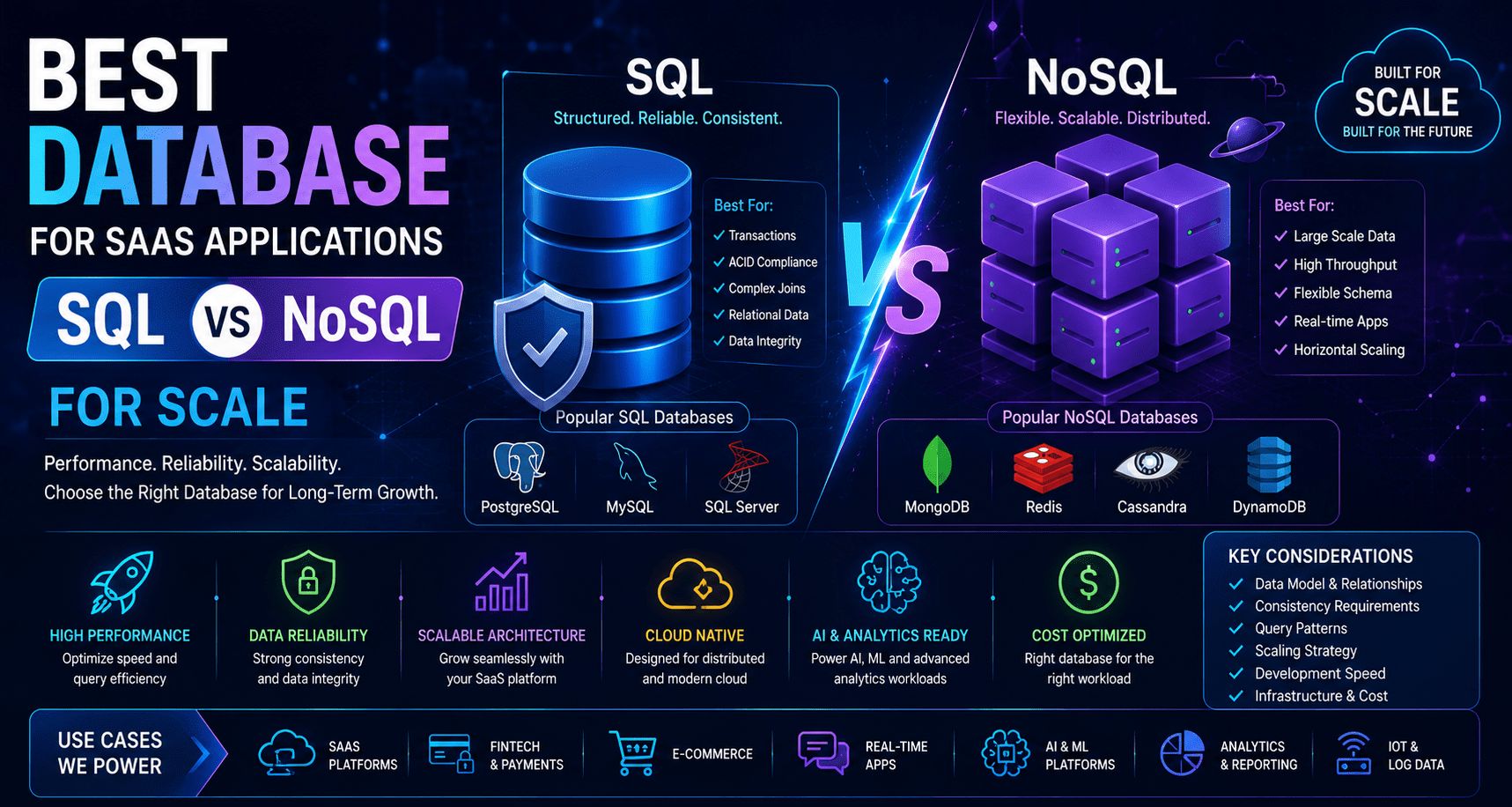
For most SaaS applications, PostgreSQL is the best starting database: it combines relational integrity, strong transactions, JSON support, advanced indexing and AI-friendly extensions such as pgvector. Add NoSQL, caching, search or vector databases only when a specific workload needs them; mature SaaS platforms use a hybrid, workload-driven data architecture.
In 2026, the database layer no longer simply stores application data.
Modern SaaS databases must support:
- Multi-tenancy
- Real-time workloads
- AI-driven applications
- Distributed systems
- Analytics
- High availability
- Massive concurrency
- Global scalability
- Intelligent automation
The debate is no longer simply:
“SQL vs NoSQL.”
The real question is:
“What data architecture best supports long-term SaaS scalability?”
The answer depends heavily on:
- Product type
- Data complexity
- Growth strategy
- AI requirements
- Operational scale
- Query patterns
- Infrastructure maturity
Modern SaaS systems increasingly combine both SQL and NoSQL databases strategically.
Understanding SQL vs NoSQL
SQL Databases
SQL databases are relational systems designed around:
- Structured schemas
- ACID transactions
- Relational integrity
- Complex querying
- Data consistency
Popular SQL databases include:
- PostgreSQL
- MySQL
- MariaDB
- Microsoft SQL Server
NoSQL Databases
NoSQL systems are designed for:
- Flexible schemas
- Horizontal scalability
- Large distributed workloads
- High-speed ingestion
- Unstructured data
Popular NoSQL databases include:
- MongoDB
- Cassandra
- DynamoDB
- Couchbase
- Redis
Why Database Choice Matters in SaaS
Your database architecture directly affects:
- Application scalability
- Product performance
- Infrastructure cost
- AI readiness
- Multi-tenancy
- Analytics capability
- Development speed
- Long-term maintainability
Choosing the wrong database model can create:
- Scaling bottlenecks
- Operational complexity
- Expensive migrations
- Performance limitations
- Data consistency problems
Why SQL Databases Still Dominate SaaS
Despite NoSQL growth, SQL databases continue powering a large percentage of modern SaaS applications.
Especially:
- Enterprise SaaS
- Financial systems
- CRM platforms
- Subscription platforms
- ERP systems
- Operational business systems
Why PostgreSQL Is Becoming the SaaS Default
PostgreSQL has become one of the strongest database choices for modern SaaS applications because it combines:
- Relational reliability
- Advanced indexing
- JSON support
- Analytical capabilities
- Scalability
- AI compatibility
PostgreSQL increasingly behaves like a hybrid database platform.
Advantages of SQL for SaaS Applications
| SQL Strength | Why It Matters |
|---|---|
| Strong consistency | Critical for transactional systems |
| ACID compliance | Prevents data corruption |
| Complex queries | Better reporting and analytics |
| Mature ecosystem | Long-term operational stability |
| Structured relationships | Ideal for SaaS business logic |
| Strong tooling | Easier maintenance and observability |
SQL databases are especially strong for:
- Billing systems
- Subscription management
- Financial operations
- RBAC systems
- Enterprise workflows
- Transaction-heavy applications
Where NoSQL Excels
NoSQL databases perform exceptionally well in:
- High-scale distributed systems
- Flexible data models
- Event-driven architectures
- Real-time systems
- AI workloads
- Massive ingestion pipelines
Advantages of NoSQL for SaaS Applications
| NoSQL Strength | Why It Matters |
|---|---|
| Horizontal scaling | Better distributed scalability |
| Flexible schema | Faster iteration |
| High write throughput | Real-time workloads |
| Large-scale distribution | Global applications |
| Unstructured data support | AI and content systems |
| Event stream compatibility | Modern architecture support |
NoSQL is often ideal for:
- Chat systems
- Activity feeds
- IoT platforms
- AI-generated content
- Logging systems
- Analytics ingestion
- Recommendation systems
The Biggest Mistake: Treating It as “Either/Or”
Modern SaaS architecture increasingly uses:
- SQL + NoSQL together
- Specialized data systems
- Polyglot persistence
Most large SaaS applications now combine:
- Relational databases
- Cache layers
- Search systems
- Analytics databases
- Vector databases
- Event stores
The future is hybrid architecture.
Modern SaaS Database Architecture Example
| Layer | Recommended Database |
|---|---|
| Core Business Data | PostgreSQL |
| Cache Layer | Redis |
| Search | Elasticsearch / OpenSearch |
| AI Retrieval | Vector Database |
| Event Streaming | Kafka |
| Analytics | ClickHouse |
Each system handles different operational workloads efficiently.
SQL vs NoSQL for Multi-Tenant SaaS
Multi-tenancy is one of the most important SaaS database considerations.
SQL Multi-Tenancy Strengths
SQL databases work extremely well for:
- Tenant isolation
- RBAC
- Transactional workflows
- Enterprise reporting
- Subscription systems
Popular models include:
- Shared schema
- Schema-per-tenant
- Database-per-tenant
NoSQL Multi-Tenancy Strengths
NoSQL systems perform well for:
- Large-scale tenant data
- High-volume ingestion
- Flexible content models
- Massive user activity systems
However, relational consistency can become more difficult.
AI Is Changing Database Requirements
One of the biggest changes in 2026:
AI workloads are reshaping database architecture.
Modern SaaS applications increasingly require:
- Semantic search
- Vector embeddings
- AI memory systems
- Retrieval pipelines
- Real-time contextual data
Traditional relational databases alone are often insufficient for these workloads.
The Rise of Vector Databases
AI-native SaaS applications increasingly use:
- Pinecone
- Weaviate
- Chroma
- pgvector
- Milvus
These systems help power:
- AI copilots
- Semantic search
- AI recommendations
- Retrieval-Augmented Generation (RAG)
- Intelligent workflows
Performance Considerations
SQL Performance
Modern SQL databases perform extremely well when:
- Indexed correctly
- Architected properly
- Optimized operationally
PostgreSQL can scale surprisingly far before requiring distributed architecture.
NoSQL Performance
NoSQL systems excel when:
- Write volume is massive
- Global distribution is required
- Schemas change frequently
- Real-time ingestion dominates
However, operational complexity may increase significantly.
Infrastructure Complexity Matters
One overlooked factor:
Operational simplicity.
Many teams prematurely adopt:
- Complex distributed NoSQL systems
- Microservices-heavy databases
- Over-engineered architectures
This often increases:
- Infrastructure cost
- Maintenance overhead
- Engineering complexity
For many SaaS products:
A well-architected PostgreSQL system is sufficient for years.
Recommended Database Choices by SaaS Type
| SaaS Type | Best Database Strategy |
|---|---|
| Enterprise SaaS | PostgreSQL |
| Financial SaaS | PostgreSQL |
| AI SaaS | PostgreSQL + Vector DB |
| Realtime Collaboration | PostgreSQL + Redis |
| Social Platforms | SQL + NoSQL Hybrid |
| Analytics Platforms | ClickHouse + PostgreSQL |
| Content Platforms | MongoDB + Search Systems |
What Winning SaaS Companies Are Doing
| Winning Strategy | Why It Works |
|---|---|
| Starting simple | Reduces operational overhead |
| Using PostgreSQL first | Strong scalability balance |
| Adding specialized databases gradually | Improves operational maturity |
| Separating workloads | Better scalability |
| Using Redis strategically | Faster performance |
| Designing AI-ready architecture | Future-proofs the platform |
SQL vs NoSQL: Which One Wins?
The answer in 2026 is:
Neither wins alone.
The strongest SaaS architectures increasingly use:
- SQL for transactional integrity
- NoSQL for scale and flexibility
- Vector systems for AI workloads
- Cache systems for performance
- Search systems for discovery
The future database architecture is hybrid.
Final Thoughts
The best database for SaaS applications depends less on hype and more on:
- Workload characteristics
- Product goals
- Scalability needs
- AI requirements
- Operational maturity
For most SaaS companies:
PostgreSQL remains one of the strongest starting points because it balances:
- Reliability
- Scalability
- Simplicity
- Flexibility
- AI readiness
The future of SaaS data architecture is not about choosing one database.
It is about building intelligent data ecosystems that evolve with the product.
Frequently asked questions
What is the best database for a SaaS application?
For most SaaS products, PostgreSQL. It offers relational reliability, transactions, JSON support, advanced indexing and AI compatibility, and it scales a long way before a distributed architecture is needed.
Should a SaaS product use SQL or NoSQL?
Usually both, for different jobs. SQL handles transactional integrity such as billing and permissions; NoSQL suits massive ingestion, flexible schemas and real-time feeds.
Which multi-tenancy model should a SaaS database use?
A shared schema suits early-stage products, schema-per-tenant adds isolation, and database-per-tenant gives the strongest isolation for enterprise customers at a higher operational cost.