The Zero-Budget Stack: Architecting for the “Free Tier”
How to architect a production-ready stack on free tiers: static hosting, free PostgreSQL, avoiding cold starts and vendor lock-in, and why constraints help.
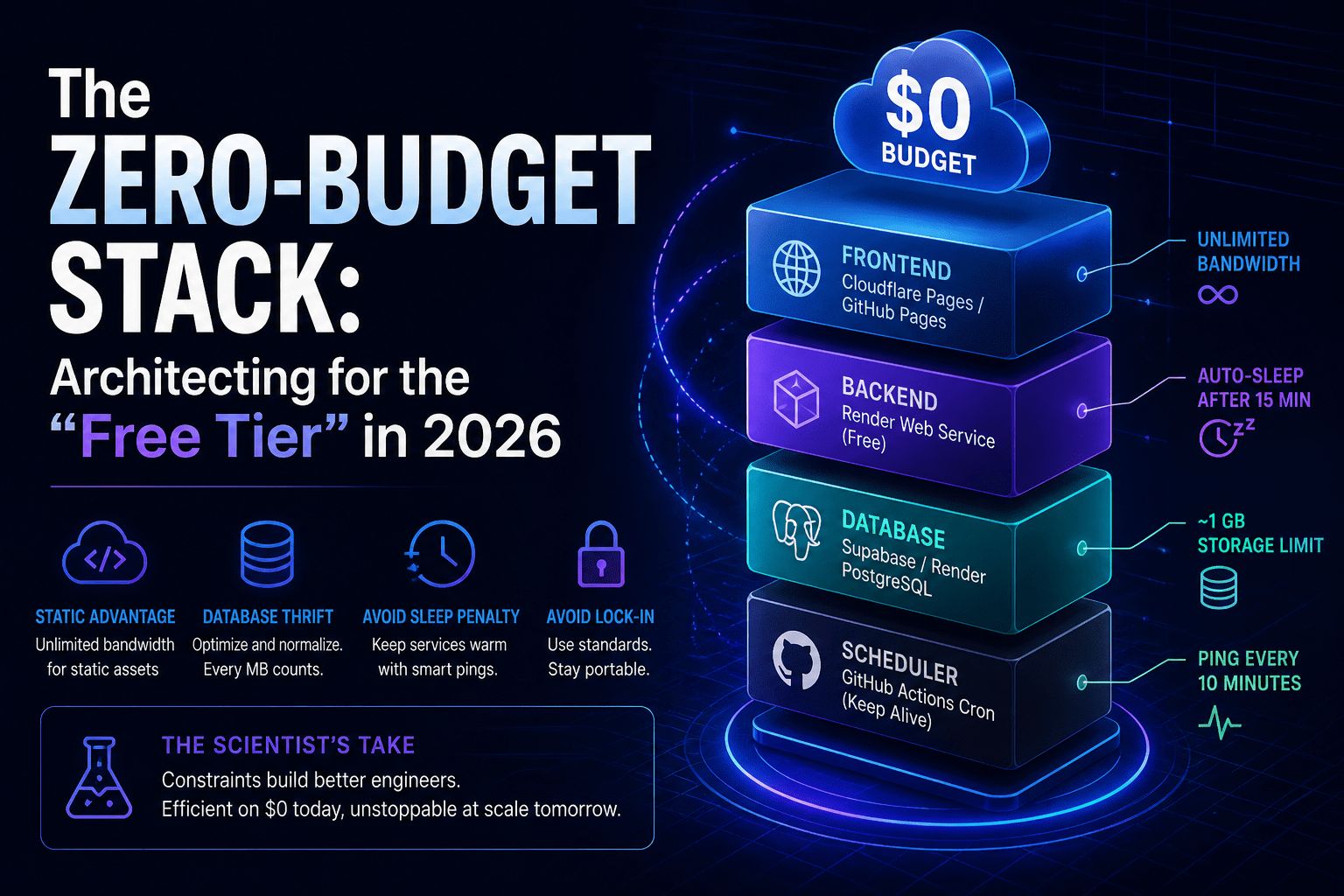
You can run a production-grade MVP or personal site on free tiers if you design for their limits: serve the front end statically from Cloudflare Pages or GitHub Pages, use a free managed PostgreSQL within its storage cap, keep sleeping services warm with a scheduled ping, and avoid proprietary SDKs so you can switch providers with a single push.
The Strategy of Elastic Limits: Maintaining a site on free services requires a shift in how we view resource management. Instead of throwing hardware at a problem, we must optimize for efficiency.
- The Static Advantage: Platforms like Cloudflare Pages or GitHub Pages offer unlimited bandwidth for static assets. By offloading your frontend here, you ensure your site remains up even if your backend hits a rate limit.
- Database Thrift: Managed services like Render or Supabase provide high-quality PostgreSQL instances for free, but they come with strict storage caps (usually around 1 GB). This forces you to be disciplined—normalization isn’t just “good practice” here; it’s a survival tactic.
Avoiding the “Sleep” Penalty: Many free-tier web services (like Render’s free web services) spin down after 15 minutes of inactivity. This creates a “cold start” delay for your visitors. A common architectural workaround is using a Cron Job (often available for free via GitHub Actions) to “ping” your service every 10 minutes, keeping the container warm and the response times low.
The Lock-in Trap: The danger of “free” is the proprietary hook. Services like Firebase make it incredibly easy to start, but their specific SDKs make it incredibly hard to leave. As a scientist, I advocate for Standardized Protocols. Use Docker-ready services. Use vanilla PostgreSQL. Use standard PHP-FPM. If a free provider changes their terms, you should be able to migrate your entire stack with a single git push.
The Scientist’s Take: on Architecture is the art of working within constraints. Building a high-performance system on a $0 budget isn’t just about saving money—it’s a stress test for your logic. If your code is efficient enough to run on a free tier, it will be a powerhouse when you finally scale to paid infrastructure.
Frequently asked questions
Can you run a production website on free tiers?
Yes, for MVPs and personal sites, if you offload the front end to static hosting, stay within database storage caps and design for rate limits and cold starts.
How do you avoid cold starts on free hosting?
Many free web services sleep after a period of inactivity. A scheduled job, for example in GitHub Actions, can ping the service regularly to keep it warm.
How do you avoid vendor lock-in on free tiers?
Use standard, portable building blocks such as Docker, vanilla PostgreSQL and PHP-FPM, so you can migrate if a provider changes its terms.