The Most Important AI Tools for Software Development Teams
A practical guide to the AI tools software teams should evaluate: coding assistants, code review, testing, documentation and DevOps, and where each adds value.
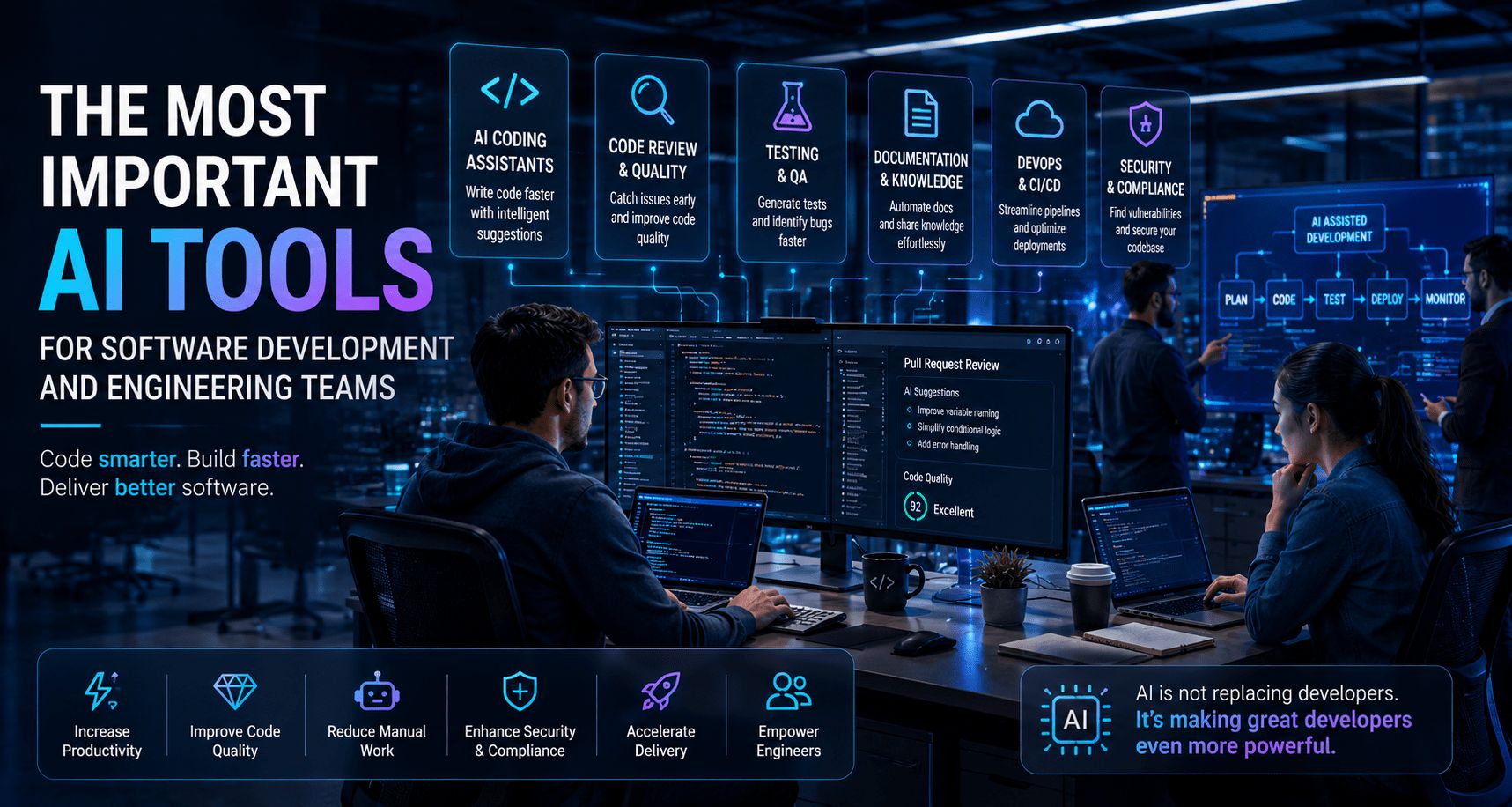
The AI tools that matter most to software teams fall into five groups: coding assistants such as GitHub Copilot, Cursor and Claude Code; code review and quality tools; AI-assisted testing; documentation and knowledge tools; and AI for DevOps. Choose them by the value they add while keeping engineering quality, security and governance intact.
The question for engineering leaders is no longer “Should we adopt AI?” It has become “Which AI tools create the most value while maintaining engineering quality, security, and governance?”
This guide explores the most important AI tools every software development organization should evaluate in 2026 and explains where each tool delivers the greatest business impact.
Why AI Has Become Essential for Software Engineering
Software teams face increasing pressure to deliver features faster without compromising quality. AI reduces repetitive work, accelerates development cycles, improves collaboration, and enables engineers to spend more time solving complex business problems instead of writing boilerplate code.
Categories of AI Tools Every Engineering Team Needs
| Category | Primary Benefit |
|---|---|
| AI Coding Assistants | Faster code generation |
| AI Code Review | Improve quality and consistency |
| AI Testing | Generate and optimize test cases |
| AI Documentation | Automate technical documentation |
| AI DevOps | Infrastructure and deployment assistance |
| AI Security | Detect vulnerabilities earlier |
| AI Knowledge Assistants | Accelerate onboarding and documentation search |
Top AI Coding Assistants
AI coding assistants have become the foundation of AI-powered software development. They generate code, explain unfamiliar logic, suggest improvements, write unit tests, and accelerate development across multiple programming languages.
| Tool | Best for | Impact |
|---|---|---|
| GitHub Copilot | In-editor completions and chat across the most popular IDEs | Very High |
| Cursor | An AI-first editor with codebase-aware, multi-file edits | High |
| JetBrains AI Assistant | Teams standardised on JetBrains IDEs | Growing Rapidly |
| Claude Code | Agentic, multi-step changes driven from the terminal | Extremely High |
AI Tools for Code Review and Quality
Modern engineering teams increasingly use AI to review pull requests, identify bugs, detect code smells, improve maintainability, and enforce coding standards before software reaches production.
🔍 CodeRabbit
- Automated pull request reviews
- Context-aware code suggestions
- Review summaries and issue detection
📊 SonarQube
- Code quality analysis
- Maintainability monitoring
- Technical debt identification
🛡️ Snyk
- Security vulnerability scanning
- Dependency risk analysis
- Secure coding recommendations
AI Tools for Testing and QA
Testing remains one of the most time-consuming activities in software development. AI accelerates test generation, regression testing, and defect prediction while improving software reliability.
- 🤖 Testim
- 🧪 Mabl
- ⚡ Diffblue Cover
- 🔍 Applitools
- 📈 Launchable
- ✅ Selenium AI Extensions
AI for Documentation and Knowledge Sharing
Engineering knowledge is often scattered across repositories, internal wikis, tickets, architecture documents, and team conversations. AI-powered documentation tools help organize that information, generate technical explanations, summarize changes, and make knowledge easier to access.
These tools are especially valuable for onboarding new developers, maintaining API documentation, explaining legacy code, and reducing dependency on a small number of senior engineers who hold critical institutional knowledge.
📚 Swimm
- Living code documentation
- Repository knowledge sharing
- Faster developer onboarding
📝 Mintlify
- AI-assisted API documentation
- Developer portal creation
- Documentation search and discovery
🧠 Source graph Cody
- Codebase-aware explanations
- Repository search and context
- Legacy code understanding
AI for DevOps and Cloud Operations
| AI DevOps Tool | Primary Capability |
|---|---|
| Harness AI | CI/CD Optimization |
| Dynatrace Davis AI | Observability |
| Datadog AI | Incident Analysis |
| New Relic AI | Root Cause Detection |
| PagerDuty AI | Incident Response |
How to Roll Out AI Tools Without Losing Quality
Buying licences is the easy part. Teams that get lasting value treat AI tools like any other engineering change:
- Pilot with one team and a baseline: record lead time, review time and defect rate before you start.
- Set data rules first: decide which repositories and data may be sent to which tools, and prefer business plans that don’t train on your code.
- Keep humans accountable: AI-generated code goes through the same reviews, tests and security scans as any other code.
- Measure, then scale: expand to more teams when the metrics improve, not when the demos impress.
- Review every quarter: the market moves fast; re-check costs, adoption and new options rather than locking in for years.
The right AI toolset is the one your engineers actually use, your security team can approve, and that measurably shortens the path from idea to production.
Frequently asked questions
What are the most important AI tools for software development teams?
AI coding assistants; code review and quality tools such as CodeRabbit, SonarQube and Snyk; AI-assisted testing tools; documentation tools such as Swimm, Mintlify and Sourcegraph Cody; and AI for DevOps and cloud operations.
Do AI coding tools replace developers?
No. The best teams use them to remove repetitive work, accelerate learning and improve quality, while engineers keep responsibility for design, review and production outcomes.
How should a team choose AI development tools?
Start from the bottleneck you want to remove, then compare tools on the value they deliver, how they handle security and data, and how well they fit existing review and governance processes.