The Coming Shift From Software Development to Software Orchestration
As AI writes more of the code, engineering shifts from producing code to orchestrating it: specifying intent, setting constraints and verifying results.
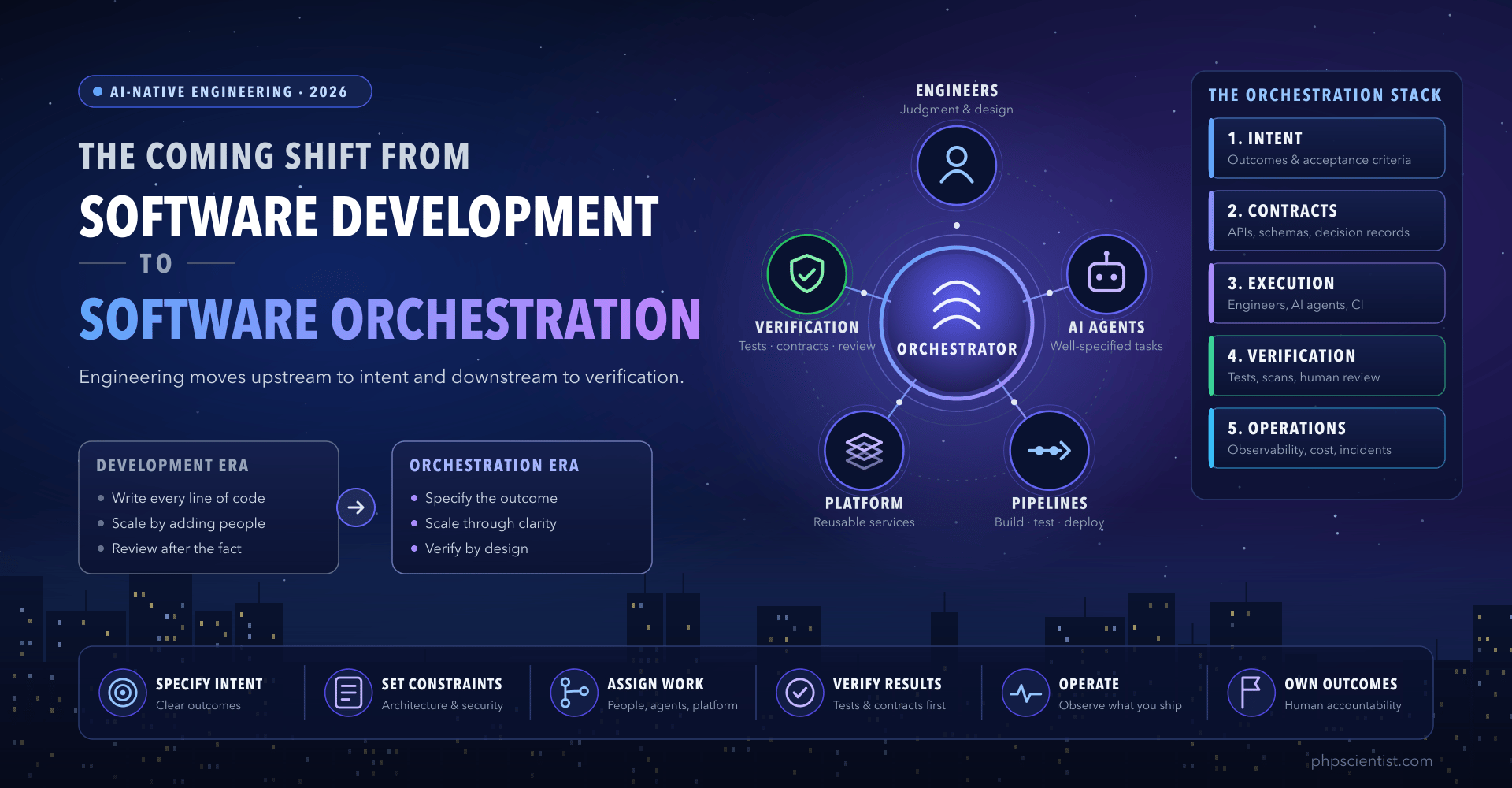
Software orchestration is the practice of directing a system of engineers, AI coding agents, automated pipelines and platform services toward an outcome, instead of writing most of the code by hand. As AI takes over more of the implementation, the scarce skill moves from producing code to specifying intent, designing constraints and verifying that the result is correct.
- 5
- layers in the orchestration stack
- 6
- core orchestration practices
- 90 days
- to pilot it on one workflow
- 4
- delivery metrics to track
This is not a prediction that developers disappear. It is a change in where engineering effort goes. For decades, the bottleneck in software delivery was the time it took skilled people to turn a requirement into working code. That bottleneck is moving. Code is becoming cheap to produce; knowing whether it is the right code, whether it is safe, and whether it fits the rest of the system is not.
Teams that recognize this early will reorganize around it. Teams that don't will generate more code than they can understand, review or operate.
What changes when code becomes cheap
AI coding assistants and agents can now produce a plausible first draft of a feature, a test suite, a migration or a refactoring in minutes. The economics of software change accordingly: the cost of a first draft has collapsed, but the cost of a wrong draft that reaches production has not changed at all.
Getting cheaper
- First drafts of features and services
- Boilerplate, tests and documentation
- Refactoring and migrations
- Exploring alternative designs
Not getting cheaper
- Knowing the code is correct
- Security and compliance review
- Keeping the whole system coherent
- Owning behavior in production
| Dimension | Development era | Orchestration era |
|---|---|---|
| Unit of work | Lines of code written by a person | A well-specified task, executed by a person, an agent or an existing service |
| Bottleneck | Implementation capacity | Specification quality and review capacity |
| Core skill | Writing correct code | Decomposing problems, setting constraints, verifying results |
| Quality gate | Code review after the fact | Acceptance tests, contracts and automated checks defined up front |
| How teams scale | Add engineers | Add clarity: better specs, tests and platform capabilities |
| Typical failure | Slow delivery | Fast delivery of code nobody fully understands |
The shift is already visible in how AI moves from autocomplete into the delivery workflow. The question is no longer whether AI can write the code. It is who decides what gets written, and how anyone knows it works.
One feature, two ways
Take a familiar request: add single sign-on to the admin panel of a B2B SaaS product. Here is how the same work looks in each model.
The development way
- A developer picks up the ticket and starts coding
- Questions about requirements are settled in chat along the way
- Tests are written once the implementation works
- Design gaps surface late, in QA or after release
The orchestration way
- Acceptance criteria and the identity contract are written first
- Constraints are explicit: approved OIDC library, session rules, audit logging
- An agent drafts the integration; an engineer owns the design
- Contract tests and a security checklist gate the merge
Both teams ship single sign-on. The difference is where the thinking happens and what the team knows when it ships. The orchestrated version leaves behind a specification, tests and an audit trail that make the next change cheaper, and it is safe to let an agent do the typing because the boundaries are written down. (If you are choosing the sign-in approach itself, see the authentication methods SaaS products need.)
What a software orchestrator actually does
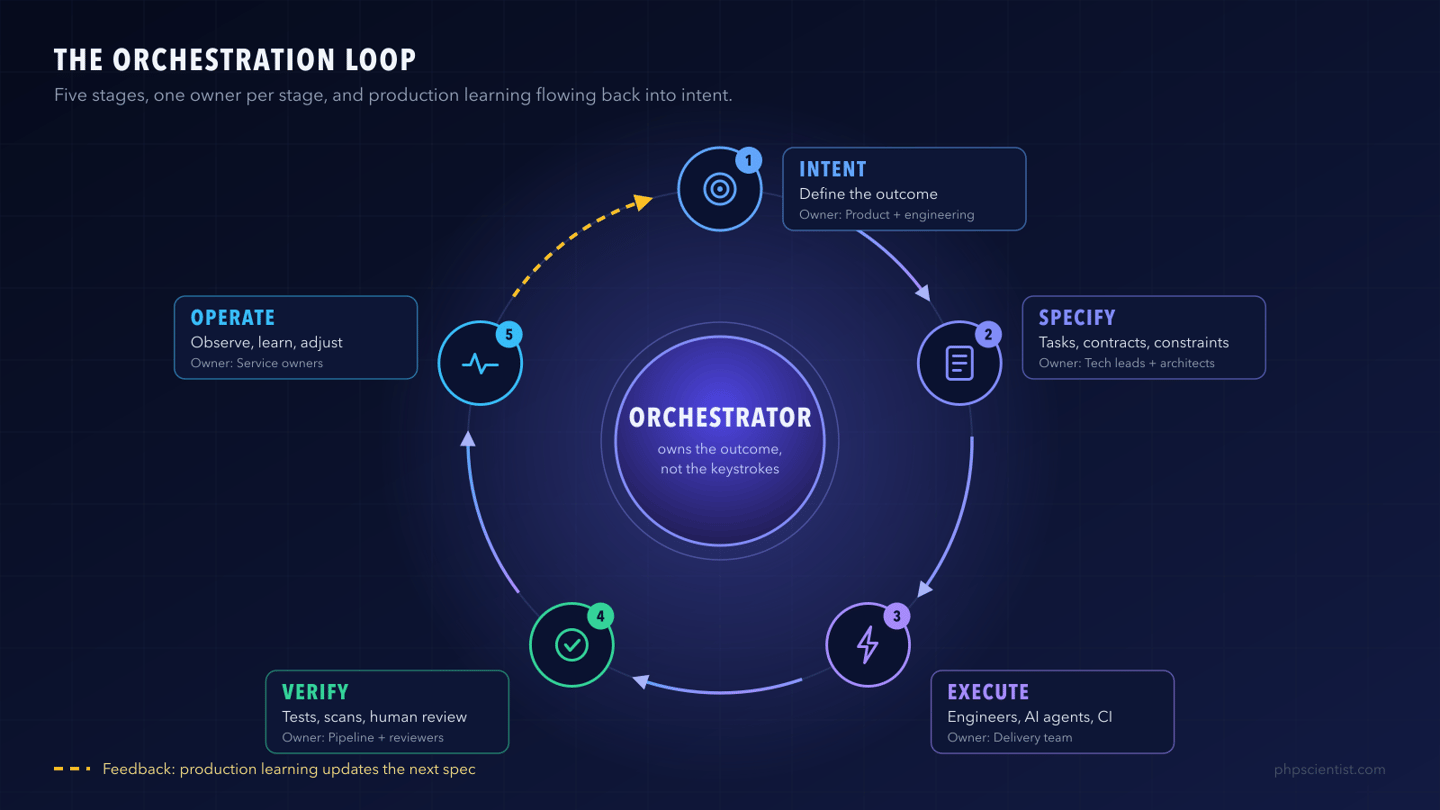
An orchestrator owns an outcome, not a file. Their work falls into five jobs:
Decompose
- Turn business outcomes into precise, testable tasks
- Write acceptance criteria before any code exists
- Size work so every piece can be verified on its own
Constrain
- Architecture boundaries and approved patterns
- Security, privacy and performance budgets
Assign
- Senior engineer, AI agent or existing service
- Remove tasks with platform capabilities
Verify
- Acceptance and contract tests first
- Human review where judgment matters
Operate
- Observability and incident ownership
- Feed production learning back into specs
Specification becomes the primary artifact
An AI agent does exactly what the task describes, including the parts the author forgot to think about. Vague requirements used to be absorbed by experienced developers who filled the gaps with judgment. In an orchestrated workflow, those gaps become defects. Acceptance criteria, interface contracts and architecture decision records stop being documentation and become the input to production.
Verification becomes the primary skill
When generating code takes minutes, reviewing it becomes the constraint. Strong orchestrators invest in verification that scales: automated tests written before implementation, contract tests between services, and review checklists that focus human attention on architecture, business logic and security rather than formatting.
Integration becomes the primary risk
Each generated component can be locally correct and still break the system: duplicated logic, inconsistent error handling, a second way of doing authentication. Orchestration requires someone to hold the whole system in mind, which is why architecture skills become more valuable, not less.
When generating code takes minutes, the scarce resource is the attention needed to know it is right.
The orchestration stack
Orchestration is easier to run when a team treats it as a layered system rather than a collection of tools:
| Layer | What it holds | Who owns it |
|---|---|---|
| 1. Intent | Outcomes, acceptance criteria, non-functional requirements | Product and engineering leads together |
| 2. Contracts | APIs, schemas, architecture decision records, coding standards | Architects and tech leads |
| 3. Execution | Engineers, AI coding agents, CI jobs, platform services | The delivery team |
| 4. Verification | Tests, static analysis, security scanning, human review | Everyone, enforced by the pipeline |
| 5. Operations | Observability, incident response, cost and performance | The team that owns the service |
The execution layer is where most attention goes today, but it is the least differentiating. Any team can buy the same AI tools. The advantage comes from the layers around it: clear intent, enforceable contracts and verification that runs automatically. Protocols such as Model Context Protocol make it easier to give agents controlled access to tools and context, but they don't decide what the agents should build.
Is your team ready? A quick self-check
Read each row honestly. If most of your answers sit in the middle column, invest in engineering discipline before adding more AI.
| Signal | Not ready yet | Ready to orchestrate |
|---|---|---|
| Requirements | Live in chats and meetings | Written acceptance criteria for every task |
| Tests | Thin, written after the code | Written first, run on every change |
| Architecture | In a few senior engineers' heads | Documented decisions and enforced boundaries |
| Review | Sized for human output | Checklists, automation and clear ownership |
| Accountability | Unclear when an agent wrote the code | Every change has a named human owner |
None of these are AI problems. They are engineering discipline problems that AI makes urgent. The same pattern explains why many organizations struggle to move from predictable AI workflows to autonomous agents: autonomy only works on top of clear rules.
How roles change
| Role | Shifts from | Shifts toward |
|---|---|---|
| Developer | Writing every line | Specifying tasks, guiding agents, reviewing and integrating results |
| Tech lead | Splitting work across people | Designing tasks and constraints across people and agents |
| QA engineer | Testing finished features | Defining acceptance tests and verification strategy up front |
| Architect | Drawing target-state diagrams | Encoding constraints the pipeline can enforce |
| Engineering manager | Managing people's output | Managing capacity, quality and accountability across humans and agents |
This is why the AI Solutions Architect role is growing, and why managing engineers who use AI assistants requires different metrics. Junior engineers need special attention: if agents take every routine task, people lose the practice that builds judgment. Keep some implementation work deliberately as learning work.
How to start: a 90-day path
You don't need a reorganization to begin. Change how one team handles one workflow, and let the results make the case.
Days 1–30 · Make intent explicit
Pick one workflow. Write acceptance criteria and tests before any implementation, and record today's lead time and rework rate as a baseline.
Days 31–60 · Add agents behind the same gates
Let AI agents take well-specified tasks, with mandatory review. Add contract tests at service boundaries so generated changes are checked automatically.
Days 61–90 · Standardize and measure
Turn what worked into task templates and review checklists. Compare delivery metrics with the baseline before widening the approach.
Measure outcomes, not output. Lines of code and pull-request counts rise automatically when agents write code; they say nothing about value. Track a small set of delivery metrics instead:
- Lead time for changes
- Change failure rate
- Rework rate
- Time waiting for review
The first two are part of the widely used DORA delivery metrics. Rework and review time show whether verification is keeping pace with generation.
Risks to manage
- Security and intellectual property: decide what code and data agents can see, and what they may send to external services.
- Skill atrophy: teams that stop practicing implementation lose the judgment needed to review it.
- Cost: agent usage is metered, and unbounded experimentation gets expensive.
- Accountability: every change still needs a human owner. An AI governance framework should say so explicitly.
Final thoughts
The shift from software development to software orchestration is less about AI writing code and more about where engineering judgment is applied. The work moves upstream into clear intent and enforceable constraints, and downstream into verification and operation.
The organizations that benefit most will not be the ones generating the most code. They will be the ones that can say precisely what they want, prove that they got it, and keep the whole system coherent while it changes faster than ever.
Frequently asked questions
What is software orchestration?
Software orchestration is directing a system of engineers, AI coding agents, pipelines and platform services toward an outcome: specifying tasks, setting constraints and verifying results, instead of hand-writing most of the code.
Will AI replace software developers?
No. AI takes over more implementation work, but someone still has to decide what to build, define constraints, verify correctness and own production behavior. The developer role shifts toward those responsibilities.
What skills does a software orchestrator need?
Problem decomposition, writing precise specifications and acceptance criteria, architecture and system design, test and verification strategy, security awareness and the judgment to review AI-generated code.
How should a team start moving toward orchestration?
Pick one workflow, write acceptance criteria and tests before implementation, let AI agents take well-specified tasks behind mandatory review, and track lead time, change failure rate and rework rather than lines of code.