
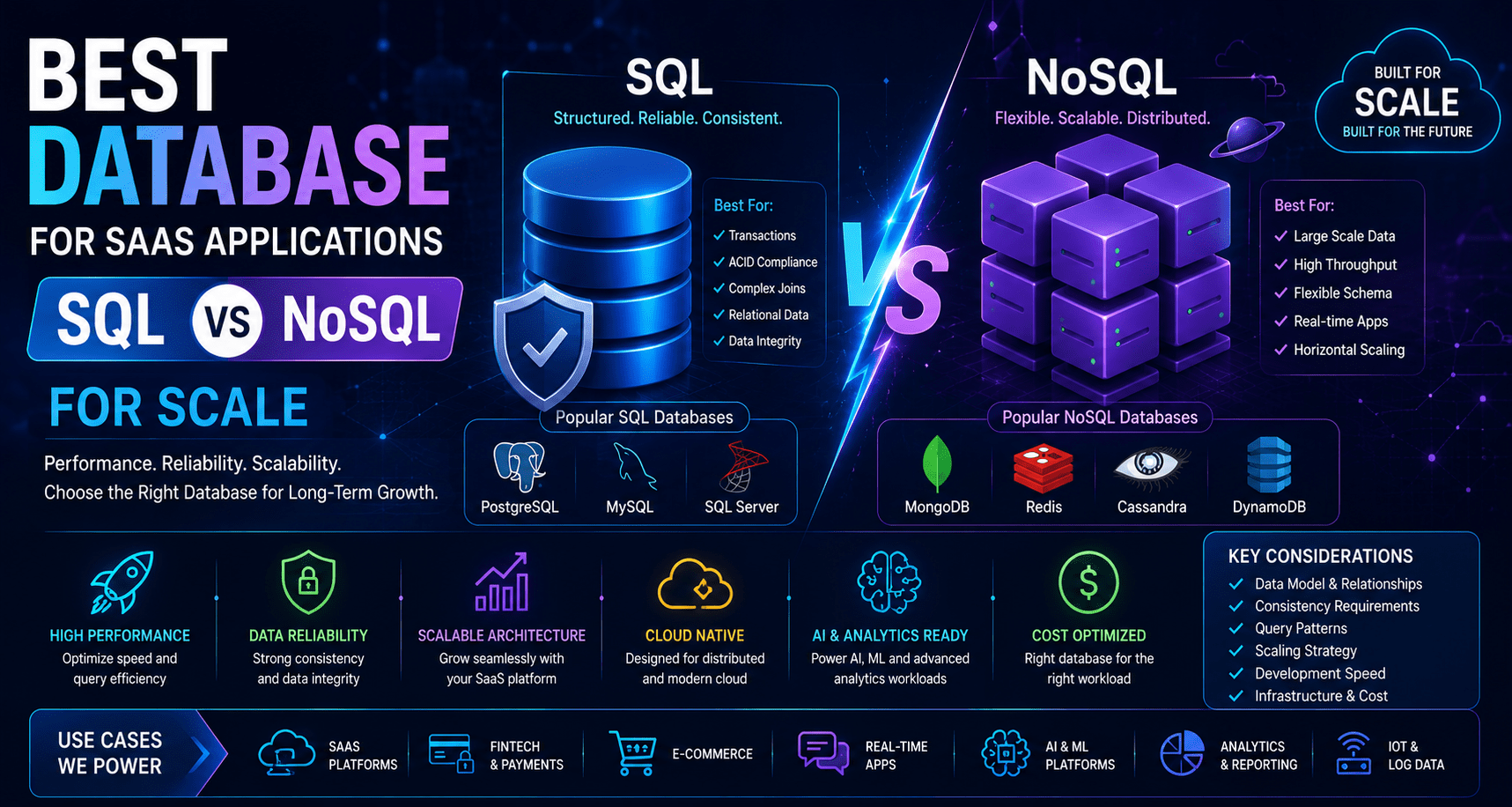
Choosing the right database architecture is one of the most important technical decisions when building a scalable SaaS application.
In 2026, the database layer no longer simply stores application data.
Modern SaaS databases must support:
- Multi-tenancy
- Real-time workloads
- AI-driven applications
- Distributed systems
- Analytics
- High availability
- Massive concurrency
- Global scalability
- Intelligent automation
The debate is no longer simply:
“SQL vs NoSQL.”
The real question is:
“What data architecture best supports long-term SaaS scalability?”
The answer depends heavily on:
- Product type
- Data complexity
- Growth strategy
- AI requirements
- Operational scale
- Query patterns
- Infrastructure maturity
Modern SaaS systems increasingly combine both SQL and NoSQL databases strategically.
Understanding SQL vs NoSQL
SQL Databases
SQL databases are relational systems designed around:
- Structured schemas
- ACID transactions
- Relational integrity
- Complex querying
- Data consistency
Popular SQL databases include:
- PostgreSQL
- MySQL
- MariaDB
- Microsoft SQL Server
NoSQL Databases
NoSQL systems are designed for:
- Flexible schemas
- Horizontal scalability
- Large distributed workloads
- High-speed ingestion
- Unstructured data
Popular NoSQL databases include:
- MongoDB
- Cassandra
- DynamoDB
- Couchbase
- Redis
Why Database Choice Matters in SaaS
Your database architecture directly affects:
- Application scalability
- Product performance
- Infrastructure cost
- AI readiness
- Multi-tenancy
- Analytics capability
- Development speed
- Long-term maintainability
Choosing the wrong database model can create:
- Scaling bottlenecks
- Operational complexity
- Expensive migrations
- Performance limitations
- Data consistency problems
Why SQL Databases Still Dominate SaaS
Despite NoSQL growth, SQL databases continue powering a large percentage of modern SaaS applications.
Especially:
- Enterprise SaaS
- Financial systems
- CRM platforms
- Subscription platforms
- ERP systems
- Operational business systems
Why PostgreSQL Is Becoming the SaaS Default
PostgreSQL has become one of the strongest database choices for modern SaaS applications because it combines:
- Relational reliability
- Advanced indexing
- JSON support
- Analytical capabilities
- Scalability
- AI compatibility
PostgreSQL increasingly behaves like a hybrid database platform.
Advantages of SQL for SaaS Applications
| SQL Strength | Why It Matters |
|---|---|
| Strong consistency | Critical for transactional systems |
| ACID compliance | Prevents data corruption |
| Complex queries | Better reporting and analytics |
| Mature ecosystem | Long-term operational stability |
| Structured relationships | Ideal for SaaS business logic |
| Strong tooling | Easier maintenance and observability |
SQL databases are especially strong for:
- Billing systems
- Subscription management
- Financial operations
- RBAC systems
- Enterprise workflows
- Transaction-heavy applications
Where NoSQL Excels
NoSQL databases perform exceptionally well in:
- High-scale distributed systems
- Flexible data models
- Event-driven architectures
- Real-time systems
- AI workloads
- Massive ingestion pipelines
Advantages of NoSQL for SaaS Applications
| NoSQL Strength | Why It Matters |
|---|---|
| Horizontal scaling | Better distributed scalability |
| Flexible schema | Faster iteration |
| High write throughput | Real-time workloads |
| Large-scale distribution | Global applications |
| Unstructured data support | AI and content systems |
| Event stream compatibility | Modern architecture support |
NoSQL is often ideal for:
- Chat systems
- Activity feeds
- IoT platforms
- AI-generated content
- Logging systems
- Analytics ingestion
- Recommendation systems
The Biggest Mistake: Treating It as “Either/Or”
Modern SaaS architecture increasingly uses:
- SQL + NoSQL together
- Specialized data systems
- Polyglot persistence
Most large SaaS applications now combine:
- Relational databases
- Cache layers
- Search systems
- Analytics databases
- Vector databases
- Event stores
The future is hybrid architecture.
Modern SaaS Database Architecture Example
| Layer | Recommended Database |
|---|---|
| Core Business Data | PostgreSQL |
| Cache Layer | Redis |
| Search | Elasticsearch / OpenSearch |
| AI Retrieval | Vector Database |
| Event Streaming | Kafka |
| Analytics | ClickHouse |
Each system handles different operational workloads efficiently.
SQL vs NoSQL for Multi-Tenant SaaS
Multi-tenancy is one of the most important SaaS database considerations.
SQL Multi-Tenancy Strengths
SQL databases work extremely well for:
- Tenant isolation
- RBAC
- Transactional workflows
- Enterprise reporting
- Subscription systems
Popular models include:
- Shared schema
- Schema-per-tenant
- Database-per-tenant
NoSQL Multi-Tenancy Strengths
NoSQL systems perform well for:
- Large-scale tenant data
- High-volume ingestion
- Flexible content models
- Massive user activity systems
However, relational consistency can become more difficult.
AI Is Changing Database Requirements
One of the biggest changes in 2026:
AI workloads are reshaping database architecture.
Modern SaaS applications increasingly require:
- Semantic search
- Vector embeddings
- AI memory systems
- Retrieval pipelines
- Real-time contextual data
Traditional relational databases alone are often insufficient for these workloads.
The Rise of Vector Databases
AI-native SaaS applications increasingly use:
- Pinecone
- Weaviate
- Chroma
- pgvector
- Milvus
These systems help power:
- AI copilots
- Semantic search
- AI recommendations
- Retrieval-Augmented Generation (RAG)
- Intelligent workflows
Performance Considerations
SQL Performance
Modern SQL databases perform extremely well when:
- Indexed correctly
- Architected properly
- Optimized operationally
PostgreSQL can scale surprisingly far before requiring distributed architecture.
NoSQL Performance
NoSQL systems excel when:
- Write volume is massive
- Global distribution is required
- Schemas change frequently
- Real-time ingestion dominates
However, operational complexity may increase significantly.
Infrastructure Complexity Matters
One overlooked factor:
Operational simplicity.
Many teams prematurely adopt:
- Complex distributed NoSQL systems
- Microservices-heavy databases
- Over-engineered architectures
This often increases:
- Infrastructure cost
- Maintenance overhead
- Engineering complexity
For many SaaS products:
A well-architected PostgreSQL system is sufficient for years.
Recommended Database Choices by SaaS Type
| SaaS Type | Best Database Strategy |
|---|---|
| Enterprise SaaS | PostgreSQL |
| Financial SaaS | PostgreSQL |
| AI SaaS | PostgreSQL + Vector DB |
| Realtime Collaboration | PostgreSQL + Redis |
| Social Platforms | SQL + NoSQL Hybrid |
| Analytics Platforms | ClickHouse + PostgreSQL |
| Content Platforms | MongoDB + Search Systems |
What Winning SaaS Companies Are Doing
| Winning Strategy | Why It Works |
|---|---|
| Starting simple | Reduces operational overhead |
| Using PostgreSQL first | Strong scalability balance |
| Adding specialized databases gradually | Improves operational maturity |
| Separating workloads | Better scalability |
| Using Redis strategically | Faster performance |
| Designing AI-ready architecture | Future-proofs the platform |
SQL vs NoSQL: Which One Wins?
The answer in 2026 is:
Neither wins alone.
The strongest SaaS architectures increasingly use:
- SQL for transactional integrity
- NoSQL for scale and flexibility
- Vector systems for AI workloads
- Cache systems for performance
- Search systems for discovery
The future database architecture is hybrid.
Final Thoughts
The best database for SaaS applications depends less on hype and more on:
- Workload characteristics
- Product goals
- Scalability needs
- AI requirements
- Operational maturity
For most SaaS companies:
PostgreSQL remains one of the strongest starting points because it balances:
- Reliability
- Scalability
- Simplicity
- Flexibility
- AI readiness
The future of SaaS data architecture is not about choosing one database.
It is about building intelligent data ecosystems that evolve with the product.