What is an AI agent?
Short answer
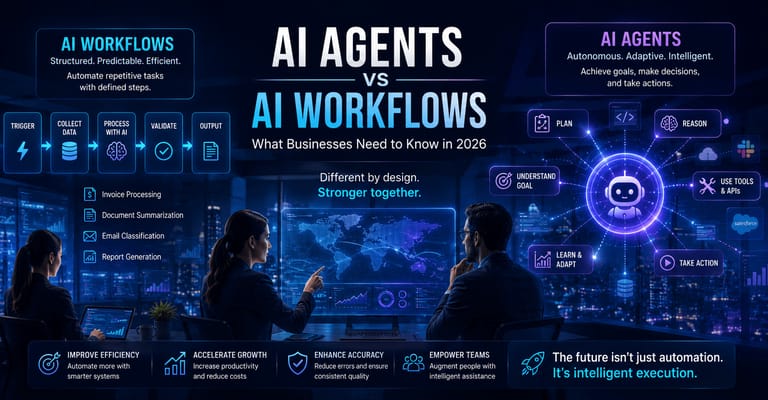
An AI agent is software that uses a large language model to pursue a goal on its own: it decides which steps to take, calls tools such as APIs, search or code, looks at the results, and repeats until the task is done or it needs a person. Unlike a chatbot, it acts rather than only replying.
How an AI agent works
At its core an agent is a loop:
- The model reads the goal, the conversation so far and a list of available tools.
- It chooses an action, such as calling
search_flightswith some arguments, or decides it is finished. - Your code runs the tool and returns the result to the model.
- The loop repeats until the goal is met, a step limit is reached, or a person must approve something.
Tools are often provided through tool calling or an MCP server; memory and planning are added around this loop.
Agent or workflow?
If you can draw the steps in advance (“extract the invoice, validate it, post it to the ledger”), a workflow that calls a model at fixed points is cheaper, faster and easier to test. Use an agent when the path genuinely depends on what it finds along the way, such as investigating a support case across several systems.
Designing agents that are safe to run
- Give each agent the narrowest set of tools and permissions it needs.
- Cap steps, time and cost per run.
- Require human approval for irreversible actions: payments, emails, deletions.
- Log every tool call with its inputs and outputs for review.
Frequently asked questions
What is the difference between an AI agent and a chatbot?
A chatbot answers messages. An agent works towards a goal: it plans steps, calls tools and acts on the results, often across several systems, with a chat window being optional.