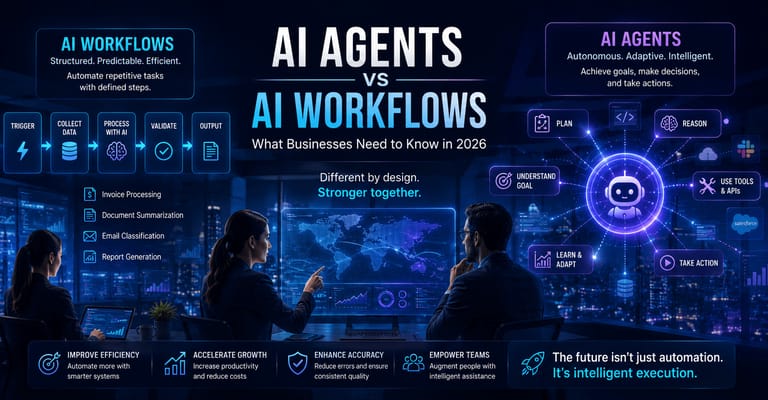
Agentic AI in Digital Transformation: How to Automate Workflows Without Creating Agent Sprawl
Agentic AI is becoming the next digital transformation battleground. This playbook shows how to automate workflows with governance, measurable value and human control built in.

The next wave of digital transformation is not another dashboard, migration programme or isolated AI assistant. It is the controlled handoff of work between people, systems and AI agents that can observe a process, decide the next step and trigger action.
That shift creates a real opportunity for companies that have already invested in cloud, APIs and data platforms. It also creates a new operational risk: agent sprawl. When every team launches its own autonomous helper, the enterprise can end up with duplicated decisions, hidden permissions and automation that nobody truly owns.
- 40%
- Enterprise apps expected to include task-specific AI agents by 2026, according to Gartner
- 3 layers
- Workflow, control and measurement layers needed before agents can scale safely
- 1 owner
- Every production agent needs a named business owner and a technical owner
Why agentic AI is now a transformation issue
AI agents are moving automation from scripted tasks to goal-oriented work. Instead of asking software to follow a fixed path, teams can ask an agent to assemble context, choose a tool, complete a step and escalate exceptions. That matters because most transformation bottlenecks are not inside one system. They sit between systems.
Invoice disputes, customer onboarding, inventory exceptions, compliance reviews and support escalations usually require data from several tools, judgment from people and a reliable audit trail. Agentic AI is attractive because it can operate across that messy middle.
Workflow ownership
- Map the workflow before choosing the model
- Define what the agent can decide, recommend or never touch
- Give every agent an accountable owner
Control plane
- Limit tools and permissions by role
- Log every action and source
- Require approvals for money, access and customer-impacting steps
Value tracking
- Measure cycle time, rework and exception rates
- Track human override reasons
- Retire agents that do not move a business metric
Continuous tuning
- Review failures weekly
- Refresh prompts and tools as the process changes
- Use incidents to improve guardrails
The architecture: agents need boundaries, not freedom
A common mistake is to frame autonomy as a spectrum from low to high. The better question is where autonomy is allowed. A useful agent can have broad context but narrow authority. It can read a complete customer history while only being allowed to draft a response. It can identify a payment anomaly while requiring a finance approver before releasing funds.
A 90-day rollout model for safe automation
Days 1-30: Find the workflow wedge
Choose one process with a clear owner, high repetition and painful handoffs. Document the current journey, exceptions, systems, data quality and decision rights.
Days 31-60: Build the governed agent
Connect only the tools required for the workflow. Add approval gates, logging, fallback paths and evaluation examples before expanding scope.
Days 61-90: Measure and harden
Run the agent alongside the existing process. Track time saved, error reduction, override reasons, adoption and customer or employee impact.
Metrics that separate transformation from experimentation
- Cycle-time reduction: how many hours or days are removed from the end-to-end process.
- Exception quality: whether the agent catches issues earlier than the old workflow.
- Human override rate: the percentage of decisions that require correction and why.
- Cost to serve: the operating cost per transaction, ticket, claim or request.
- Trust indicators: user adoption, escalation quality and incident frequency.
The leadership decision
The winners will not be the companies with the largest number of AI agents. They will be the companies that make agents part of a disciplined operating model. Digital transformation in 2026 is less about proving that AI can act and more about proving that the business can govern action at scale.
Frequently asked questions
What is agentic AI in digital transformation?
Agentic AI in digital transformation means using AI systems that can plan, decide and act inside business workflows. The value comes from governed execution, not from adding isolated chatbots to every department.
How do companies avoid agent sprawl?
Companies avoid agent sprawl by treating agents as governed products with owners, permissions, observability, risk controls and retirement rules. Every agent should map to a measurable business workflow.
Which workflows should be automated first?
Start with high-volume workflows that have clear rules, clean data and measurable cycle-time or quality impact. Avoid automating ambiguous decisions until the control model is mature.