Digital Transformation ROI in 2026: The Operating Model That Turns AI Pilots Into Growth
Digital transformation ROI now depends on operating discipline. Learn how leaders can connect AI pilots, governance, adoption and metrics to real growth in 2026.

Digital transformation ROI has become harder to fake. In the early cloud and SaaS era, a company could point to migration, tool adoption or process digitisation as evidence of progress. In 2026, boards want a sharper answer: what changed in the business?
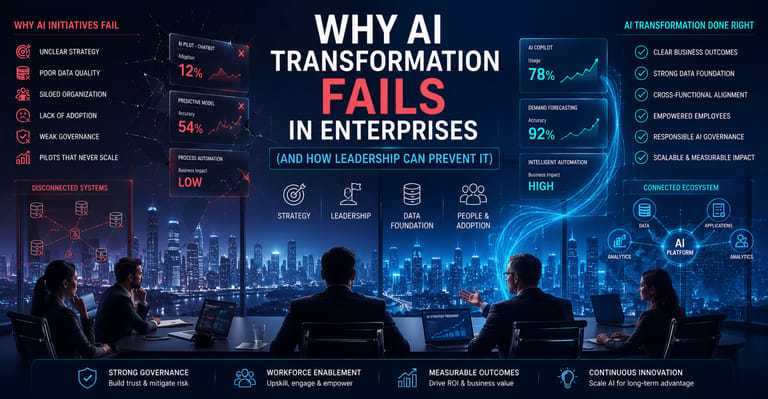
That question is especially urgent for AI. Many organisations now have pilots, copilots and automation experiments. Far fewer have a repeatable operating model that turns those experiments into measurable growth, lower cost, better customer experience or faster decision-making.
- 75%
- Top technology performers shift spending to capture digital or business benefits, according to McKinsey
- 11%
- Organisations with AI agents already in production in Deloitte research cited for 2026 trends
- 5 metrics
- Revenue, cost, speed, quality and risk should anchor every transformation scorecard
The ROI problem is usually an operating model problem
Low ROI rarely means the technology was useless. More often, the organisation never changed the workflow, incentives, governance or adoption model around it. AI makes this gap obvious because model capability can move faster than organisational capability.
A pilot can generate impressive outputs in a controlled setting. Production value requires new behaviours: people need to trust the output, managers need to redesign work, security teams need visibility and finance needs a credible measurement model.
Value hypothesis
- Name the business metric before funding the pilot
- Define the baseline
- Set a decision point for scaling or stopping
Workflow redesign
- Change the process, not only the tool
- Remove duplicate approvals
- Clarify human and AI decision rights
Outcome scorecard
- Track adoption and realised value
- Measure cost-to-serve and quality
- Report leading and lagging indicators
Governance rhythm
- Review risk and incidents monthly
- Update controls as usage grows
- Retire weak initiatives quickly
A portfolio model for transformation bets
Instead of funding disconnected pilots, leaders should run transformation as a portfolio of bets. Each bet needs a value owner, a technical owner, a measurable outcome, a production path and an adoption plan. This makes it easier to compare initiatives and stop the ones that consume energy without changing performance.
Frame the business outcome
Start with a value pool: revenue leakage, manual service cost, slow onboarding, inventory waste, compliance effort, churn or engineering throughput.
Design the future workflow
Map the human, AI and system responsibilities. Decide what changes in the daily work, not just what software is introduced.
Instrument the value path
Capture baseline metrics before launch. Measure adoption, quality, speed, financial impact and risk signals after launch.
Scale what proves value
Move funding, leadership attention and platform support toward the initiatives that demonstrate repeatable business impact.
The five metrics every executive should ask for
- Revenue impact: conversion, retention, expansion, pricing quality or sales productivity.
- Cost-to-serve impact: labour hours, rework, ticket volume, exception handling and automation yield.
- Speed impact: cycle time, release frequency, decision latency and onboarding time.
- Quality impact: error rate, customer satisfaction, compliance accuracy and incident volume.
- Capability impact: reusable platform services, data products, automation patterns and employee adoption.
Scale, fix or stop: the quarterly review
A portfolio only works if bets can end. Review every initiative each quarter against the same three outcomes, and record the decision in writing so the reasoning survives leadership changes.
- Scale when the outcome metric has moved for two consecutive months, the workflow has been redesigned around the change, and adoption is growing without mandates.
- Fix when the technology works but adoption, data quality or the production path is the bottleneck. Give it one more quarter with a named owner for that bottleneck.
- Stop when there is no value owner, the metric has not moved after two quarters, or the cost to operate exceeds the value created. Publish what was learned so the next bet starts further ahead.
Stopping visibly is a sign of discipline, not failure. It frees budget and attention for the bets that are compounding.
What changes in 2026
The market is moving from AI curiosity to AI accountability. Leaders are not asking whether generative AI can produce a useful answer. They are asking whether the company can absorb AI into how work is designed, governed and measured.
That is why the most valuable transformation capability in 2026 may not be a model or a tool. It is the management system that repeatedly turns technology change into business change.
Frequently asked questions
How do you measure digital transformation ROI in 2026?
Measure digital transformation ROI through business outcomes such as revenue lift, cost-to-serve reduction, cycle-time improvement, risk reduction and adoption. Technology delivery metrics should connect to those outcomes.
Why do AI pilots fail to produce ROI?
AI pilots fail to produce ROI when they are not tied to workflow change, ownership, user adoption, production controls or financial metrics. A useful demo is not the same as an operating capability.
What operating model improves transformation ROI?
A product-based operating model improves ROI by giving each transformation bet an owner, value hypothesis, funded team, adoption plan, governance model and measurable business scorecard.