
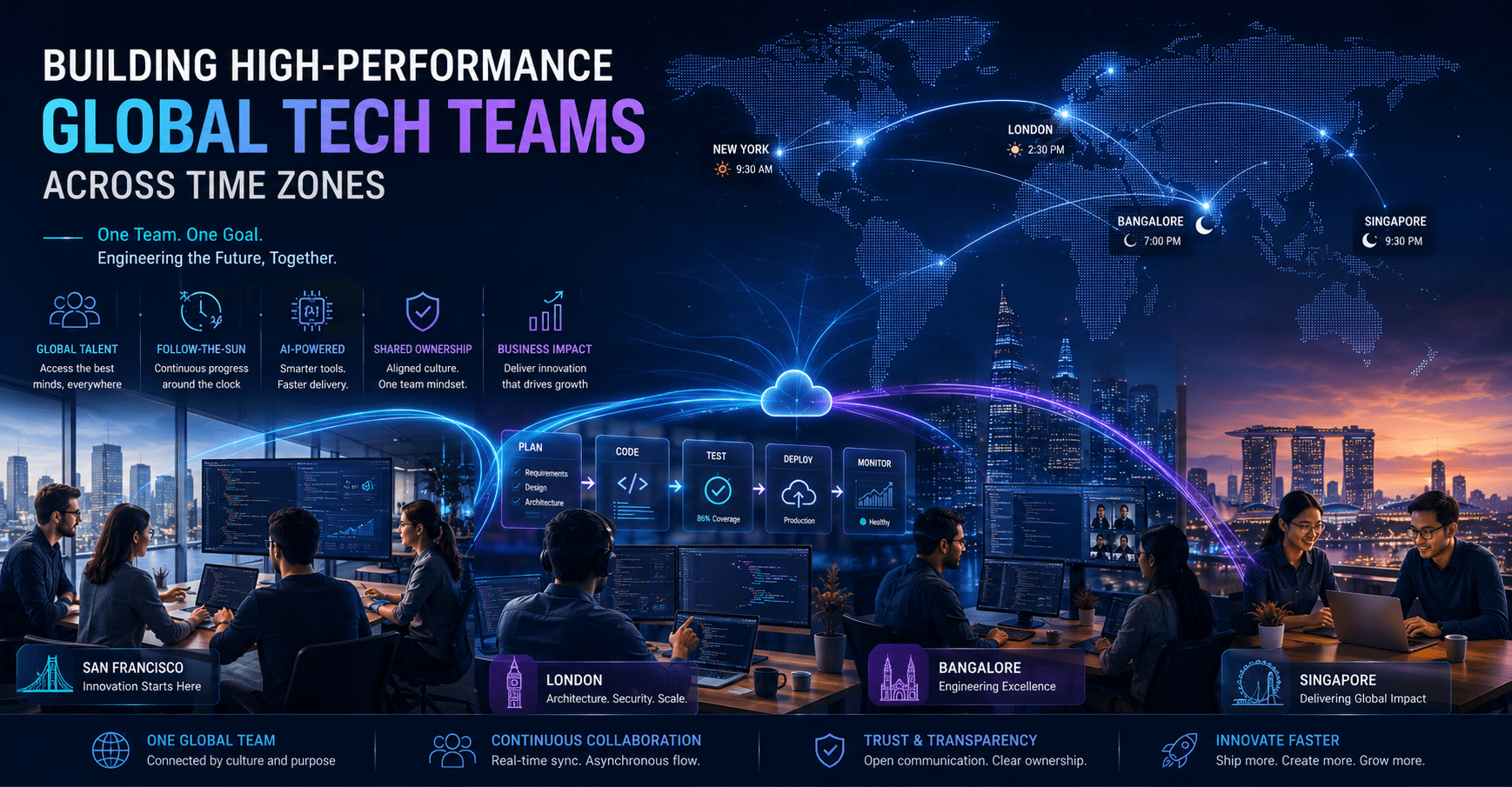
The conversation around global software development has changed dramatically.
For years, organizations viewed offshore engineering primarily as a cost-saving initiative.
Today, the world’s most successful technology companies see it very differently.
They are building high-performance global engineering organizations where talent, experience, and innovation flow seamlessly across continents.
The goal is no longer to find the lowest-cost developers.
The goal is to build engineering teams capable of delivering continuous innovation—regardless of geography.
In today’s AI-powered engineering landscape, experience has become the most valuable resource.
That experience should not remain limited by borders or time zones.
It should become an organization’s competitive advantage.
Or put another way:
Your real engineering experience becomes a global business advantage.
The New Global Engineering Reality
Software development no longer happens between 9 AM and 5 PM in a single office.
Modern engineering organizations operate across:
- North America
- Europe
- India
- Southeast Asia
- Latin America
- Australia
Products are shipped continuously.
Customers expect continuous improvement.
Markets evolve every day.
Engineering teams that only operate within one geography often struggle to maintain this pace.
Global engineering is becoming a strategic capability rather than an operational convenience.
Why Geography Matters Less Than Talent
Cloud platforms…
AI coding assistants…
Modern collaboration tools…
Cloud-native infrastructure…
Everything has changed.
The location of an engineer matters far less than:
- Technical expertise
- Business understanding
- Communication
- Ownership
- Collaboration
- Engineering culture
Organizations increasingly compete for experience rather than geography.
From Offshore Delivery to Global Engineering
The traditional offshore model focused on:
- Lower costs
- Task execution
- Separate delivery centers
- Limited collaboration
Modern engineering organizations build integrated global teams.
| Traditional Offshore Model | High-Performance Global Team |
|---|---|
| Cost optimization | Business acceleration |
| Task ownership | Product ownership |
| Separate teams | One engineering organization |
| Limited collaboration | Continuous collaboration |
| Handoffs | Shared accountability |
| Vendor relationship | Strategic engineering partnership |
This shift fundamentally changes engineering outcomes.
Time Zones Are No Longer a Barrier
One of the biggest misconceptions about distributed engineering is that time zones reduce productivity.
In reality, properly managed global teams often create:
- Faster delivery
- Continuous development
- Better customer support
- Increased innovation
- Reduced release cycles
Instead of waiting until the next business day, work continues around the clock.
The result is a nearly continuous engineering pipeline.
What Makes Global Teams Successful?
Technology alone doesn’t create great distributed teams.
Leadership does.
Successful organizations focus on:
Shared Engineering Culture
Every engineer should understand:
- Business goals
- Product vision
- Customer needs
- Quality expectations
- Security standards
Culture travels farther than process.
Communication First
High-performing global teams prioritize:
- Clear documentation
- Daily collaboration
- Transparent decision-making
- Shared engineering standards
- Asynchronous communication
Communication becomes the operating system of distributed engineering.
Ownership Over Tasks
Instead of assigning isolated tickets, successful organizations give teams ownership of outcomes.
Engineers become responsible for:
- Product quality
- Customer impact
- Performance
- Reliability
- Continuous improvement
Ownership creates engagement.
AI Is Making Global Teams Even Stronger
Generative AI is reducing many of the historical challenges associated with distributed engineering.
AI now helps teams:
- Explain unfamiliar code
- Generate documentation
- Translate technical knowledge
- Improve onboarding
- Accelerate reviews
- Standardize coding practices
The result is faster collaboration across locations.
AI is becoming the universal engineering assistant.
Leadership Changes in Global Teams
Managing distributed engineers requires different leadership skills.
Modern engineering leaders spend less time monitoring activity and more time enabling collaboration.
Successful Leaders Focus On
| Leadership Area | Business Value |
|---|---|
| Outcome-based management | Higher productivity |
| Trust-first culture | Better collaboration |
| AI-enabled workflows | Faster delivery |
| Documentation quality | Easier knowledge sharing |
| Cross-functional communication | Reduced friction |
| Engineering enablement | Higher retention |
Leadership determines whether geography becomes an advantage or an obstacle.
Building Trust Across Time Zones
Trust is one of the most valuable assets inside global engineering organizations.
It is built through:
- Reliable communication
- Shared goals
- Transparent leadership
- Consistent quality
- Mutual accountability
High trust dramatically reduces management overhead.
Why Experience Is Becoming More Valuable Than Cost
The software industry has entered an AI-powered era.
Routine coding is increasingly automated.
What remains uniquely valuable is:
- Engineering judgment
- Product thinking
- Architecture
- Customer understanding
- Leadership
- Problem solving
Organizations are no longer buying hours.
They are investing in experience.
This is where mature global engineering teams create tremendous value.
Common Mistakes Companies Make
Many organizations still approach distributed engineering incorrectly.
Common mistakes include:
| Mistake | Business Impact |
|---|---|
| Measuring hours instead of outcomes | Lower productivity |
| Treating offshore teams as vendors | Reduced engagement |
| Poor documentation | Knowledge silos |
| Weak onboarding | Slow delivery |
| Limited communication | Misalignment |
| No engineering culture | High turnover |
Global teams succeed when they operate as one engineering organization.
Building a High-Performance Engineering Model
A modern global engineering organization should include:
Standardized Engineering Practices
- Shared coding standards
- CI/CD automation
- AI-assisted development
- Security-first workflows
Continuous Knowledge Sharing
- Architecture reviews
- Documentation
- AI knowledge assistants
- Internal engineering communities
Leadership Alignment
- Shared OKRs
- Product ownership
- Customer-focused decision making
- Continuous feedback
Why This Matters for U.S. Enterprises
Many U.S. organizations face:
- Engineering talent shortages
- Rising development costs
- Faster release expectations
- AI transformation initiatives
- Digital modernization programs
Building high-performance global engineering teams enables businesses to:
- Access world-class talent
- Increase delivery capacity
- Accelerate innovation
- Improve engineering resilience
- Scale without compromising quality
Global engineering is becoming a strategic growth accelerator.
The Future of Global Engineering
The next generation of engineering organizations will not be defined by headquarters.
They will be defined by connected talent.
Teams will increasingly combine:
- Human expertise
- AI-assisted development
- Cloud-native collaboration
- Continuous delivery
- Shared engineering culture
The companies that master global collaboration will innovate faster than those constrained by geography.
Final Thoughts
High-performing global technology teams are no longer built by outsourcing work.
They are built by sharing ownership, aligning culture, embracing AI, and empowering experienced engineers regardless of location.
The organizations that will lead the next decade are those that recognize a fundamental shift:
Engineering experience is no longer limited by geography.
When organizations successfully connect that experience across borders, time zones become an advantage rather than a limitation.
Because in today’s digital economy, your real engineering experience becomes a global competitive advantage.