MCP vs REST APIs: When Enterprise Architects Should Use Each
When to use REST APIs, when to use Model Context Protocol, and why most enterprises should layer MCP over existing REST services rather than replace them.
Use REST APIs when an application already knows which operation it needs; use Model Context Protocol (MCP) when an AI assistant or agent needs a governed way to discover and call business capabilities. For most enterprises the answer is not MCP versus REST but MCP layered over REST, with each kept to the job it does best.
The tempting answer is that MCP is the newer technology and will eventually replace APIs. That is also the wrong answer.
REST APIs and MCP solve different architectural problems. REST is excellent when software already knows what service it needs, which endpoint to call, what data to send, and how to process the response. MCP becomes valuable when an AI application or agent needs a standardized way to discover and use capabilities, tools, and contextual resources.
For most enterprises, the architecture of the next few years will therefore not be MCP versus REST. It will be MCP with REST—provided architects are disciplined about where each belongs.
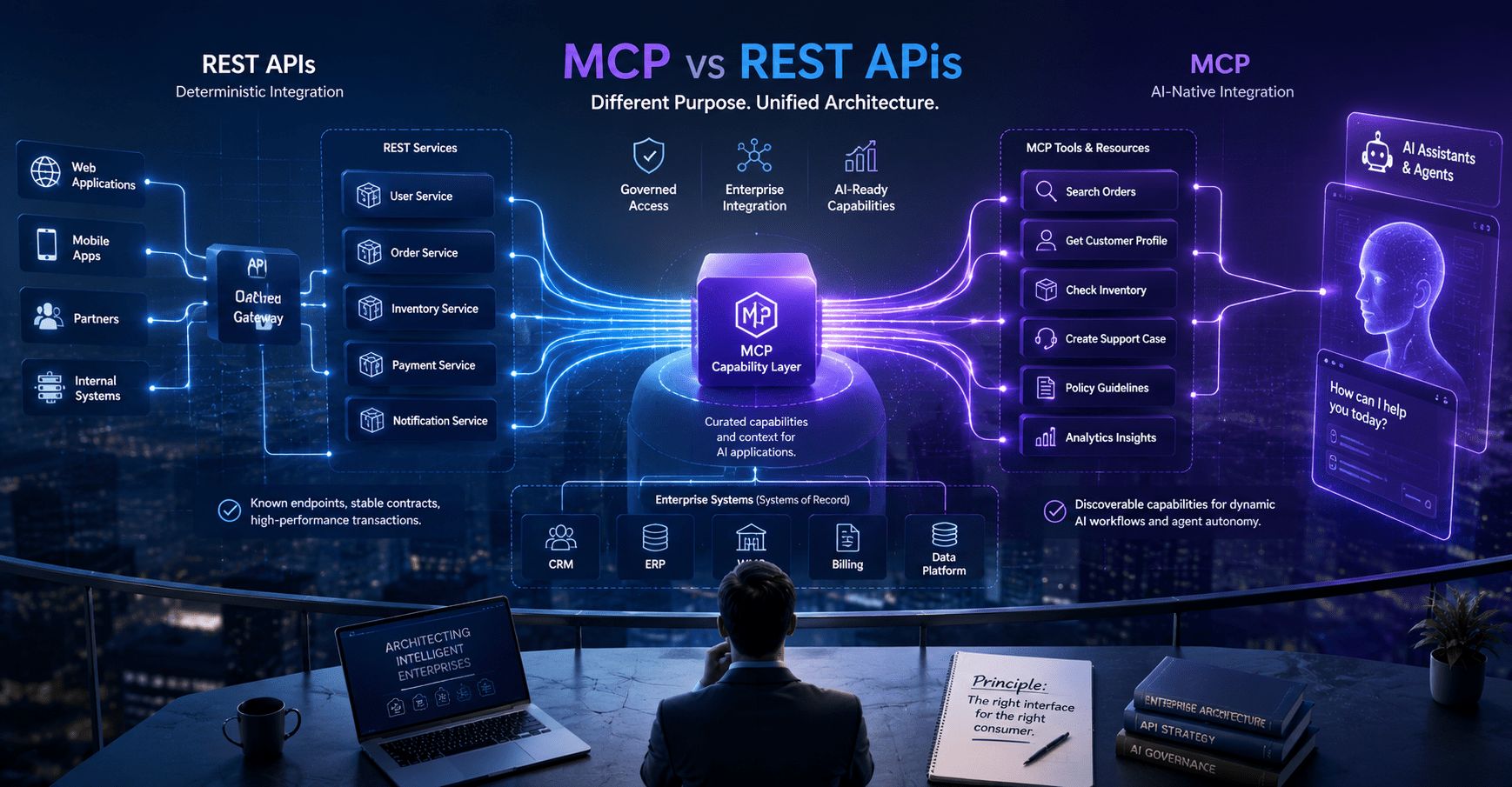
The Difference in One Architecture Diagram
REST typically connects an application to a service through an explicitly programmed contract. The application developer knows the endpoint and incorporates the API into application logic.
MCP introduces an AI-oriented integration layer. An MCP server can expose approved capabilities from underlying systems in a form that an MCP-compatible AI client can understand and invoke.
| REST Pattern | MCP Pattern |
|---|---|
| Application → REST API → Business System | AI Client → MCP Server → Business Capability |
| Developer selects endpoint | AI client can discover exposed capabilities |
| Resource-oriented integration | AI-oriented tool and context integration |
| Contract consumed by application code | Capabilities described for AI clients |
| Excellent for deterministic workflows | Useful for dynamic agent workflows |
This distinction matters because enterprise systems should not suddenly expose every internal API directly to AI agents. MCP can provide a purpose-built boundary where architects decide exactly which capabilities an AI system should see and how those capabilities should be described.
What REST APIs Still Do Extremely Well
REST remains deeply useful because it provides a predictable model for distributed systems. Mature enterprise API programs already have gateways, observability, throttling, authentication, authorization, documentation, versioning, testing, and lifecycle governance built around REST and HTTP.
If an ecommerce application needs order number 48172, there is little value in asking an AI model to decide how to retrieve it. The application can make a deterministic API call.
- System-to-system integration
- Web and mobile backends
- Transactional services
- Product and order services
- Identity integrations
- Core business platforms
If the caller already knows exactly what operation should happen, a conventional API is often the simpler architecture.
What MCP Adds to Enterprise Architecture
The problem changes when the caller is an AI assistant or autonomous agent.
Imagine an internal operations assistant asked: “Find the customer’s open order, check whether the shipment is delayed, determine whether they qualify for expedited replacement, and prepare the next action for approval.”
That request may cross CRM, order management, logistics, policy documentation, and customer support systems. The AI application needs more than a single endpoint. It needs controlled access to a collection of capabilities and enough description to determine when those capabilities are appropriate.
🛠️ Tools
Expose approved actions that an AI client can invoke, such as retrieving an order or creating a support case.
📚 Resources
Provide contextual information the AI application needs to understand the task or environment.
🧭 Discovery
Allow compatible clients to understand the capabilities exposed by an MCP server rather than hard-coding every integration into prompts.
MCP vs REST APIs: Architecture Comparison
| Decision Factor | REST API | MCP |
|---|---|---|
| Primary consumer | Applications and services | AI applications and agents |
| Interaction style | Predetermined API call | AI-oriented capability access |
| Capability discovery | Usually handled through API specifications and developer integration | Built into the protocol model |
| Best for | Deterministic transactions | Dynamic AI workflows |
| Existing enterprise maturity | Very high | Rapidly developing |
| AI context integration | Requires application-specific orchestration | Designed around AI context and tools |
| Typical architecture role | System interface | AI capability layer |
| Should replace the other? | No | No |
The Most Useful Enterprise Pattern Uses Both
For organizations with mature API estates, one of the most practical MCP strategies is not to replace those APIs at all.
Instead, expose selected business capabilities through MCP while allowing existing REST services to continue doing the transactional work underneath.
| Architecture Layer | Responsibility |
|---|---|
| AI Assistant / Agent | Understands intent and determines appropriate capability |
| MCP Layer | Exposes approved AI-facing tools and context |
| API Gateway | Controls API traffic, policy, routing, and observability |
| REST Services | Execute deterministic business operations |
| Systems of Record | Maintain authoritative enterprise data and transactions |
When Enterprise Architects Should Choose REST
REST should usually remain the default when the integration is deterministic, application-driven, and already well represented as a business service.
- The consumer is a conventional application
- The workflow is deterministic
- The endpoint is known at design time
- High-volume transactional traffic is expected
- Existing API governance already solves the problem
- No AI capability discovery is required
A checkout service, payment request, inventory update, account lookup, or mobile application backend does not become better simply because an MCP server is placed in front of it.
When Enterprise Architects Should Choose MCP
MCP becomes more compelling when the consumer is an AI system and the objective is to provide a reusable portfolio of governed capabilities rather than program a single predetermined integration.
- AI assistants need enterprise tools
- Agents need contextual resources
- Capabilities need to be discoverable
- Multiple AI clients may consume the same integration
- AI access needs a governed boundary
- Agent workflows may change dynamically
The 60-Second Architecture Decision Framework
Before adding another protocol to the enterprise architecture, ask these questions in order.
| Question | If Yes |
|---|---|
| Is the primary consumer a normal application or service? | Start with REST |
| Does the caller know the exact operation at design time? | Prefer REST |
| Is an AI assistant or agent the primary consumer? | Evaluate MCP |
| Must the AI discover available capabilities dynamically? | MCP is a strong candidate |
| Do mature REST services already implement the business capability? | Keep them and consider an MCP facade |
| Would MCP merely duplicate an existing API without adding AI-specific value? | Do not add MCP |
Security Changes the Decision
Enterprise MCP adoption should not begin with the question, “How quickly can we expose our APIs?” It should begin with, “What is the minimum capability an AI system needs to accomplish this task safely?”
An API designed for trusted backend services may expose operations that should never be available to an AI agent. The MCP layer is an opportunity to create narrower, intent-specific capabilities rather than blindly wrapping every endpoint.
| Control | Enterprise Requirement |
|---|---|
| Identity | Know which user, application, or agent initiated the action |
| Authorization | Expose only capabilities permitted for that context |
| Least privilege | Keep AI tools narrower than unrestricted backend APIs |
| Human approval | Require confirmation for high-impact operations |
| Auditability | Record tool selection, parameters, execution, and outcome |
| Data controls | Prevent unnecessary exposure of sensitive context |
A Practical 90-Day MCP Implementation Guide
The safest way to introduce MCP is not an enterprise-wide rollout. Select one useful workflow where an AI assistant needs access to several existing systems, but where the operational risk can still be controlled.
| Period | Implementation Focus | Primary Owner | Success Measure |
|---|---|---|---|
| Days 1–30 | Select use case, map APIs, classify data, define allowed tools | Enterprise Architecture + Security | Approved capability map |
| Days 31–60 | Build MCP facade, integrate identity, logging, and approvals | Platform Engineering | Controlled end-to-end workflow |
| Days 61–90 | Pilot with users, test failures, measure accuracy and operational value | Product + Engineering | Business KPI improvement without unacceptable risk |
Useful pilot metrics include task completion rate, tool-call success rate, human override rate, authorization failures, end-to-end latency, cost per completed task, time saved per workflow, and the percentage of agent actions requiring manual correction.
Common Architecture Mistakes to Avoid
- Replacing stable REST APIs without a business reason
- Creating one MCP tool for every API endpoint
- Giving agents broad system permissions
- Skipping API gateway and security controls
- Ignoring tool descriptions and semantics
- Measuring protocol adoption instead of business outcomes
The Architecture Is Converging, Not Competing
An important change is already happening in MCP itself. Its architecture is becoming more compatible with the operational characteristics enterprise teams expect from modern distributed systems.
This reinforces an important point: the future is unlikely to consist of two completely separate integration worlds. Enterprise AI infrastructure will increasingly reuse the networking, identity, gateways, observability, APIs, and domain services organizations already operate.
MCP adds an AI-native contract to that environment. REST continues to provide durable application and service interfaces underneath it.
Final Thoughts
Enterprise architects should resist turning MCP versus REST into another technology replacement debate.
REST APIs remain an excellent foundation for deterministic application integration and business services. MCP addresses a newer requirement: giving AI applications and agents a standardized, governable way to discover and use enterprise capabilities.
The practical architecture is therefore often straightforward. Preserve the REST services that already represent your business correctly. Place strong API and domain boundaries around systems of record. Then introduce MCP selectively where AI clients need tools and contextual access.
The question is not whether MCP will replace REST. The better question is where an AI-native capability layer creates enough value to justify adding it to the architecture.
Frequently asked questions
Will MCP replace REST APIs?
No. REST APIs remain the foundation for deterministic application integration. MCP adds an AI-facing layer that lets AI clients discover and use capabilities, usually backed by the same REST services.
When should an enterprise choose MCP over REST?
When the consumer is an AI assistant or agent that needs a reusable, governed set of tools and contextual resources rather than one predetermined integration.
How should MCP be secured?
Start from the minimum capability an AI system needs, expose narrow intent-specific tools, and enforce identity, authorization, audit logging and human approval for sensitive actions.