
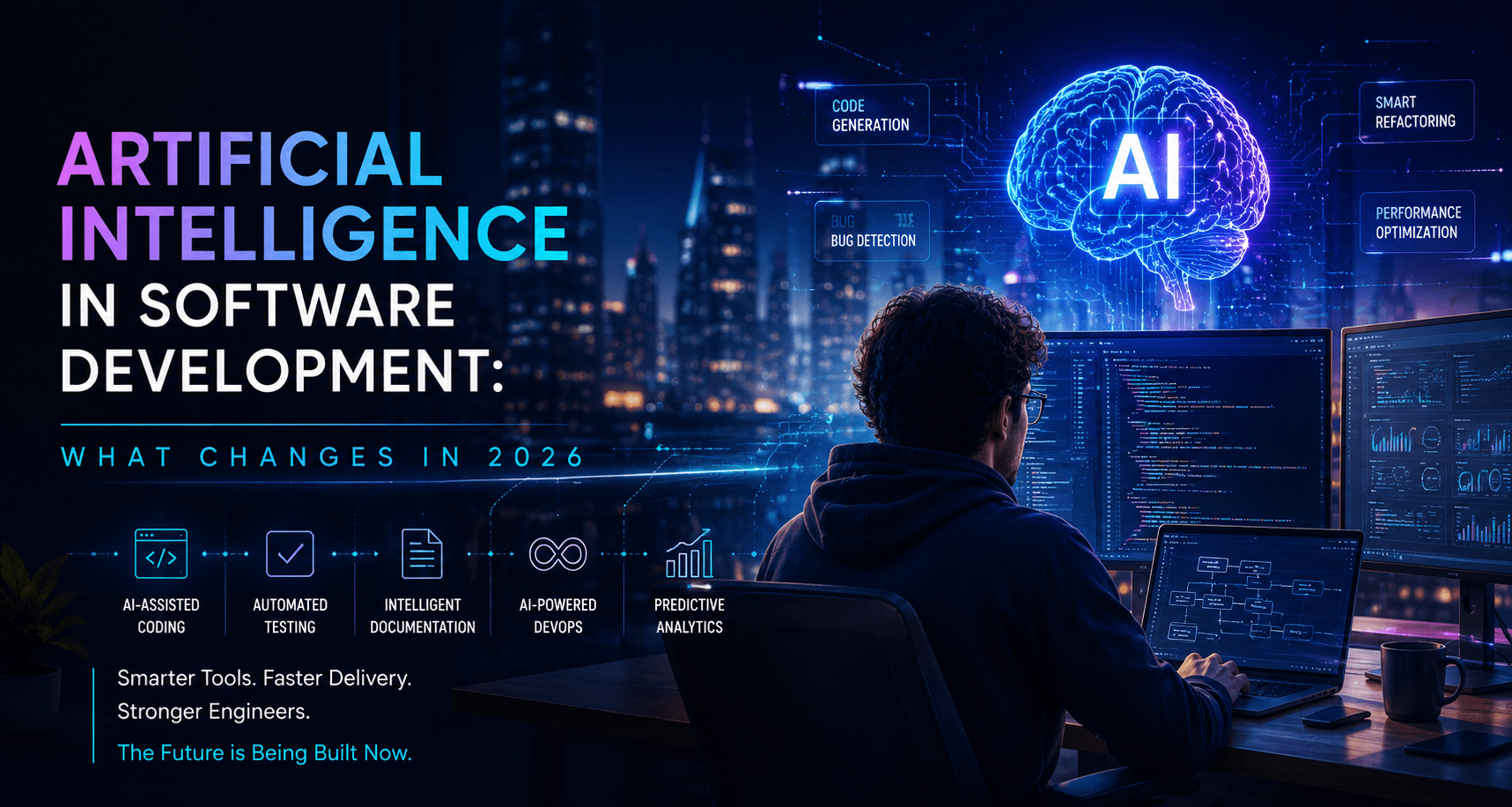
Artificial intelligence is no longer a side tool inside software engineering.
In 2026, AI is becoming part of the core software development lifecycle itself.
The conversation has evolved beyond:
“Can AI generate code?”
The real industry shift is now about:
- AI-assisted engineering workflows
- Autonomous development operations
- AI-augmented delivery teams
- Intelligent software architecture
- AI-enabled testing
- Workflow orchestration
- Engineering productivity acceleration
Software development is entering a new operational era where developers increasingly collaborate with AI systems instead of simply using traditional tooling.
This is not the end of software engineering.
It is the redesign of software engineering.
The Biggest Shift: AI Moves Into the Workflow
In earlier stages, AI in development mostly meant:
- Code autocomplete
- Basic code generation
- Documentation assistance
- Chat-based coding support
In 2026, AI is becoming deeply embedded into engineering operations.
Modern AI systems now participate across:
- Planning
- Architecture
- Development
- Testing
- Deployment
- Monitoring
- Optimization
- Incident response
The workflow itself is becoming AI-augmented.
What AI Changes in Software Development
1. Developers Spend Less Time Writing Boilerplate Code
AI coding assistants are dramatically reducing repetitive engineering work.
Developers increasingly use AI for:
- CRUD generation
- API scaffolding
- Unit test generation
- Refactoring
- Documentation
- SQL query generation
- Infrastructure templates
| Traditional Development Work | AI-Augmented Workflow |
|---|---|
| Manual boilerplate coding | AI-generated implementation |
| Manual test writing | Automated test generation |
| Repetitive refactoring | AI-assisted optimization |
| Manual documentation | AI-generated documentation |
| Repetitive debugging | AI-supported analysis |
The result is a major shift toward higher-level engineering thinking.
2. Software Engineers Become System Orchestrators
The role of the developer is evolving.
Engineers increasingly focus on:
- Architecture
- Validation
- System design
- AI orchestration
- Workflow optimization
- Security oversight
- Product logic
- Operational scalability
Instead of manually building every component, developers increasingly guide and validate AI-assisted systems.
AI Is Accelerating Development Velocity
One of the biggest changes in 2026 is engineering speed.
AI significantly reduces:
- Development cycles
- Testing overhead
- Documentation effort
- Knowledge lookup time
- Environment setup complexity
| Engineering Area | AI Impact |
|---|---|
| Development speed | Faster implementation |
| QA cycles | Increased automation |
| Documentation | Faster knowledge creation |
| Onboarding | Improved learning acceleration |
| Incident resolution | Faster debugging support |
Engineering organizations are beginning to measure:
- AI-assisted productivity
- Workflow acceleration
- Automation coverage
- Delivery velocity
instead of only traditional engineering metrics.
AI-Generated Code Is Becoming Operationally Important
AI-generated code is no longer experimental.
Many engineering teams now use AI-generated output inside:
- Internal tools
- SaaS platforms
- APIs
- Automation systems
- Testing pipelines
- Infrastructure tooling
However, this creates new engineering responsibilities.
The New Risks Emerging in 2026
1. AI-Generated Technical Debt
Poorly reviewed AI-generated code can introduce:
- Inconsistent architecture
- Security vulnerabilities
- Hidden dependencies
- Maintainability issues
- Performance inefficiencies
Engineering oversight becomes more important — not less.
2. Security and Governance Become Critical
AI-assisted development introduces:
- Intellectual property concerns
- Source code exposure risk
- Compliance challenges
- Dependency security issues
- Governance complexity
Organizations increasingly require:
- AI coding policies
- Governance frameworks
- Human validation
- Secure AI workflows
3. Engineering Quality Becomes the Competitive Advantage
As code generation becomes easier, differentiation shifts toward:
- Architecture quality
- Operational scalability
- Product thinking
- Workflow design
- Reliability engineering
- Security maturity
The value of engineering does not disappear.
It shifts upward.
AI Is Reshaping Software Team Structures
Traditional engineering structures are evolving rapidly.
Smaller teams can now produce:
- Larger outputs
- Faster iterations
- Higher automation coverage
- More scalable workflows
This changes hiring priorities.
The Most Valuable Skills in 2026
| Declining Focus | Increasingly Valuable Skills |
|---|---|
| Repetitive implementation | System architecture |
| Manual testing | AI workflow orchestration |
| Basic coding speed | Engineering judgment |
| Framework memorization | Product thinking |
| Isolated technical execution | Cross-functional problem solving |
The strongest engineers increasingly combine:
- Technical depth
- AI fluency
- Business understanding
- Operational thinking
- Systems design capability
The Rise of AI-Native Engineering Teams
Some organizations are now designing engineering teams around AI-first workflows.
Characteristics include:
- AI-assisted development
- Automated testing pipelines
- AI-driven documentation
- AI-powered DevOps
- Intelligent monitoring
- AI-enhanced collaboration
These teams operate with significantly higher engineering leverage.
DevOps Is Becoming AI-Augmented
AI is increasingly integrated into:
- Infrastructure monitoring
- Deployment analysis
- Incident detection
- Root-cause analysis
- Performance optimization
- Cloud cost management
This is accelerating the rise of intelligent operational engineering systems.
Product Development Is Becoming Faster
AI dramatically shortens:
- MVP timelines
- Iteration cycles
- Feature validation
- Prototyping
- Product experimentation
Startups and SaaS companies are especially benefiting from AI-assisted delivery acceleration.
What AI Will Not Replace
Despite rapid automation growth, AI still struggles with:
- Deep business context
- Complex architectural tradeoffs
- Organizational decision-making
- Product strategy
- Human collaboration
- Long-term systems thinking
- Governance leadership
AI remains an amplifier — not a complete replacement for experienced engineering judgment.
Industries Being Transformed Fastest
| Industry | AI Development Transformation |
|---|---|
| SaaS | Extremely High |
| Enterprise Technology | Very High |
| Fintech | Very High |
| Ecommerce | High |
| Healthcare Technology | High |
| Logistics | Growing Rapidly |
| Manufacturing Software | Growing Rapidly |
Virtually every software-driven industry is experiencing AI-assisted operational transformation.
The Future Developer Workflow
The modern developer workflow increasingly looks like:
- Define business objective
- Use AI for implementation acceleration
- Architect and validate systems
- Automate testing
- Monitor operational outcomes
- Continuously optimize workflows
The developer becomes:
- Strategist
- Architect
- Validator
- System orchestrator
- Workflow designer
What Winning Engineering Organizations Are Doing
| Winning Strategy | Why It Matters |
|---|---|
| Embedding AI into workflows | Improves engineering leverage |
| Training engineers on AI systems | Accelerates adoption |
| Building governance early | Reduces operational risk |
| Automating repetitive work | Increases productivity |
| Focusing on architecture quality | Maintains scalability |
| Combining human oversight with AI | Preserves engineering reliability |
Final Thoughts
Artificial intelligence is fundamentally changing software development in 2026.
But the biggest shift is not simply faster code generation.
The real transformation is operational.
AI is becoming:
- Part of engineering workflows
- Part of software delivery
- Part of DevOps
- Part of testing
- Part of architecture decisions
- Part of operational systems
The future belongs to engineering organizations that learn how to combine:
- Human engineering judgment
- AI-assisted execution
- Intelligent workflows
- Operational scalability
- Strong architecture discipline
The next generation of successful software companies will not just use AI tools.
They will build AI-augmented engineering systems.