
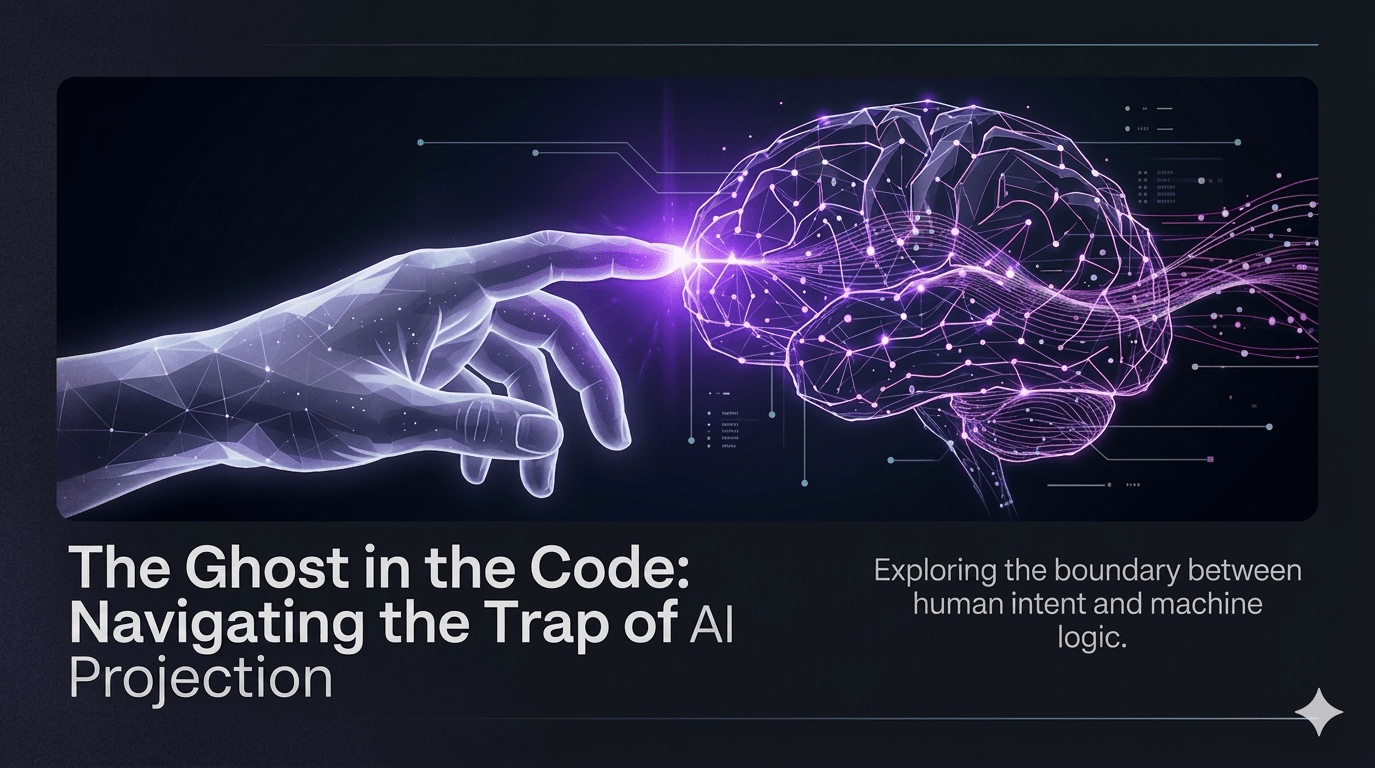
We’ve all done it. You’re debugging a prompt, and the model gives you a response so nuanced that you find yourself typing “thank you” or “I see what you mean.” That is AI Projection, and for a software architect, it is a dangerous distraction.
The Mirror Effect: Neural networks are essentially high-dimensional statistical mirrors. They don’t “know” facts; they calculate the probability of the next token based on a massive corpus of human thought. When we project intent onto these models, we stop treating them as tools and start treating them as collaborators. This leads to “automation bias,” where we trust the output because it sounds confident, rather than because it is logically sound.
Architectural Reality vs. User Perception As developers, our job is to peel back the curtain. We understand that behind the “empathetic” response is a series of matrix multiplications and weight distributions.
- The Trap: Building UI/UX that encourages anthropomorphism can lead to user frustration when the “intelligence” inevitably hits a logic wall.
- The Solution: Build with transparency. Design systems that remind the user they are interacting with an engine, not a person.
The Scientist’s Take Logic doesn’t have a heartbeat. When we project our consciousness onto AI, we lose the objectivity required to monitor it effectively. In the lab, we treat every output as a hypothesis that requires validation—never as a personal opinion from a machine.