
Modern PHP frameworks are no longer limited to traditional websites or small business applications. In 2026, PHP powers enterprise SaaS platforms, AI-enabled systems, ecommerce ecosystems, fintech applications, cloud-native APIs, and globally distributed backend infrastructures.
The biggest challenge today is not choosing a framework that simply works. The real challenge is selecting a PHP framework that can scale efficiently under growing traffic, complex business logic, distributed infrastructure, asynchronous processing, and long-term operational complexity.
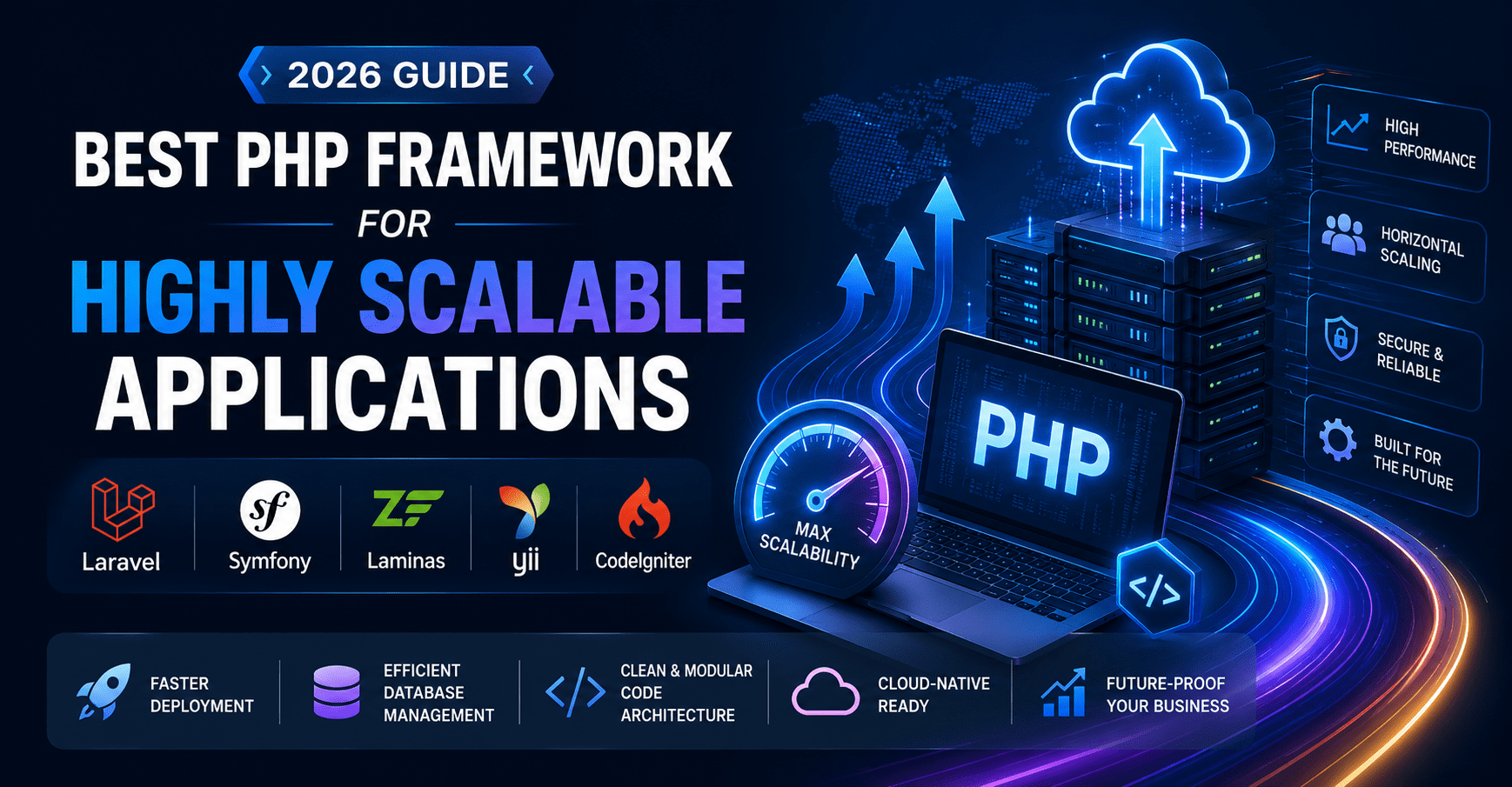
For most modern businesses, Laravel currently leads as the best PHP framework for highly scalable applications because of its ecosystem maturity, cloud scalability, developer productivity, and operational simplicity. However, frameworks like Symfony, Laminas, Yii, and CodeIgniter still serve important architectural use cases.
What Makes a PHP Framework Scalable?
Scalability is not just about handling millions of requests. A scalable framework must support:
| Scalability Factor | Why It Matters |
|---|---|
| Queue Processing | Handles background jobs efficiently |
| Redis & Caching | Reduces database load |
| Horizontal Scaling | Supports multiple server instances |
| API Architecture | Enables modern frontend/mobile systems |
| Cloud-Native Deployment | Works well with Docker/Kubernetes |
| Observability | Easier monitoring and debugging |
| Security | Protects large-scale systems |
| Developer Productivity | Reduces long-term engineering cost |
| Maintainability | Keeps large codebases manageable |
| Async Processing | Improves workload efficiency |
The best scalable framework is the one that balances architecture quality, performance optimization, maintainability, and developer efficiency.
Top PHP Frameworks for Scalable Applications
| Framework | Best For | Scalability Strength | Complexity |
|---|---|---|---|
| Laravel | SaaS, enterprise apps, APIs | Excellent ecosystem and scaling tools | Moderate |
| Symfony | Enterprise systems | Extremely flexible architecture | High |
| Laminas | Enterprise integrations | Component-driven architecture | High |
| Yii | High-performance business apps | Lightweight and fast runtime | Moderate |
| CodeIgniter | Lightweight APIs | Minimal overhead | Low |
Why Laravel Leads in 2026
Laravel has evolved far beyond rapid prototyping and startup MVPs. Modern Laravel applications are capable of powering enterprise-grade distributed systems.
Laravel’s biggest advantage is ecosystem maturity. Instead of forcing engineering teams to build infrastructure manually, Laravel provides integrated solutions for queues, scheduling, authentication, caching, observability, API management, and background processing.
Modern scalable Laravel systems commonly use:
- Redis caching
- Horizon queue management
- Laravel Octane
- Swoole-based runtime optimization
- Distributed queue systems
- Kubernetes deployment
- Event-driven architecture
- API-first backend design
- AI integration pipelines
Laravel dramatically reduces engineering overhead while maintaining strong scalability potential.
Laravel Scalability Features
| Feature | Scalability Benefit |
|---|---|
| Laravel Octane | High-performance runtime |
| Redis Integration | Faster caching and queue systems |
| Horizon | Queue visibility and management |
| Event Broadcasting | Realtime system support |
| Eloquent ORM | Developer productivity |
| API Resources | Clean API architecture |
| Scheduler | Reliable background task management |
| Strong Ecosystem | Faster development cycles |
Best Use Cases for Laravel
| Application Type | Laravel Fit |
|---|---|
| SaaS Platforms | Excellent |
| CRM & ERP Systems | Excellent |
| Ecommerce Applications | Excellent |
| AI-Powered Business Systems | Excellent |
| Enterprise APIs | Excellent |
| Realtime Dashboards | Very Good |
| Internal Business Tools | Excellent |
Symfony for Enterprise Architecture
Symfony is one of the most architecturally flexible PHP frameworks available today. It is widely used in large enterprise ecosystems where modularity, maintainability, and customization are critical.
Symfony’s component-driven design allows organizations to build highly customized backend systems with strict architectural patterns.
However, Symfony introduces more complexity than Laravel and typically requires experienced engineering teams.
Symfony Strengths
| Enterprise Strength | Benefit |
|---|---|
| Modular Architecture | Flexible enterprise design |
| Dependency Injection | Better maintainability |
| Reusable Components | Cleaner large-scale systems |
| Long-Term Stability | Enterprise reliability |
| Strong Security Components | Safer enterprise systems |
| API Platform Support | Excellent API architecture |
Symfony is ideal for organizations requiring extensive architectural customization.
Laminas for Enterprise Integration
Laminas, formerly Zend Framework, remains highly respected in enterprise PHP environments.
It is particularly strong for:
- Enterprise integrations
- Internal business systems
- Banking and fintech platforms
- Legacy modernization
- Component-driven architecture
Laminas prioritizes control and modularity over rapid development speed.
Yii for High Performance
Yii remains attractive for teams seeking lightweight performance and low runtime overhead.
Yii offers:
| Yii Advantage | Benefit |
|---|---|
| Lightweight Runtime | Faster execution |
| Strong Caching Support | Better scalability |
| Clean MVC Architecture | Easier maintenance |
| Rapid CRUD Generation | Faster development |
| Performance Optimization | Lower resource usage |
Yii is commonly selected for high-performance business systems.
CodeIgniter for Lightweight Systems
CodeIgniter continues to be useful for lightweight applications and APIs where simplicity matters more than enterprise-scale architecture.
It is especially useful for:
- Lightweight APIs
- Small business systems
- Fast deployment environments
- Low-overhead hosting
- Minimal infrastructure applications
However, CodeIgniter lacks the ecosystem depth available in Laravel or Symfony.
Performance Comparison
| Framework | Developer Productivity | Enterprise Flexibility | Performance Optimization |
|---|---|---|---|
| Laravel | Excellent | Very Good | Excellent |
| Symfony | Very Good | Excellent | Excellent |
| Laminas | Moderate | Excellent | Very Good |
| Yii | Very Good | Good | Excellent |
| CodeIgniter | Good | Moderate | Very Good |
AI-Ready PHP Frameworks
In 2026, backend systems increasingly integrate with:
- AI agents
- LLM APIs
- Vector databases
- Realtime automation
- Document processing
- AI copilots
- Workflow orchestration
Laravel currently provides the strongest AI-ready ecosystem because of its queue management, API architecture, event systems, and developer ecosystem.
AI Readiness Comparison
| Framework | AI Integration Readiness |
|---|---|
| Laravel | Excellent |
| Symfony | Excellent |
| Laminas | Very Good |
| Yii | Good |
| CodeIgniter | Moderate |
Which PHP Framework Should You Choose?
| Scenario | Recommended Framework |
|---|---|
| Modern SaaS Platform | Laravel |
| Enterprise Custom Architecture | Symfony |
| Enterprise Integration Systems | Laminas |
| Lightweight High-Performance App | Yii |
| Minimal Lightweight API | CodeIgniter |
Final Thoughts
PHP continues to evolve aggressively in 2026, and modern frameworks are fully capable of powering highly scalable applications.
The best framework is no longer determined only by raw benchmark numbers. The real decision depends on:
- Architecture goals
- Team expertise
- Infrastructure strategy
- Developer productivity
- Operational complexity
- Scalability requirements
- Long-term maintainability
For most modern businesses building scalable SaaS platforms, APIs, AI-enabled systems, and enterprise applications, Laravel currently offers the strongest balance between scalability, ecosystem maturity, developer productivity, and operational efficiency.