
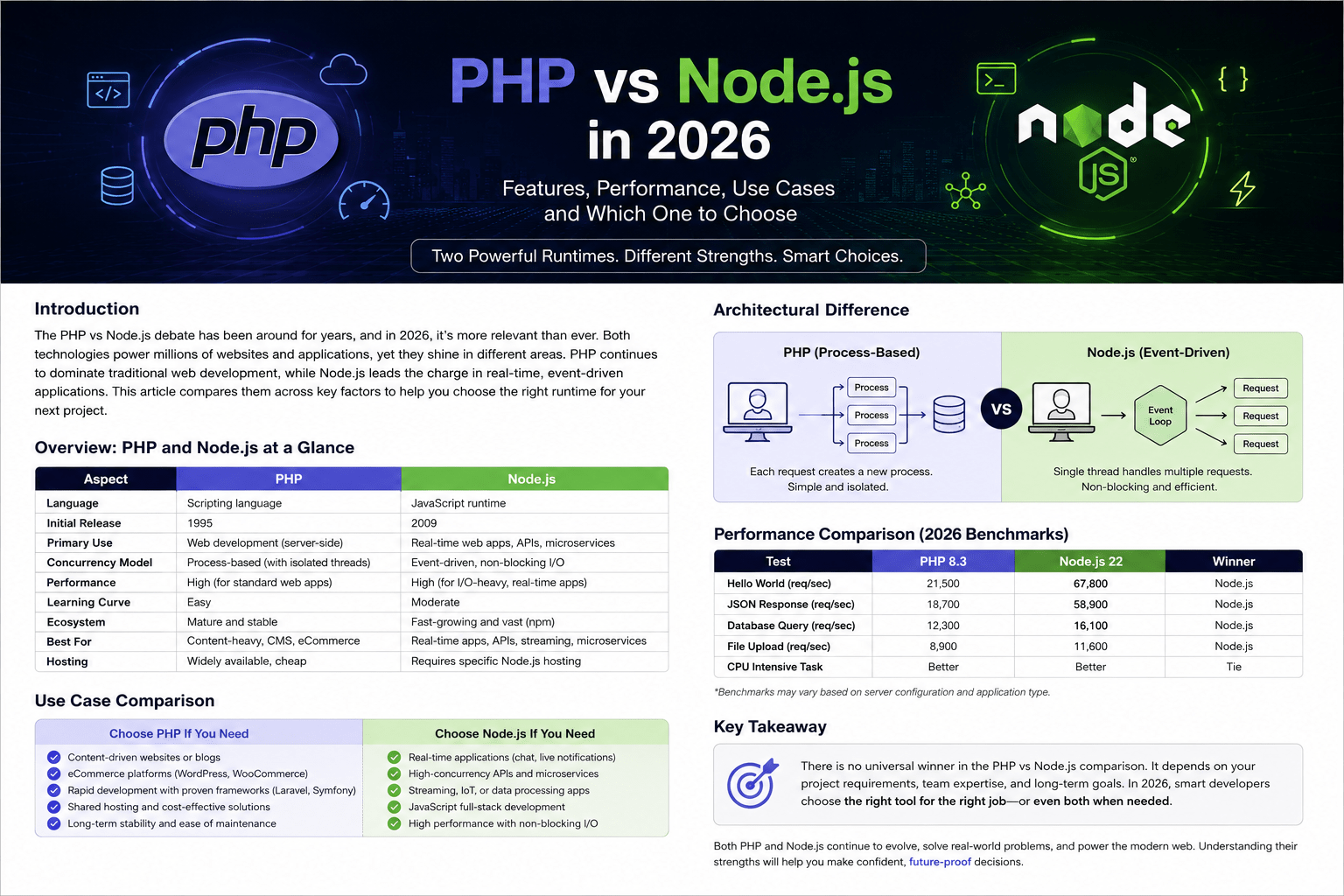
PHP and Node.js are both mature backend choices in 2026, but they solve different problems best. PHP is highly effective for structured web applications, SaaS platforms, ecommerce, CMS-driven systems, and cost-efficient APIs. Node.js is stronger for realtime apps, streaming workflows, event-driven systems, and JavaScript-first product teams.
The old PHP vs Node.js debate used to sound simple: PHP was treated as the traditional web language, while Node.js was seen as the modern JavaScript runtime. That comparison no longer holds up.
In 2026, both ecosystems are mature, cloud-ready, AI-capable, and widely used in production. The better choice depends less on popularity and more on your product architecture, team skill set, scalability model, operational cost, and long-term maintainability.
This article compares PHP and Node.js from a practical engineering and business perspective so you can choose the right backend stack for your next application.
Quick Comparison
| Category | PHP | Node.js |
|---|---|---|
| Best For | SaaS, ecommerce, CMS, APIs, portals | Realtime apps, streaming, microservices, AI chat |
| Architecture Style | Request-response, structured backend | Event-driven, non-blocking runtime |
| Developer Experience | Excellent with Laravel and Symfony | Excellent with TypeScript, NestJS, Express, Fastify |
| Realtime Support | Possible with extra tooling | Native strength |
| Cost Efficiency | Often lower for standard web apps | Efficient for concurrent workloads |
| AI Integration | Strong for business automation and SaaS AI | Strong for streaming AI and realtime agents |
Backend Decision Flow
Choose PHP When
- Your application is primarily request-response based.
- You need SaaS, CRM, ERP, CMS, or ecommerce backend.
- You want faster delivery with Laravel.
- You care about predictable infrastructure cost.
Choose Node.js When
- Your product needs realtime communication.
- You are building chat, streaming, or collaboration tools.
- Your team works heavily in JavaScript or TypeScript.
- You need async-first WebSocket-heavy architecture.
Core Difference
PHP is a server-side language designed around the web request lifecycle. A request comes in, PHP processes it, returns a response, and clears memory. This model is simple, stable, and highly effective for most business applications.
Node.js is a JavaScript runtime built around non-blocking, event-driven execution. It handles many concurrent connections efficiently, which makes it especially useful for realtime applications, streaming systems, and highly interactive platforms.
Performance in 2026
Performance is not just about benchmark numbers. Real-world performance depends on architecture, caching, database design, queue handling, cloud deployment, CDN usage, and code quality.
Modern PHP has improved significantly with PHP 8.x, Opcache, JIT, Laravel Octane, RoadRunner, and Swoole-based execution models. For standard APIs, ecommerce applications, CMS platforms, dashboards, and SaaS products, PHP can be extremely fast and cost-efficient.
Node.js performs very well for I/O-heavy systems. Its non-blocking architecture is ideal when the application must handle thousands of open connections, realtime updates, or frequent async operations.
| Workload | Better Fit | Reason |
|---|---|---|
| Traditional web application | PHP | Simple request lifecycle and mature web frameworks |
| Realtime chat | Node.js | Strong WebSocket and async handling |
| Ecommerce backend | PHP | Strong CMS and commerce ecosystem |
| Streaming dashboard | Node.js | Efficient concurrent connection handling |
| Business SaaS | PHP | Fast development and structured architecture |
Performance Strengths
PHP Strength Path: Request → Framework Router → Business Logic → Database/Cache → HTML/API Response
Node.js Strength Path: Event → Async Queue → Non-blocking Operation → WebSocket/API Stream → Realtime Response
Developer Experience
Developer experience is one of the biggest reasons companies choose a backend stack. A technology that helps teams ship faster, onboard developers quickly, and maintain clean architecture can reduce long-term product cost.
PHP, especially with Laravel, offers a highly polished development workflow. Authentication, routing, queues, events, validation, ORM, testing, broadcasting, and background jobs are available in one cohesive ecosystem.
Node.js gives teams flexibility and the advantage of using JavaScript or TypeScript across the full stack. This is valuable for frontend-heavy products and teams that want shared language, shared types, and shared tooling.
AI Readiness
In 2026, backend systems are increasingly expected to connect with AI models, vector databases, automation agents, document pipelines, and conversational interfaces.
PHP is a strong choice for AI-powered business workflows. It works well for AI-enabled SaaS platforms, ecommerce assistants, content automation systems, internal tools, CRMs, and business process automation.
Node.js has an edge when the AI experience is realtime. Streaming model responses, AI chat interfaces, agent-to-agent messaging, and WebSocket-based AI products align naturally with Node.js architecture.
AI Backend Fit
PHP + AI
Business rules, automation, dashboards, CMS workflows, ecommerce intelligence, CRM actions, and structured SaaS features.
Node.js + AI
Streaming chat, realtime interfaces, AI copilots, async agents, WebSocket experiences, and event-driven AI products.
Scalability and Cloud Deployment
Both PHP and Node.js can scale well when designed correctly. The difference is in the scaling pattern.
PHP scales horizontally in a predictable way. Add more application instances, use caching, optimize queues, tune the database, and place a CDN in front of static assets. This model is battle-tested for content platforms, ecommerce systems, and SaaS products.
Node.js scales well in distributed, event-driven systems. It is commonly used for microservices, realtime event pipelines, collaboration platforms, and streaming applications.
Security
Both PHP and Node.js can be secure. Most security issues come from poor implementation, outdated dependencies, weak authentication, missing validation, and misconfigured infrastructure.
PHP frameworks like Laravel provide strong built-in protection against common web vulnerabilities, including CSRF, SQL injection, validation failures, insecure sessions, and unsafe authentication patterns.
Node.js can also be highly secure, but teams must be careful with dependency management. The npm ecosystem is large, which increases the importance of package auditing, version control, and supply-chain security practices.
Cost and Hiring
Cost is not only about hosting. It includes engineering time, debugging effort, hiring difficulty, infrastructure complexity, maintenance, and deployment workflow.
PHP is often more cost-effective for traditional business applications because the ecosystem is mature, hosting is widely available, Laravel accelerates development, and operational patterns are predictable.
Node.js can be cost-effective for JavaScript-heavy teams because frontend and backend development can share language, tooling, and sometimes code. However, complex async systems require strong engineering discipline.
Best Use Cases
| Choose PHP For | Choose Node.js For |
|---|---|
| SaaS platforms | Realtime chat applications |
| Ecommerce websites | Streaming dashboards |
| CMS and publishing systems | Collaborative editing tools |
| Business portals | Event-driven microservices |
| CRM and ERP systems | JavaScript-first product platforms |
| AI-enabled business workflows | Streaming AI interfaces |
Final Recommendation
Choose PHP if your goal is to build a stable, cost-effective, maintainable business application with strong backend structure. PHP is especially powerful when paired with Laravel for SaaS, ecommerce, APIs, portals, and AI-enabled business workflows.
Choose Node.js if your product depends on realtime communication, streaming, event-driven architecture, or a full-stack JavaScript development model. It is especially strong for chat systems, collaboration platforms, realtime dashboards, and AI interfaces that stream responses to users.
The right choice in 2026 is not about which technology is more popular. It is about which backend model fits the product you are actually building.